L15- 'New' Group Selection Theory
Old group selection:
idea by VC Wynne-Edwards
observed that individual fecundity was lower at high population densities→ density dependance through competition
believed it was due to reproductive self-restraint to avoid over-exploitation of resources so the group could survive
ideas were demolished by George Williams and Richard Dawkins
know that group selection is unlikely as any behaviour designed to increase success of conspecifics is vulnerable to exploitation by selfish individuals
Model:
in theory→ can work if selfish groups die out faster than cooperative groups
if selection is operating most strongly at the group level:
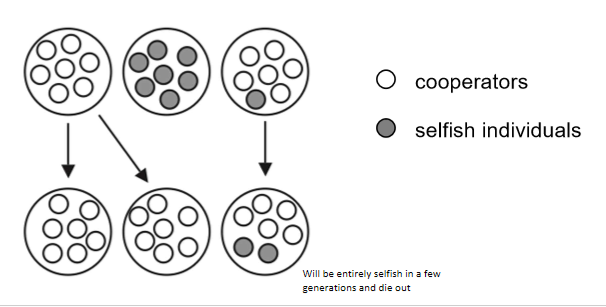
but know that selection acts more on individuals than groups
for group selection to work, groups have to be isolated and individuals cannot move→ biologically unlikely
→ these models do not have much biological realism
New group selection:
advocated by 4 main people:

idea that we can see a hierarchy of multilevel selection:
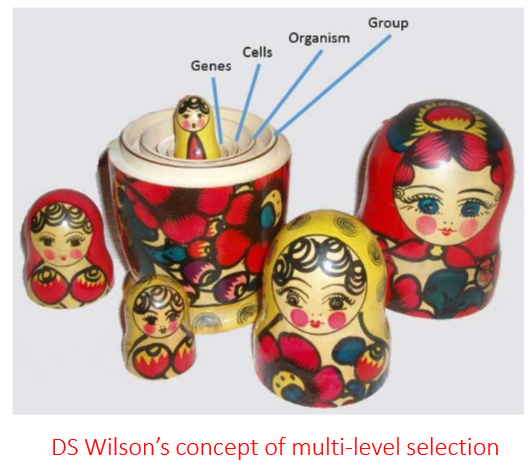
Model:
populations are divided into trait groups or demes (share similar traits)
groups can mix together before splitting into new groups
cooperative groups are expected to contribute more to new groups→ are more successful than selfish groups
new groups tend to share traits→ mainly cooperators or mainly selfish
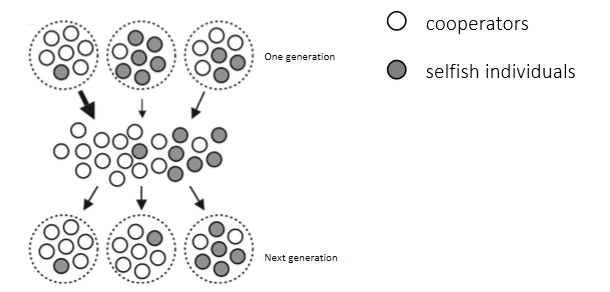
→ cooperative traits spread when between group selection (how much groups outcompete other groups to contribute to new groups) is stronger than within group selection
Predictions of model:
cooperation is favoured by:
increasing group benefits→ cooperative groups are more likely to contribute to new generation
reducing individual cost of cooperating
reducing within-group variance in cooperative behaviour, relative to between-group variance→ the more like individuals cluster together increase the probability of cooperation being expressed
3 conditions link to Hamilton’s rule:
increasing group benefits→ high B
reducing individual cost of cooperating→ low C
reducing within-group variance in cooperative behaviour, relative to between-group variance→ high r
→ condition under which cooperation evolves in the new group selection models is mathematically equivalent to Hamilton’s rule for the evolution of altruism
Are these two equal then? NO:
inclusive fitness theory→ tells us the quantity natural selection seeks to maximised under all conditions, expect an individual to be selected based on how its behaviour contributes to its inclusive fitness
new group selection→ tells us the certain conditions that group selection will operate (isolation), does not look at the maximum group fitness that will be selected for
is causing conflict in literature
study→
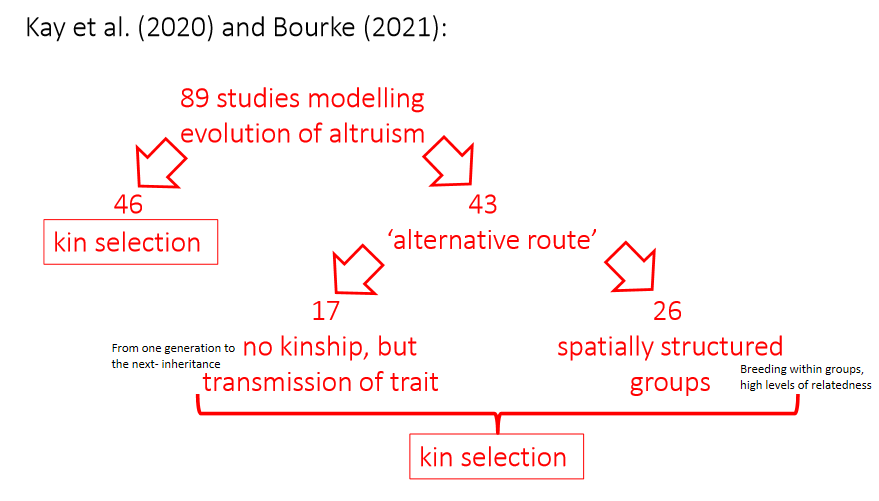
looked for models of evolution of altruism in the literature→ analysed 89 of these that were significantly different from each other
46 concluded kin selection was driver of selection
43 argued there was another route
all alternative routes were reinventing kinship→ high relatedness favours altruism
Do we see group selection in natural systems?→ empirical studies:
e.g. Social Spider-
live in large groups, capture prey collectively, composition of bold and shy spiders, massive webs
conditions matching predictions for group selection→
colonies frequently became extinct
had limited dispersals between colonies
colonies had a mix of docile and aggressive phenotypes
manipulated compositions of groups, observed what happened over time:
group level traits persisted, combinations tended to be more successful in certain habitats than others
HOWEVER fabricated data→ was scientific fraud
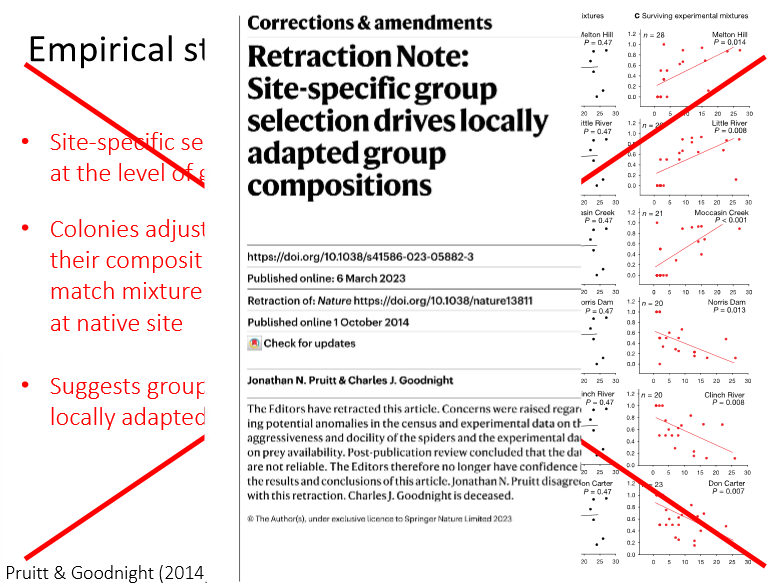
→ there is no good evidence of group selection in natural systems
selection mainly occurs at the level of individuals or genes
Conclusions-
Theoretical work to ‘revive’ group selection continue…
Group selection models that work and inclusive fitness models are mathematically equivalent
Inclusive fitness theory is far more useful because it gives us the quantity that natural selection maximises
Advocates of group selection often appear to have an agenda of denial e.g. Nowak et al. (2010): “empirical evidence [for IFT] is meagre”
No empirical evidence…