B3
Communicable disease
Pathogens- These are microorganisms that enter the body and cause disease. Usually a communicable disease
Communicable disease- A disease that can be easily spread from organism to organism, these affect both plants and animals
Bacteria-
Cells 1/100th the size of normal body cells
reproduce very quickly
produce toxins that damage your cells and tissues
Viruses-
1/100th the size of bacterium,
reproduce quickly,
living inside your cells,
forcing it to reproduce copies of itself
until the cell bursts causing cell damage, which makes you ill
Protists-
Simple eukaryotic organisms
that live on or inside other organisms,
can cause damage
Fungi-
Some single celled,
others grow hyphae
which can penetrate skin and cause diseases
can produce spores which can spread to other plants or animals
Pathogens can spread via:
Water- Drinking it e.g. Cholera
Air- Carried through breathed though droplets in the air in sneezes or coughs
Direct contact- e.g. athletes foot
Viral, Fungal, Protist and bacterial Diseases
Virus- Measles:
Spread through droplets in persons cough or sneeze
Causes red skin rash and fever
Can lead to complications such as pneumonia or encephalitis (Brain infection)
Most people are vaccinated against it when young
Virus- HIV:
Can spread as an STD or when people share needles when taking drugs
Initially causes flu symptoms
Then causes goes dormant as it attacks immune cells
Then immune system breaks down unable to cope with other infections or cancers
Causing AIDS
Virus- Tobacco Mosaic Virus (TMV):
Only affects plants
Causes a discolouration in leaves
Which interferes with photosynthesis
Fungal disease- Black Rose Spot
Causes black or purple spots
Turning leaves yellow and making them drop off
Causing a decrease in rate of photosynthesis
Stunting plant growth
Can be treated by stripping affected leaves
And using fungicides
and cleaning disposal equipment
Protist disease- Malaria:
Protist uses mosquito as vector (living inside or on it)
Mosquito feeds on other animals
inserting protist into the animals blood stream
causing repeating episodes of fever
spread can be reduced using insecticides and mosquito nets
Or stopping mosquitos from breeding
Bacterial disease- Salmonella
This causes food poisoning
Symptoms include: fever, stomach cramps, vomiting, diarrhoea
It is contracted by ingesting infected food
Such as food that has been prepared in unhygienic conditions
Or poultry that where infected whilst they were alive
It can be prevented by vaccinating poultry and preparing food with good hygiene standards
Bacterial disease- Gonorrhoea
This is an STD, meaning that it is passed by sexual contact
This causes pain when urinating and thick yellow discharge
To stop this you can treat it with antibiotics
(but there are now anti-biotic resistant strains)
Or use barrier methods of contraception such as condoms
Preventing disease- this can be done by:
Being hygienic-
Washing hands before preparing food
Washing hands after sneezing
Using a mask around infected people
Thoroughly Cooking food
Destroying vectors-
Killing mosquitos and other protist carriers
Using insecticides against insects
Isolating infected
QUARANTINEEE
using a mask
Wearing gloves
Sops people passing it on
Vaccination
Stops people becoming infected and passing it on
Causing herd immunity
Where vaccinated people can’t pass it on to other non-vaccinated people as they can’t contract it as easily
Disease defence systems
The skin: acts as a barrier protecting against pathogens
and secretes antimicrobial substances, killing pathogens
The Nose: Has hairs + mucus which trap large particles that may contain pathogens
The trachea and bronchi: Secrete mucus to trap pathogens
And are lined with Cilla which waft mucus to the back of the throat
The stomach- Has Hydrochloric acid which kills pathogens coming from the mouth
The immune system attacks pathogens in a process called phagocytosis
This is where the white blood cell engulfs the pathogen
They also produce anti-toxins which neutralise the toxins produced by pathogens
And they produce antibodies:
Which are produced when a white blood cell notices a pathogen
This is because all cells have unique molecules on their surface called antigens
If the white blood cell discovers a foreign antigen it produces antibodies
Which lock onto and attack the foreign object
Via binding onto the foreign antigen
The body remembers the antigen and what killed it causing a natural immunity
Vaccination
This takes advantage of the body remembering antibodies and antigens
By injecting someone with a dead or inactive form of the pathogen
Which lets the body create antibodies for the pathogen and learn how to kill it
Making the process of producing the necessary antibodies much faster
Causing immunity
Pros:
This has helped stop once common communicable diseases
Such as: Measles, whooping cough, rubella, mumps, tetanus, smallpox and poli
With cases of polio being reduced by 99% and small pox almost irradicated
This has greatly lowered the amount of epidemics
Cons:
These don’t always give you immunity, only working sometimes
These can give you a bad reaction e.g.: swelling, fever, seizure, but these are rare
Drugs
There are:
Pain killers- e.g. Aspirin which just relieve the pain and other symptoms
Antibiotics- e.g. Penicillin, which kills/ prevents the growth of bacteria
With different ones killing different bacteria
But these don’t kill viruses
As they use your body cells to reproduce
So there’s no way to kill the virus without killing your body cells too
Antibiotic Immunity:
Bacteria mutate
Meaning antibiotic strands can form
And as the non-resistant strands are killed
The resistant strands reproduce
Causing the same problem all over agian
e.g. MRSA
To stop this people should
Finish antibiotic courses, to make sure that bacteria doesn’t have the time of day to mutate
Not over prescribe- The more you prescribe something the quicker it mutates
So, don’t prescribe things unless they are absolutely needed
Plants
Plants produce lots of our medicines and antibiotics (Alexander Fleming discovered antibiotics)
Aspirin the painkiller, comes from willow trees
Digitalis used to treat heart conditions, Comes from foxgloves a plant
Developing drugs
This anime has 3 arcs, but first some lore on key quotes:
Efficacy- Weather the drug produces the desired effect or not
Toxicity- How harmful it is to people
Placebo- A similar substance, that doesn’t do anything
Peer review- When other scientists review data, and copy experiments to see if the results are repeatable, or if the claims are false or not
Optimum dosage- The best amount to give to someone and its concentration, the one with the highest effectiveness and lowest amount of side effects
1.) Preclinical TESTING- On Living Cells
This is when you test the drug on human cells and tissues
This, however, doesn’t tell you the affect on whole organ systems
2.) Preclinical TESTING- On Living Animals
This to test the efficacy, toxicity, and optimum dosage
This has to be done on at least 2 live mammals e.g. mice or rabbits in the UK
Some may think that this is unethical others think its the safest way
3.) Clinical Trials- On Living humans
If it passes the first to arcs then it moves onto this
First on health people in low doses
To see if it has side effects on people who are healthy
This dosage is gradually increases
Then the optimum dosage is found
Then a does is given to 2 groups of patients
one is given a placebo, and the other is given the actual drug
This is often done double blind where neither the doctors or patients know who had what
Which removes bias as results are being recorded
These results and claims, and drugs are then peer reviewed before being published to prevent false claims
Monoclonal Antibodies
Antibody- This is a certain protein that helps fight infection locking onto the antigen of a specific pathogen
Antigen- These are the unique substances on the outside of cells that the immune system uses to identify pathogen from body cell (basically friend from foe)
B-lymphocyte- This is a certain type of blood cell that produces antibodies to help fight pathogens
Monoclonal antibodies- Antibodies made from B-lymphocyte clones, these are all identical
Fast dividing tumour cells- Used in the process for making fast diving lymphocytes
HCG- A hormone found only in the urine of pregnant women
Hybridoma- This is a B-lymphocyte, tumour cell fusion that creates multiple Fast diving B-lymphocytes, that all produce the same antibodies (MONOCLONAL ANTIBODIES) which can be collected and purified
Pipeline:
Usually a mouse is injected with a certain antigen
The mouse makes B-lymphocytes that make antibodies that target the antigen
These B-lymphocytes are taken from the mouse
And are fused with fast dividing tumour cells from a lab
Creating a hybridoma which produces the desired monoclonal antibodies
Which can be collected and purified
These monoclonal antibodies can be used in certain applications such as~
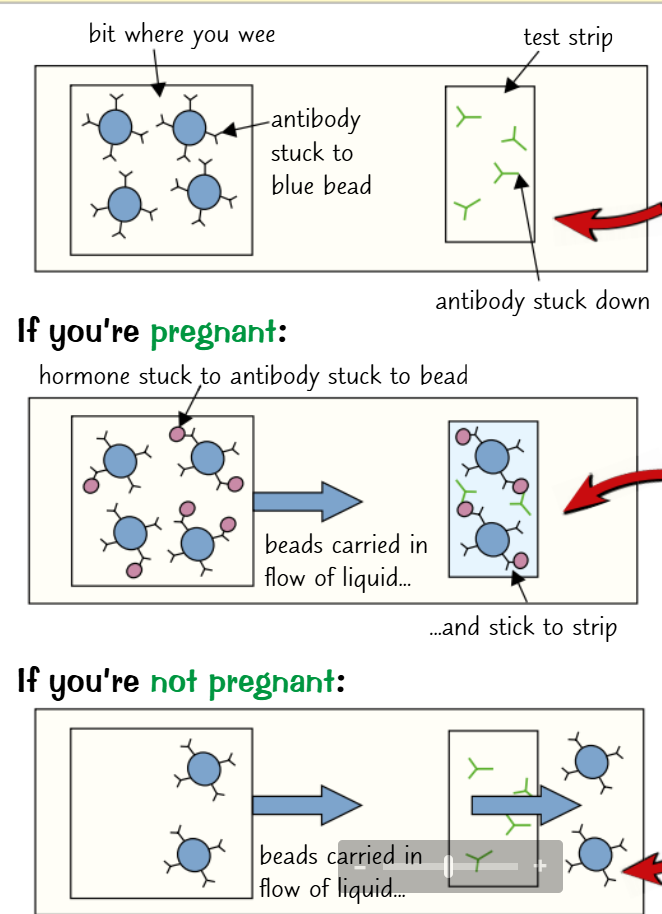
Pregnancy Tests: (AAAHHHHH NOOOOOO)
Antibodies attached to blue dye
The test strip has more antibodies wired to the hormone
If the test is positive:
The urine moves up the stick carrying the hormone
Theses bind to the antibodies with the blue dye
The dye and the hormones bind through the antibodies turning the strip blue
If it is negative this means
The there is no hormone to bind
CANCER CELLZ:
Cancer cells have a different type of antibody called a tumour marker
Monoclonal Antibodies can be made to bind to these and be attacked to a toxic drug
so they target the cancer with the drug or radioactive substance
Leaving healthy body cells untouched
Find substances:
They are made to bind to the specific substance that your looking for
Then they bind to a fluorescent dye
If the substance is present, the antibodies attach to them, being detected via the dye
ADV
They help with cancer treatments and damage body cells less the chemotherapy
And radiotherapy
However cause side effects such as:
fever
Vomiting
Low blood pressure
Plant Diseases and Defences
Plants need:
Nitrates to create proteins for growth
Nitrate deficiency causes stunted growth
Magnesium for making chlorophyll
Magnesium deficiency causes chlorosis and yellow leaves
Plants can be damaged by:
Viral diseases
Bacterial diseases
Fungal pathogens
Insect infestations E.g. aphids
Common signs are:
Stunted growth
Spots on the leaves
Patches of decay / rot
Abnormal growths and lumps
Malformed stems or leaves
Discolorations
Visible pests
These specific signs can be identified by:
Using a gardening manual
Using a gardening website
Using a testing kit with monoclonal antibodies
Taking the plant to a laboratory where scientists can identify the pathogen
Physical plant defences
Waxy cuticle- A barrier to stop pathogens from entering
Cell walls- Made of cellulose, another physical barrier
Bark- A layer of dead cells around stems
Chemical defences:
Poisons- Deters herbivores from eating the plant
e.g. tobacco, foxgloves, deadly night shades
Antibacterial chemicals-
E.g. mint plants, witch hazel
Mechanical defences
Thorns + hairs
Mimic organisms
Drooping or curling when touched to knock off insects
NEEEEEXXXXXXXXXT