14. Emotional Development
What are emotions?
A way of expression
Our use of language plays an important role in how we express ourselves and our thoughts
Happy, sad, mad
Expressions describe our emotions → smiling, frowning
Physiology of emotion
→ History of emotions
Our experiences in life can effect our bodies and minds
Changes in the ANS (Autonomic Nervous System)
Involuntary bodily functions, homeostasis → internal balance
Heart and breathing rate
Blood pressure
sweating, pupil dilation
skin responses
Our Cultural experiences shape how we experience emotion
e.g.
American moms tend to be more bubbly compared to Japanese moms more reserved
Emotional Expressions
Universality of emotions
→ 7 basic emotional expressions seem to be a universal experience
Anger, Fear, Interest, Joy, Sadness, Disgust, and Surprise
Recognized across cultures, a shared emotional response in humans
Paul Ekman
Looked at the expression of emotion in African tribes
Expression photos were used and participants were asked what emotion is being presented
RESULTS:
Emotional expressions were recognized across cultures, indicating a universal understanding of basic emotions such as happiness, sadness, anger, and fear.
Studies in the last 5 years…
The internet provides many emotions
Networks pull out many photos and videos
Asked the P’s to identify the emotions being displayed in the photos and videos
Results: same as Ekman’s study
Emotions → A cognitive-social approach
Emotions are the products of cognitive processing
Cognitive processes mediate the mental state and lead to the response
EVENT → COGNITION → EMOTIONAL RESPONSE
Our emotions come from thinking (cognitions)
This suggests that by changing our patterns of thinking, we can influence our emotional responses
By understanding how cognition and emotion work together
Our cognition of the social world is going to influence how we feel about it emotionally
Children are socialized about the rules of emotional expression
This process of socialization is important as:
It helps children learn appropriate ways to express their feelings, recognize emotions in others, and develop empathy
E.g.
Visiting Santa at the mall an evoke a range of emotions, from excitement to fear. All depending in the child’s experiences and understanding of social cues
Emotions → Functional Approach
This approach emphasizes how emotions help children adapt to their environment.
Seeing that emotions act as a guide for behaviour and decision-making
ex → A child may feel fear when encountering a new situation, prompting them to seek comfort or support from caregivers
Emotions are not just reactions → but have adaptive purposes that help with navigating challenges and help thrive in an environment.
Ex → Fear: Seeking protection and safety
Function: Fear alerts children of danger and encourages them to seek safety
→ Toddler hears thunder, runs to parent for reassurance
Helps them feel safe and strengthens bond with caregivers
How do infants express their emotions?
basic emotions are expressed with their faces
Crying
By 6-7 months infants show all basic emotions
Infant recognition of emotions in others
Infants discriminate between emotional expressions in faces, and in voices
→ Metlzoff & Moore (1980)
Went into baby rooms in hospitals to express faces to newborns
Results: Babies can internalize facial expressions and copy them not too long after
Infants can recognize emotions and copy them
Recognition of emotion in others
Infants tend to recognize more positive emotions than negative ones
positive emotions elicit more of a stronger and more immediate reaction
emotions of joy and happiness happens earlier
Social Referencing
Meaning when someone looks to another person for emotional cues
We look at emotional states to see what we should be interpreting
At 12 months babies look at their caregivers for a sign whether or not to proceed
Differences in Emotional Expression
The ways in which the thing we post on the internet (helps us understand emotional behaviour)
Study
Real world facial expressions on flicker
how people express happiness
Looked at 3 demographics to look at expressions:
Ethnicity, gender, and age
Findings..
Women are more expressive
male babies tend to be more expressive that female babies
6 month old male babies express more (crying more when frustrated)
Why is there a change in boys and girls expression as they age?
socialization
social referencing
Girls are more verbal earlier
parents are more likely to talk to their daughters about emotions
What is appropriate to have a meltdown about?
Takeaway
Expressions are culturally and socially developed
less about genes
Emotion Regulation
Interaction between babies and their caregivers
Helpful in assisting children in regulating their emotions
Development of specific emotions
We have typical behaviours that we use in situations
Smiling and Laughter
Reflexive smiling (babies randomly smiling)
Bowlby → smiling is a signalling behaviour
infants will smile back as a reinforcing expression at 6 months
Smiling and the environment
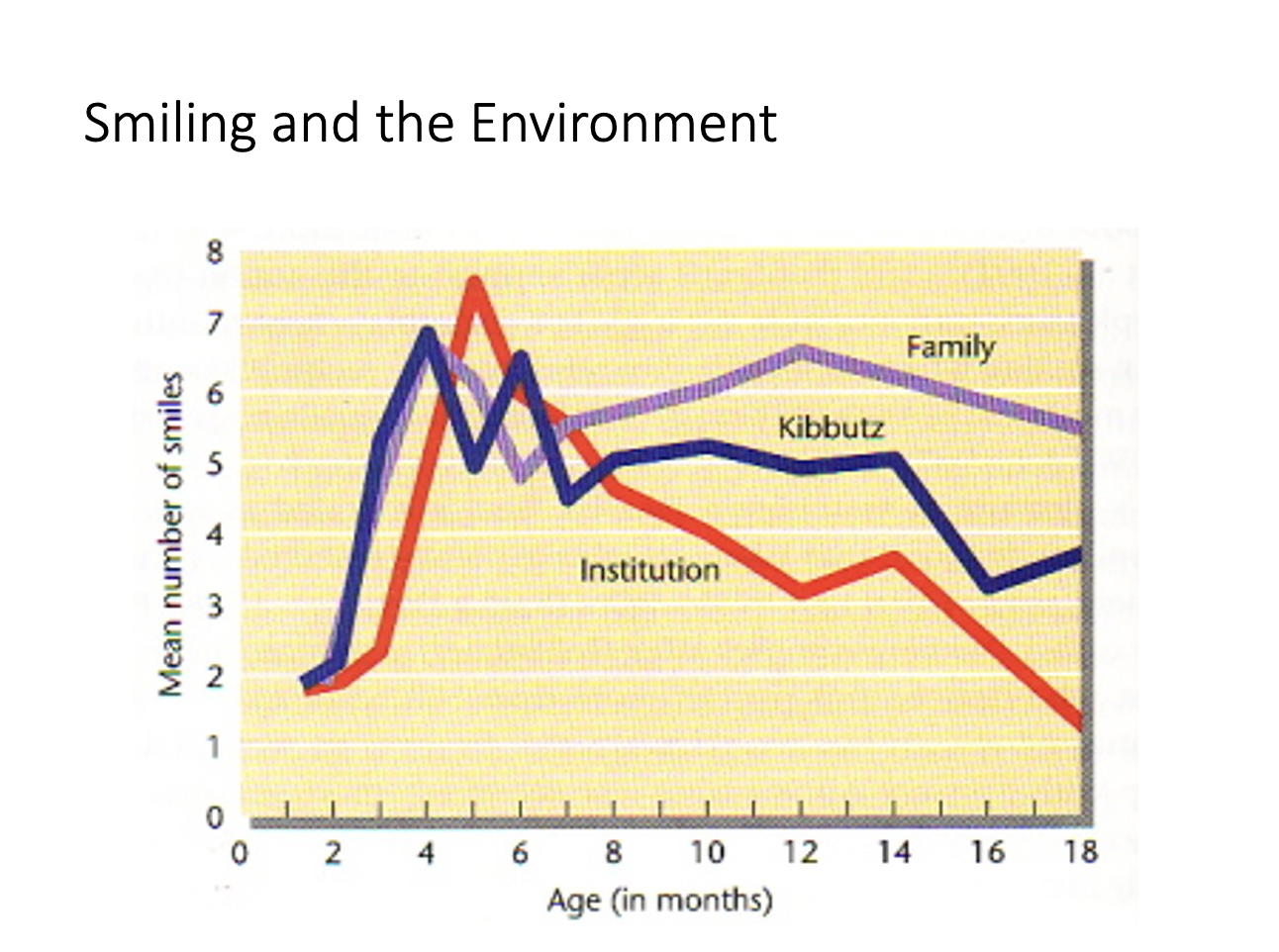
Early in age (6 months) rise in total number of smiles for all groups
Negative emotions
Fear
3 Months → Wariness
9 Months → True fear
The Development of Specific Emotions:
Biological Perspective
Theres a similarity in development of emotions in genetically related people
Monozygotic twins more likely to be similar in timing when social smiling emerges
Separation protest
Protest in separation is a normal developmental response across cultures
There is cultural differences,
Peaks at 12-18 months then gradually decreases
Most protest in African babies
Less in Antiguan, Guatemalan, and Israeli babies
Cognitive perspective
Concept development → the formation of new schemas may drive the development of emotion
What is appropriate for girls and boys → Schemas
As infants grow, they begin to understand the cause and effect to make sense of the world
If they cry → A parent will comfort them
Children learn to understand other peoples reactions can provide valuable information about the consequences of their actions
Helps with predicting outcomes more effectively
Learning perspective
Is useful for explaining differences in emotional expression among different people
also useful for explaining conditioned fear responses
e.g. → A child reacting to a dog, could be seen as not scary for some but not the same for all children
Secondary emotions
Pride, Guilt, Shame
Pride
From: Success and achievement
Response: smiling, seeking recognition
Outcome: confidence, motivation
Can reinforce positive behaviour and motivation
Guilt:
From: Harm to others or breaking rules
Response: Apologizing, fixing the harm
Outcome: Moral development
Guilt encourages empathy and prosocial behaviour
Shame
From: Feeling exposed or unworthy
Response: hiding, pulling back
outcome: low self worth
when balanced can promote humility and self-improvement
→ All play a key role in moral and social development