translation
Central Dogma of Molecular Biology
DNA → RNA → Protein
DNA to RNA is Transcription
RNA to Protein is Translation
transcription review
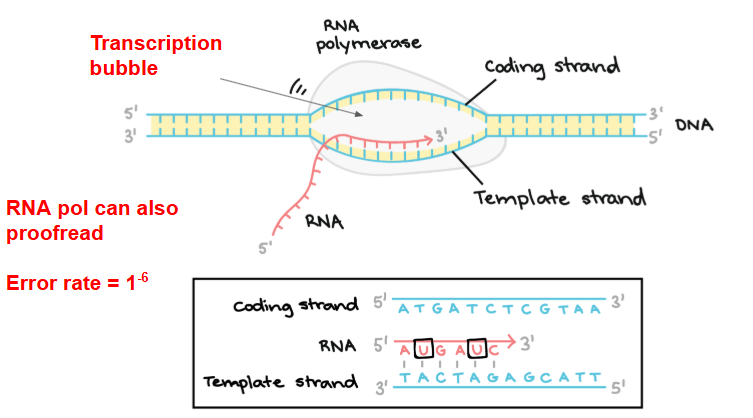
The biosynthesis of a messenger RNA (mRNA) from a DNA template
Only about 1.5% of the genome actually codes for a protein
Occurs in the nucleus (in eukaryotes)
Uses RNA polymerase (RNApol)
Synthesizes in the 5’ to 3’ direction
Has helicase activity
Does NOT need a primer
Only one of the two DNA strands is transcribed
The transcribed mRNA is complementary and uses A, U, G, C
Only part of the DNA code is transcribed
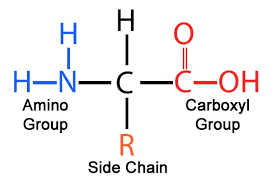
amino acid structure
monomer:
carboxyl group
amino group
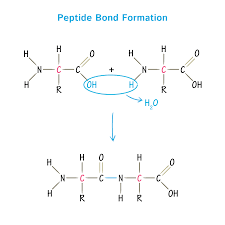
amino acid polymers = polypeptides
RNA amino acids
1 base → aa 4 total 4^1
2 bases → aa 16 total 4²
3 base → aa 64 combos 4³
why only 20?
degenerate = multiple 3-letter combos
tRNAs
decoders that translate mRNA → proteins
even tRNA is loaded with a specific amino acid at its 3’OH end
anticodon loop of tRNA complimentary to the input codon
Loading tRNAs with anti codon
ATP facilitates ester bond between the carboxyl group and the 3’ hydroxyl group (OH)
the enzyme that does this is aminoacyl tRNA synthase
difference amino acids are loaded by different aminoacyl tRNAs synthase
humans have 20 different aminoacyl tRNAs
During translation: polypeptide chain
amino acid chain immediately start folding in cytoplasm
primary - linear peptide strand
secondary - alpha helices and the beta sheets
tertiary - folds to make 3d shape
4th - complex of multiple proteins