4. Covalent bonds
A covalent bond is a chemical bond in which atoms share one or more pairs of electrons, typically between 2 non-metal atoms, to achieve a stable outer electron configuration. This sharing of electrons holds the atoms together in a molecule, with the positive nuclei of the atoms being attracted to the shared electron pair located between them.
If the difference in electronegativity between the 2 atoms in a covalent bond is less than 0.4 then the bond will be non-polar.
If the difference in electronegativity between 2 atoms in a covalent bond is between 0.4 and 1.7 the bond will be polar
For atoms to share electrons, their orbitals must overlap to form molecular orbitals. Orbitals may only overlap if they have the correct energy, shape and orientation
C, H, O, and N can share electrons because their valence orbitals have similar energies
The octet rule
Second period, p block elements strive to achieve 8 electrons in their outer shell (C, O, N,..)
Period 3 elements can violate the octet rule and hold more than 8 electrons due to the presence of empty d orbitals. This is called hypervalency. For example, in the backbone of DNA, phosphorus is hypervalent and forms 5 covalent bonds meaning it holds 10 electrons in its outer shell.
Combining waves
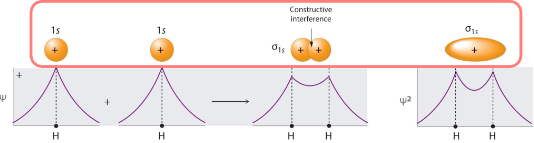
Constructive interference - peaks of the waves align and the troughs of the waves align resulting in a wave with increased amplitude

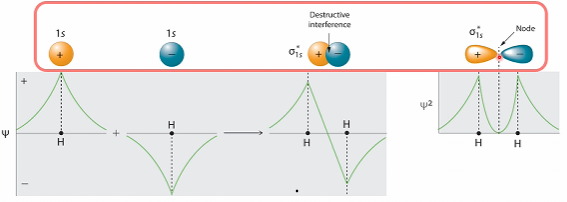
Destructive interference - waves are misaligned resulting in a wave with reduced or no amplitude

Combining unhybridized atomic orbitals
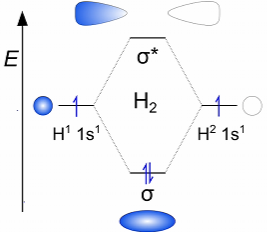
When atoms form a covalent bond, the number of molecular orbitals formed is equal to the number of atomic orbitals that combine to form them. For example, if 2 atomic orbitals combine, 2 molecular orbitals will be formed - one bonding and one antibonding.
Atomic orbitals are wave functions, they can combine constructively or destructively.
In-phase combination - orbitals overlap constructively to form a bonding molecular orbital ( or bond)
Out of phase combination - orbitals overlap destructively to form an antibonding molecular orbital (* or * bond). A node is formed between the atoms
Bonding molecular orbitals have lower energy than the atomic orbitals that combined to form them while antibonding molecular orbitals have higher energy
A covalent bond is formed if the number of electrons in the bonding molecular orbitals is greater than the number of electrons in antibonding molecular orbitals.
p orbitals can also combine in phase and out of phase to form and * orbitals when they overlap straight on. They can also overlap side on to form and * orbitals
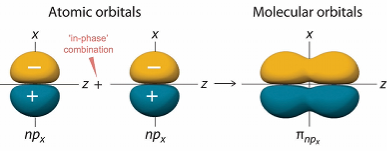
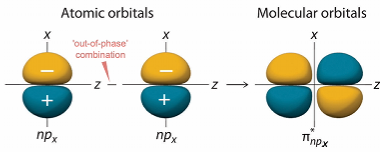
p and s orbitals can combine to form and * orbitals
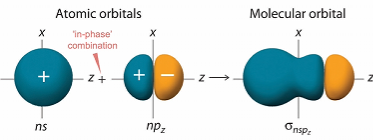
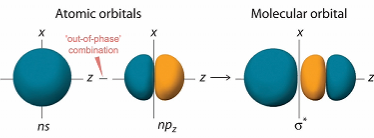
Allowed orbital overlaps:

Disallowed orbital overlaps:

sp3 hybridisation
1 2s orbital and 3 2p orbitals hydridise to form 4 sp3 orbitals
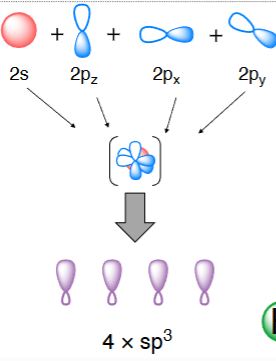
The sp3 orbitals have equal energy and arrange themselves in a tetrahedral arrangement with 109.5o orbital angles.
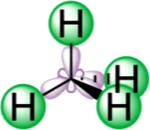
Carbon in methane is sp3 hybridised, with 1 electron in each sp3 orbital, the orbitals can each overlap and form sigma bonds with the 1s orbitals of hydrogen atoms.
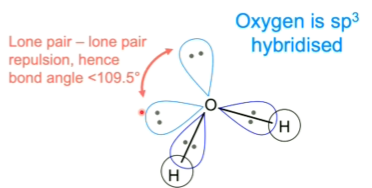
Oxygen in water is also sp3 hybridised, with 2 of the orbitals being full while the remaining orbitals contain 1 electron. The unfilled orbitals can overlap and form sigma bonds with the 1s orbitals of hydrogen atoms.
sp2 hybridisation
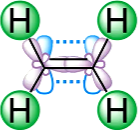
Atoms that form double bonds are sp2 hybridised. Double bonds have 1 sigma bond and 1 pi bond. The pi bond is formed by p orbital overlap. The remaining 2 2p and 1 2s orbital hybridise to give 3 sp2 orbitals
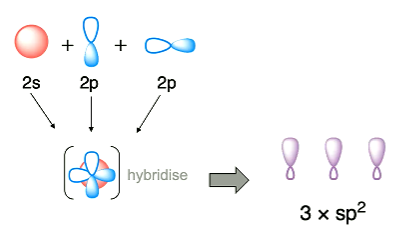
sp2 orbitals have equal energy and arrange themselves in a trigonal planar arrangement with 120o bond angles.
In ethene, the sp2 orbitals between the carbons overlap head on to form a sigma bond while the p orbitals overlap sideways forming a pi bond. This forms the double C=C bond.
sp hybridisation
Atoms that form triple bonds are sp hybridised. Triple bonds have 1 sigma bond and 2 pi bonds. 2 p orbitals from each atom across the triple bond form the pi bonds. The remaining p and s orbital hybridised to give 2 sp orbitals
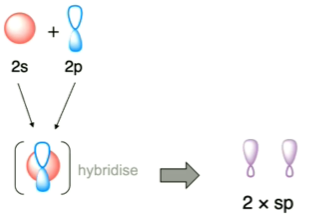
The 2 sp orbitals have equal energy and arrange themselves in a linear arrangement with 180o bond angles.
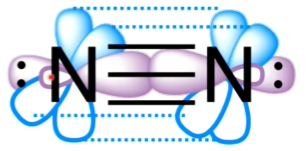
Nitrogen in N2 is sp hybridised. The sp orbitals overlap head on to form the sigma bond while the p orbitals overlap sideways.
Energies of hybridised orbitals
The greater the s character of the spn hybridised atoms, the tighter the electrons are held by the nucleus. This leads to shorter bond lengths, and stronger bonds
In order of increasing energy;
s < sp < sp2 < sp3 < p
Coordinate bonds (dative covalent bonds)
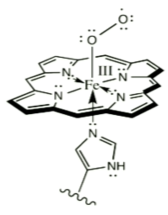
This is a covalent bond, where both electrons come from the same atom. These are not usually common in biomolecules however an example would be the iron in the heme group. It is bound by 6 dative covalent bonds.
Conjugation, delocalisation and resonance
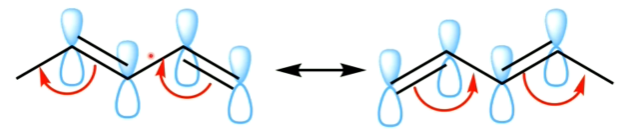
Conjugation is the overlap of 3 or more adjacent, parallel p orbitals, forming a continuous pi system of delocalised electrons. Typically occur where there are alternating single and double bonds.
Delocalisation is the spreading of electron density across multiple atoms or over a larger molecular framework, rather than being restricted to a single atom or bond (e.g. in a conjugated system).
Resonance is the result of conjugation, represented by multiple Lewis structures