Krebs cycle
Krebs cycle
takes place in the mitochondrial matrix
processes acetyl CoA to prepare substrates for the final stage of aerobic respiration
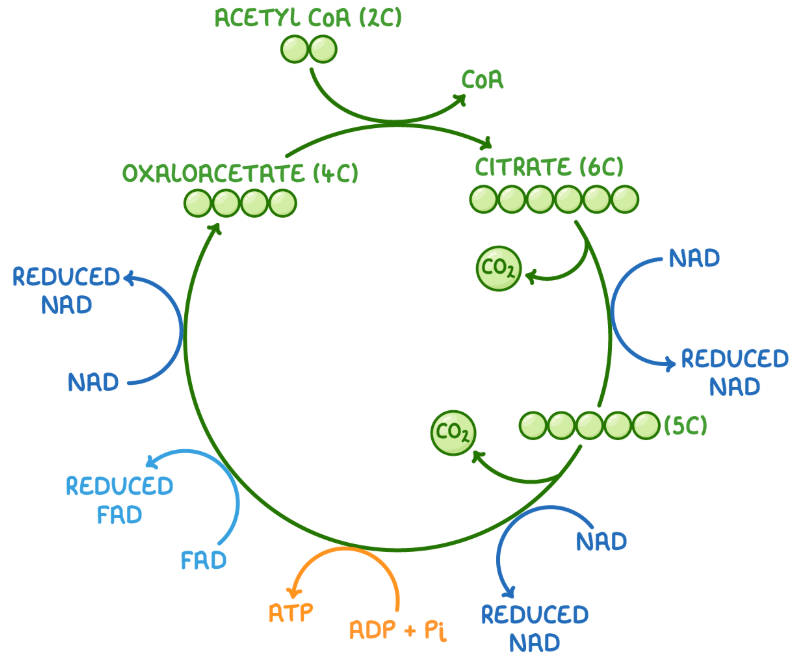
For each molecule of acetyl CoA:
2x molecules of CO2 produced as by-product
electron carriers including 3x molecules of reduced NAD and 1x reduced FAD produced
1x molecule of ATP produced
Krebs cycle as a series of enzymatic reactions
acetyl CoA merges with a 4C molecule, oxoacetate, to create a 6C molecule, citrate
citrate is decarboxylated, releasing two molecules of CO2 in two stages
citrate is also dehydrogenated (oxidised), releasing hydrogens that reduce three molecules of NAD and one molecules of FAD
for each acetyl CoA that enters the cycle, one ATP is synthesised directly via substrate level phosphorylation
oxoacetate is regenerated for the next turn of the cycle
The role of coenzymes
initially act as oxidising agents
reduced coenzymes later donate these gained electrons to the electron transport chain
facilitates the transfer of electrons that is crucial for the synthesis for the synthesis of ATP
Importance of the Krebs cycle
oxidises and breaks down large nutrients into smaller ones
eg CO2 which can be removed as waste
generates reduced NAD and reduced FAD
carry electrons and protons into oxidative phosphorylation
continually regenerates the 4C molecule to combine with acetyl CoA
provides a variety of intermediate compounds required for the biosynthesis of essential cellular components such as fatty acids, amino acids, and chlorophyll