Unit 5: Business Markets and Business Buying Behaviour
Unit 5: Business Markets and Business Buying Behaviour
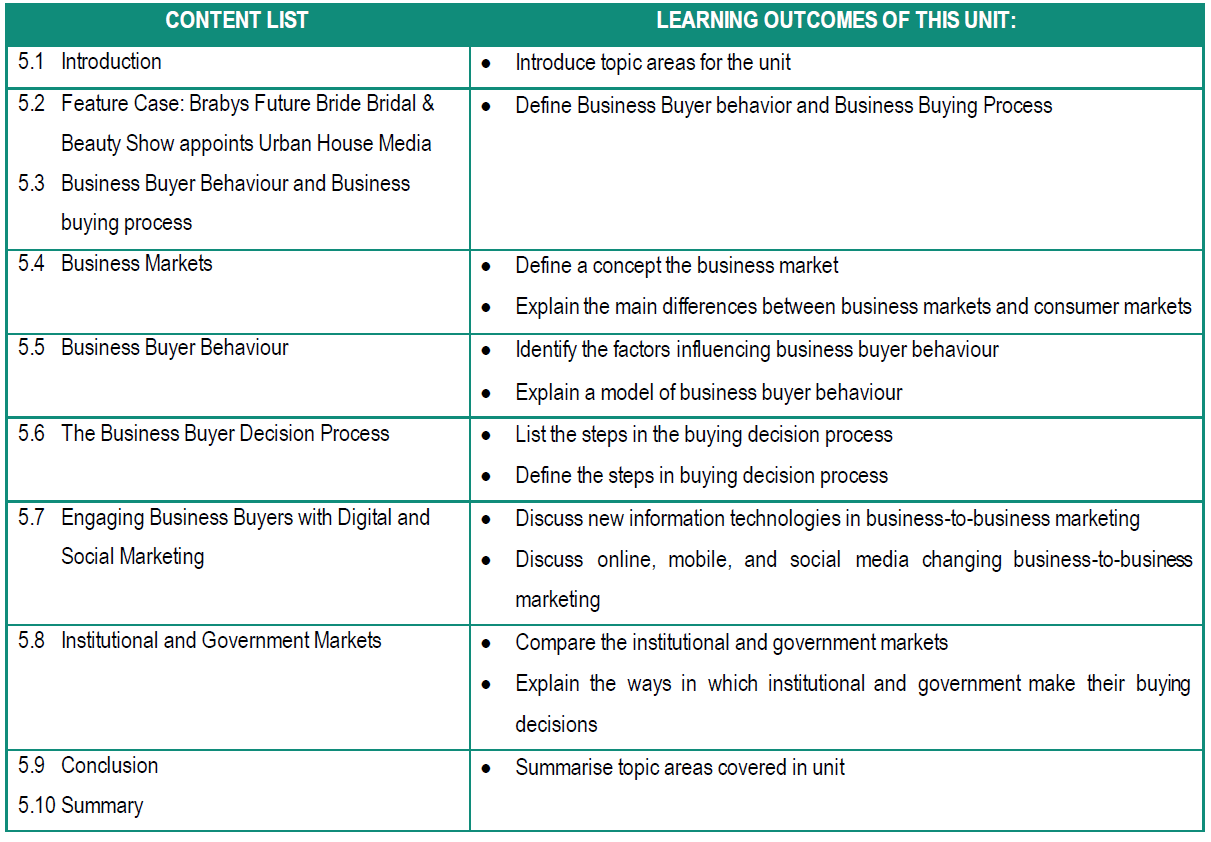
Unit Learning Outcomes
 | Prescribed and Recommended Textbooks/Readings Prescribed Reading(s)
Recommended Reading(s)
|
5.1 Introduction
Business-to-business (B2B) brands are growing in solving customer problems. Marketers, whether in small or large corporates, therefore continuously face the challenge of strategies to build their brands in business-to-business markets. The need and task to demonstrate the importance of the company’s branding when it is involved in B2B markets is always a daunting one. This Unit focuses on B2B markets and business buying behaviour. Emphasis is on business customers that buy goods and services for use in producing their own products and services or for resale to other companies or to consumer markets.
You shall learn that when marketers are selling goods and services to business buyers, they should involve business customers and build profitable business-to-business relationships. In addition to that, you shall also learn that for marketers to be successful and competent in B2B markets they should not just think “selling” products and services to B2B customers. Rather, marketers should work closely and deeply with B2B customers. This is the strategy in the next section of the feature case about the Urban House Media.
5.2 Feature Case: Brabys Future Bride Bridal & Beauty Show appoints Urban House Media
Public relations and media communications agency Urban House Media will once again be managing the PR, digital and social media marketing for the Brabys Future Bride Bridal & Beauty Show 2019, formerly known as the NWJ Bridal and Beauty Experience. Urban House Media will be creating original content for traditional, digital and social media platforms in an interactive public relations campaign. The campaign aims to generate credible media opportunities and online awareness for the event by bringing the best of the bridal and beauty worlds together. The Brabys Future Bride Bridal & Beauty Show will aim to offer the KwaZulu-Natal bridal market a fresh, modern and unique experience at the Globe at Suncoast Casino from Friday, 1 March to Sunday, 3 March 2019.
Begin this unit by attempting a thinking exercise below.
 | Think Point 1. In your opinion, how is the Urban House Media becoming successful in the B2B markets? Discuss what is the Urban House Media’s B2B strategy to their B2B customers? |
|
5.3 Business Buyer Behaviour and Business buying process
Business-to-business purchases are many. These purchases are influenced by business buyer behaviour and business buying process way before the final consumer is involved. In these next two sections you should be able to recognize that there are many business-to-business purchases happening in the marketplace before final consumers are involved. You need to understand how to contrast business demand from consumer demand.
 | LEARNING OUTCOMES |
What is meant by business buyer behaviour, and by business buying process?
Business buyer behaviour refers to “the buying behavior of organizations that buy goods and services for use in the production of other products and services that are sold, rented, or supplied to others.” (Kotler and Armstrong, 2018:188).
Business buying process refers to “the decision process by which business buyers determine which products and services their organizations need to purchase and then find, evaluate, and choose among alternative suppliers and brands.” (Kotler and Armstrong, 2018:188).
STUDENT TIP: Business markets is huge, and entails businesses buying goods and services for further production, or reselling. |
5.4 Business Markets
Let us say you want to buy a laptop computer for your Business Management studies. Do you know that before you came forward with this demand many business purchases activities on this product have already been taking place at various stages and in various forms of its supply chains? For this laptop computer you need, B2B activities are happening without you seeing, or being involved in them? Hence, Kotler and Armstrong (2018:188) argue that “Business markets operate “behind the scenes” to most consumers”. The business markets sets are larger than the consumer markets sets.
5.4.1 Business Market Vs Consumer Market
Business market is the market that only consist of companies: whereby selling and buying goods and services involves business with other businesses, while consumer market is when in buying and selling, companies create value for individual customers (Kotler and Armstrong, 2018:188).
In the business market, the business buyer behaviour solely relates to the buying behaviour of companies buying goods and services that the business transforms into products and services that are rented, sold, or supplied to other businesses. In addition, the buying process in the business is different to consumer market. Business markets differ, mainly, from consumer markets in the following ways (Kotler and Armstrong, 2018:189-190):
Market structure and demand,
The nature of the buying unit, and
The types of decisions and the decision process involved.
 | KNOWLEDGE CHECK QUESTIONS Discuss what the B2B marketing is? Submit Your Answer View Correct Answer What is the difference between business market and consumer market? Submit Your Answer View Correct Answer |
5.5 Business Buyer Behaviour
According to Kotler and Armstrong (2018:190), “Business buying decisions can range from routine to incredibly complex, involving only a few or very many decision makers and buying influences”. In this section you should be able to critically compare types of buying situations as these influences a few or many business buyer decision-makers. You need to adapt a model of business buyer behaviour.
| LEARNING OUTCOMES |
Marketers should understand how different business buyers respond to various marketing stimuli because that affects and changes marketing strategies. The buying activity in business consists of the buying centre and buying decision process as depicted in Figure 5.1 below.
5.5.1 Model of Business Buyer Behaviour
Figure 5.1 depicts a model of buyer behaviour process.
Figure 5.1 A Model of Business Buyer Behaviour.
Source: Kotler and Armstrong (2018:191).
In Figure 5.1, the buying decision in business buying behaviour is made up of the buying centre that is prone to interpersonal and individual influences and organisational influences with various business buyer responses (Kotler and Armstrong, 2018:191).
5.5.2 Major types of Buying Situations
There are three major types of buying situations influencing how businesses respond to marketing stimuli as presented in Figure 5.2 below.
Figure 5.2 Types of business situations.
Source: Study Guide Author.
In view of Figure 5.2 Kotler and Armstrong (2018:191) outlines that business situations comprise of:
Straight rebuy - A business buying situation in which the buyer routinely reorders something without modifications
Modified rebuy - A business buying situation in which the buyer wants to modify product specifications, prices, terms, or suppliers
New task - A business buying situation in which the buyer purchases a product or service for the first time
Systems selling – This involves “buying a packaged solution to a problem from a single seller, thus avoiding all the separate decisions involved in a complex buying situation” (Kotler and Armstrong, 2018:191)
5.6 The Business Buyer Decision Process
The business buyer decision process has eight stages. In this section you should be able to identify and examine these eight steps for a typical business buying situation. You need to give an explanation how each step applies to a different task in buying situations.
| LEARNING OUTCOMES |
The marketing managers need to learn who participates in the decision, degree of participant’s relative influence, and to understand the evaluation criteria used by each participant to come to a decision. Typically, buyers faced with a new task purchase situation go through all the eight stages of the buying process. Whereas, buyers making modified or straight rebuys may skip some of the stages because of the familiarity of the purchase (Kotler and Armstrong, 2018:195). The eight steps are presented in Figure 5.3 below.
Figure 5.3 Stages of the Business Buyer Decision Process
Source: Kotler and Armstrong (2018:195)
Figure 5.3 illustrates the eight stages of the business buyer decision process, and Kotler and Armstrong (2018:196) explain each stage as:
Problem Recognition - “This is the first important stage in the buying process and it initiated by someone in the company who recognises a problem or a need that can be addressed by acquiring a specific product or a service” (Kotler and Armstrong, 2018:195)
General Need Description - The focus in this stage is to understand the need and hence the buyer describes the arising needs as per need recognition. It further describes the characteristics and quantity of what items are needed (Kotler and Armstrong, 2018:196)
Product Specification - Post defining the need, the buying business in the buying process decides on and specifies the best technical product characteristics for a needed item
Supplier Search - At this stage, the buyer conducts a supplier search to find the best vendors that meet the product need (Kotler and Armstrong, 2018:196)
Proposal Solicitation- The buyer goes into proposal solicitation once they are happy with the composed list suppliers and invites qualified suppliers to submit proposals (Kotler and Armstrong, 2018:196)
Supplier Selection - This is the stage when the buyer reviews proposals and selects a supplier or suppliers, and the buying centre matches each supplier’s attributes and their relative importance against one another (Kotler and Armstrong, 2018:196)
Order-Routine Specification - This is the stage when the buyer writes the final order with the chosen supplier/s listing the technical specifications, quantity needed, expected time of delivery, return policy, and warranties. (Kotler and Armstrong, 2018:196)
Performance Review - This is the stage in the buying process after order-routine specifications has been agreed on with a selected supplier (Kotler and Armstrong, 2018:196)
5.7 Engaging Business Buyers with Digital and Social Marketing
The face of B2B buying and marketing process is changing owing to the explosion and the importance of technology advancements such as internet, online, mobile, and social media. This is enhancing social and digital media marketing. In this section you should be able to reflect on recent advances in information technology in generating e-procurement and think of what business-to-business digital and social tools marketers use to engage customers.
| LEARNING OUTCOMES |
Advances in information technology are impacting the landscape of the B2B buying process. Due to marketing management integrating these technologies, mature B2B customer-supplier relationships are being built using the internet and online media tools. Great results are showing for marketers. Marketing strategies are changing and business customer responses have rapidly shifted towards the online buying. Contemporary B2B marketers are therefore using a wide range of digital and social media marketing approaches (Kotler and Armstrong, 2018:196-198).
Figure 5.4 Information technology
Source: Study Guide Author
Figure 5.4 presents how E-Procurement and online purchasing and B2B Digital and Social Media Marketing are a force and benefit to B2B marketers in today’s B2B buying process.
 | PRACTICAL APPLICATION OR EXAMPLES Submit Your Answer |
5.8 Institutional and Government Markets
While emphasis has favoured the discussion of the buying behaviour and decision process of business buyers, also known as private business, of equal importance are the buying practices of two nonbusiness markets. Nonbusiness markets here refers to institutional markets and government organization markets. At the end of this section you should be able to differentiate and address the special features of institutional markets and of government markets. You need to design and implement buying practices for institutional and government organizations (Kotler and Armstrong, 2018:199).
| LEARNING OUTCOMES |
5.8.1 Institutional Market
Comprise of institutions entrusted to provide goods and services to people in their care (Kotler and Armstrong, 2018:199). Examples include schools, hospitals, nursing homes, prisons, and others. These institutions differ from one another in their sponsors and their objectives (Kotler and Armstrong, 2018:199). Many marketers are making a clear distinction with the sole objective of meeting the special characteristics and needs of institutional buyers.
5.8.2 Government Market
Comprise of governmental units— local, provincial and national, and international (intergovernmental) —that purchase or rent goods and services for carrying out the main functions of government (Kotler and Armstrong, 2018:201). Marketers need to be familiar with noneconomic criteria used in various countries they wish to sell their goods and services.
 | ACTIVITY 1. Contrast institutional markets and government markets Submit Your Answer View Correct Answer 2. Discuss how institutional and government buyers make their buying decisions. Submit Your Answer View Correct Answer |
5.9 Conclusion
Often the focus of marketing literature in consumer markets has resulted in too many people not seeing the importance of both business and non-business markets. Businesses seeking success and competitive advantage and growth opportunities need to look beyond just the consumer market and invest in the B2B market. Thus, companies need to devote efforts in the B2B marketing strategies to better engagements that create value for business customers and that enhance the building of business customer relationships.
The companies that implement B2B marketing strategies work through the challenges of understanding both internal and external stimulus influencing business buying centres and business buyer decision process. B2B marketers cannot afford to ignore the potential of non-business markets. Government and institutional markets consist of large buyers of goods and services. Marketers and companies need not be short sighted when dealing with government and institutional market segments because these markets provide added growth opportunities. Understanding opportunities and threats resulting from business-to-business and non-business markets helps the company to effectively position itself and pursue market opportunities it better understands and let go of threatening market segments.
5.10 Summary
This unit explored the marketers’ understanding of business markets, business buyer behaviour and business buyer decision process. You were taken through the factors impacting business buyer behaviour consisting of market environment, interpersonal and individual influence, organisational influences, and the buyer responses. The eight stages in business buyer decision were the explained demonstrating how and when businesses make their purchases. The unit then examining the technological surge and its influence on business markets and business buyer responses.
It was explained that increasingly B2B marketers and company marketing managements are embracing B2B digital and social marketing. Finally, the unit looked at non-business markets. It was explained that the government and institutional markets that businesses can target today. Overall, suppliers often do not take into consideration both non-business markets. However, the two markets can provide suppliers with substantial business opportunities. The next unit deals with customer value-driven strategy.
 | REVISION QUESTIONS 1. “Business markets operate “behind the scenes” to most consumers” (Kotler and Armstrong, 2018:188). Simplify this statement by giving a compelling explanation about how business markets differ from consumer markets. Submit Your Answer |