Note: Lobbying and Money in Politics
Lobbying and Money in Politics
Political Economics Topic 10
Simple Model Overview
Three political groups (denoted as J) each of size with equal ideological density .
Groups either have lobbying representation or not
Lobbyists contribute donations to candidates, which are utilised for campaign advertising. The assumption is that such contributions augment candidate popularity.
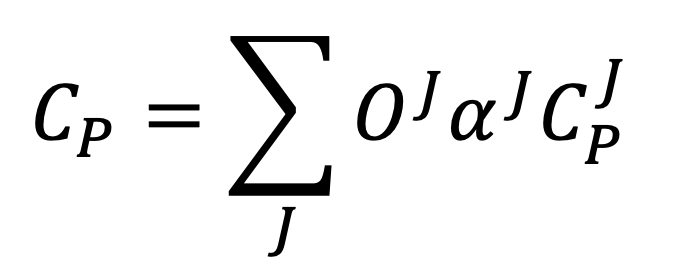
The total political contributions accumulated by candidate P (denoting candidates A and B) are formulated as:
Model Timing
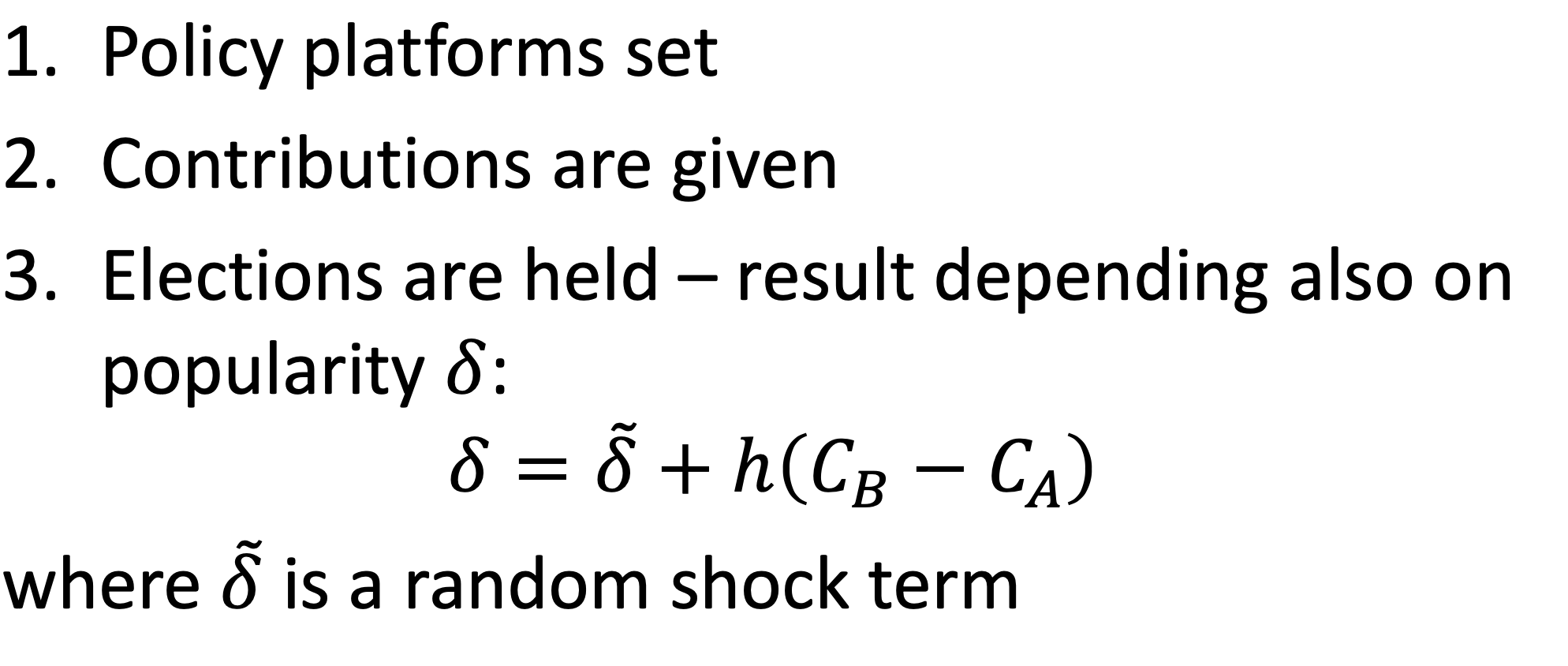
Stage Outcomes
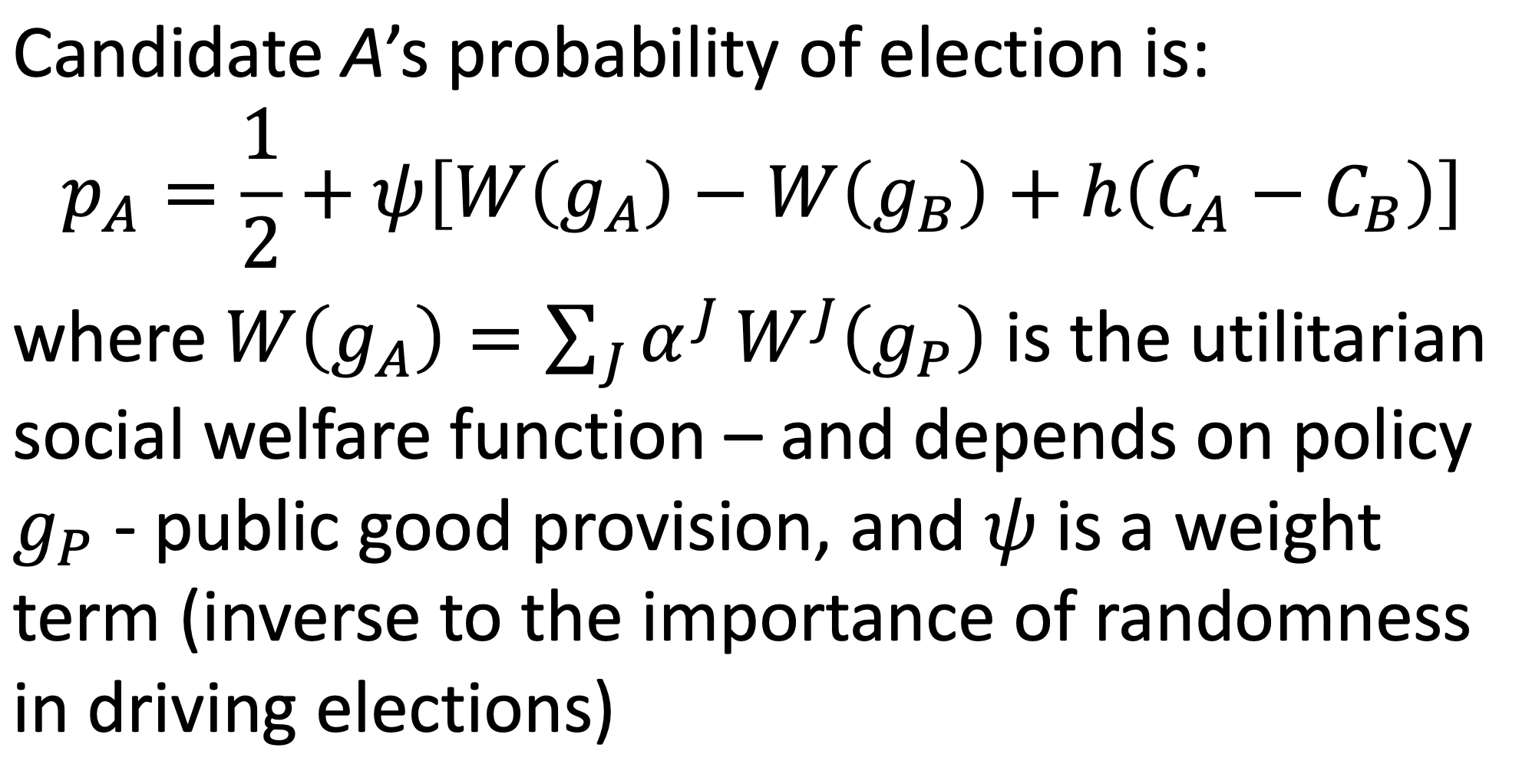
Stage 3 - Candidate Election Probability
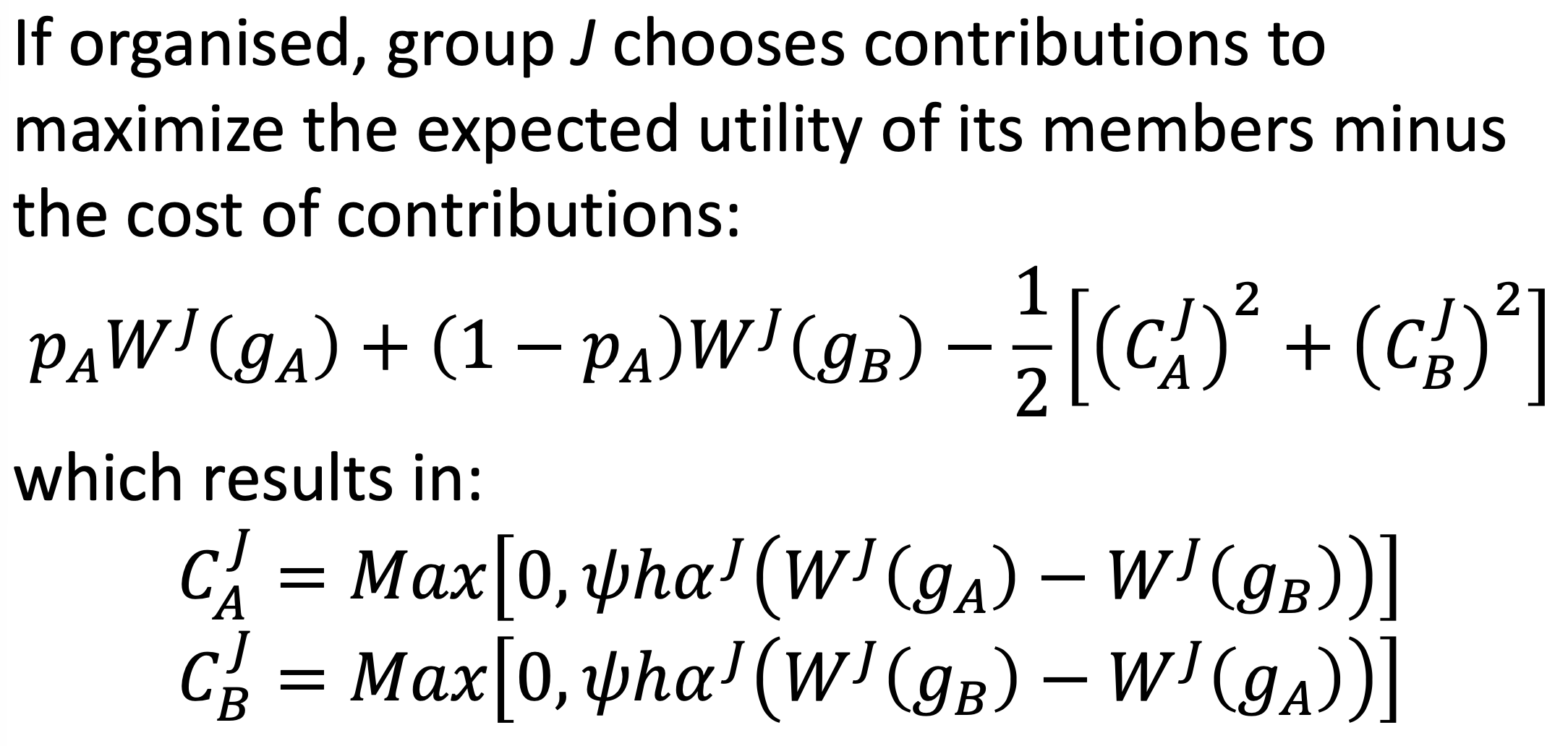
Stage 2 - Contributions to Maximize Utility
If organized, group J determines contributions aiming to maximize expected utility of its members minus cost of contributions
Stage 1 - Candidate Motivations
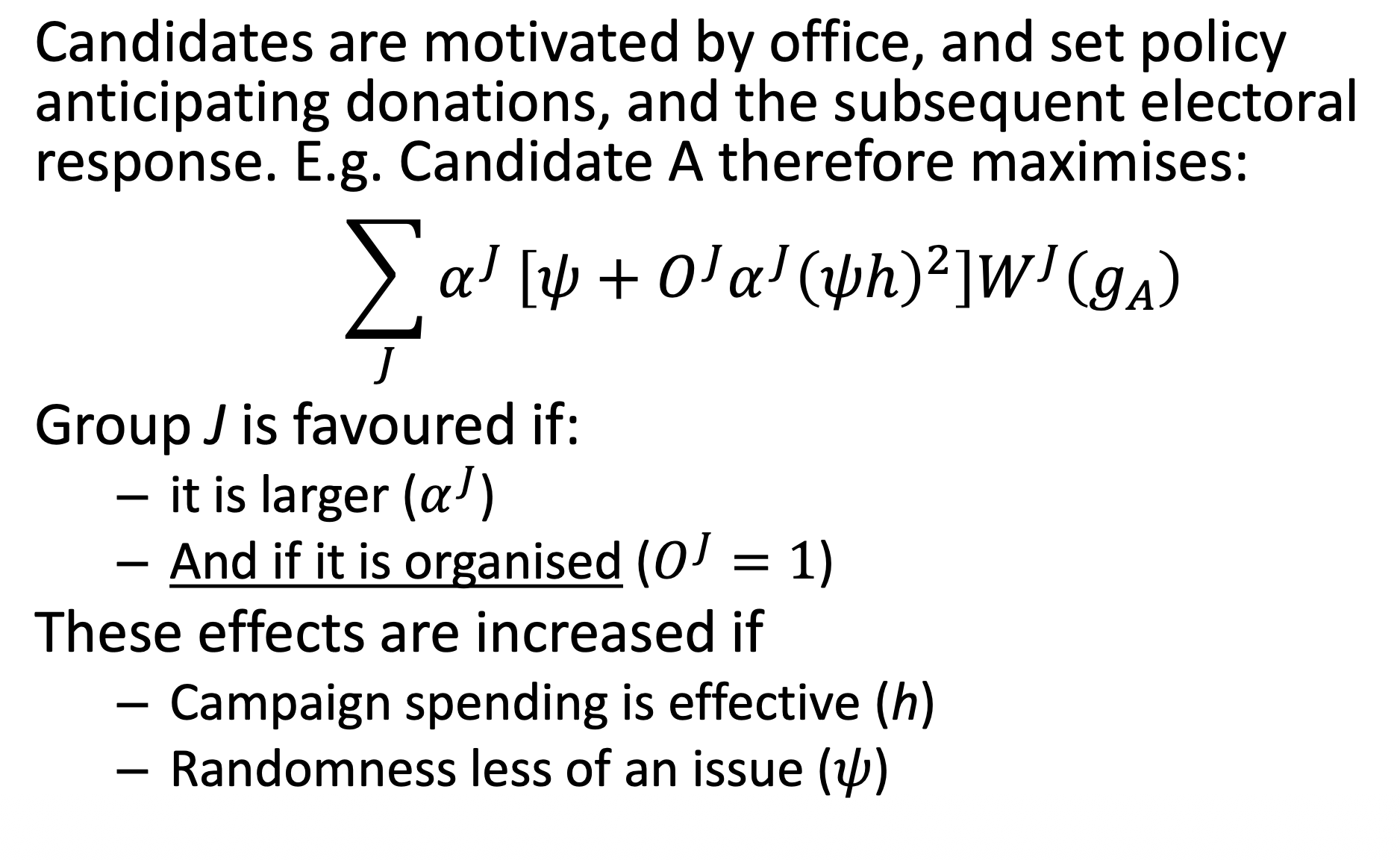
Candidates driven by the desire for office anticipate donations and electoral reactions. Thus, Candidate A set's policy based on:
Bottom Line of the Simple Model
An illustrative scenario shows the rich being organized while the poor are not. The implications include:
Rich donations lead to policies favoring them - characterized by lower taxes and minimal public good provision, deviating from social optimum.
Policymakers aligned with the wealthy are more likely to be elected.
Key Comments on the Model
The model premises include:
Donations finance campaigns.
Candidates are motivated by office-seeking.
Voter response to campaign expenditure is positive.
Discussion Points
Candidates pursue election victories, which can be augmented through political contributions.
Group representation through lobbying tends to be inequitable and demands coordination. Groups with substantial stakes (like the wealthy or impoverished) are more often organized.
The model presupposes that voter response to advertising is requisite; increasing $h$ may lead to skewed political platforms.
Lobbying shows vast potential returns when governmental budgets are large.
Campaign Spending Data - Presidential Elections
Time-series Analysis on Campaign Spending (Normalized) 1960-2016
Significant figures outline the campaign spending trajectories across various presidential contenders.
Highlights include peaks in spending for candidates like Kennedy, Nixon, and Obama.
Public Perspective on Political Financing
Common sentiment reflects a belief that excessive money influences politics. A comparative outlook with the projected Federal Budget of $7 trillion for 2025 brings into question the 'Investment hypothesis'.
Limitations of Money in US Politics
Reflections from Ansolabehere et al. (2003) include:
Comprehensive disclosures on campaign contributions since 1974, with limitations on individual donations and available public fund agreements conditioned on spending caps.
Notably, while overall spending limits are often without bounds, loopholes persist such as 'independent expenditures' and 'soft money'.
Campaign Contributions - Statistics
In the 1999-2000 election cycle, campaign expenditures totaled $3 billion, with presidential candidates accounting for approximately $500 million of this sum.
The bulk of campaign funds originates from small contributors; about 10% of the U.S. electorate participated in the funding process via donations.
A noted trend is that many firms abstain from political contributions, and PAC contributions exhibit low binding effects at the time ($10,000 limit with only 4% of individual donations reaching this threshold).
Theoretical Perspective on Political Investment
There exists a standard view (implicit in previous models) that legislators with substantial political sway accumulate more funding than less prominent legislators.
However, the sheer scale of monetary contributions does not evidently correlate with the scale of resultant policy decisions.
Tullock’s Puzzle
Campaign spending statistics reflect historical figures from 1972 ($200 million) and 2000 ($3 billion), juxtaposed against colossal public sector budgets.
Despite a theoretical framework predicting increased monetary involvement in politics, reality suggests a contradiction against this premise, challenging the investment model's assumptions.
Disconnect Between Contributions and Legislation
Contributions, particularly corporate, appear limited because stakeholders perceive minimal benefits.
Studies exhibit that PAC contributions frequently yield negligible impacts on the voting behaviors of representatives.
Econometric complexities arise, including reverse causality and missed control variables, compromising the analysis of corporate contributions lacking significant policy leverage.
Efficacy of Campaign Spending on Votes
While empirical correlations exist between campaign spending and electoral votes, causality is not firmly established.
A notable 1994 study by Levitt utilized repeat challengers to determine minimal effects attributable to spending, an assertion contested in other studies.
Campaign Contributions - Ideological Drivers
Smaller donations tend to align with ideological motivations devoid of direct exchange, akin to charitable donations.
Evidence from political giving by top corporate executives shows contributions amount to 0.05% of total income, compared to a national average of 0.04%.
Time-series documentation on campaign spending indicates a reduction relative to GDP throughout the 20th century.
Policy Implications on Political Financing
Suggestions for enhancing political transparency include stricter disclosure laws and potential caps on spending and donations.
Mindful consideration is required for the potential consequences of imposing limits on contributions, as unforeseen outcomes may arise from such regulations.
Subsequent Topics and Literature
The ongoing discourse and academic research include contributions by Maloney and Pickering (2018) which delve into the economic repercussions of political donation limits. They present polarized viewpoints regarding the implications of unrestricted financial contributions on political integrity.
Debates within the existing empirical literature have yielded minimal effects of contribution caps on public trust and corruption levels, highlighting the necessity for ongoing examination of political financing dynamics and donor motivations.
Proposed Model and Empirical Evidence
Future modeling efforts concentrate on electoral competition and donor/voter behavior, analyzing how varied limits on donations influence rent-seeking behavior.
Conclusion
Findings indicated that higher political competition correlates with favorable policy outcomes, while limits on donations appear beneficial under low competition settings.
Notably, state legislation presently trends oppositely to what the data would suggest to be optimal, warranting critical scrutiny of current policies from a theoretical perspective.