5.4 - Location
Reasons for a Specific Location of Production
Location of a business can affect its costs, demand, image, and ability to attract employees to work for it
Right locations for a business may affect:
Costs of production
Tax rates paid
Availability of employees and skills available
Demand for the products
Ease of accessing markets
Ease of accessing supplies
Access to natural resources
Benefits of Optimal Location
Lower costs may reduce the risk of losses if sales are lower than expected
Being closer to the customer may boost sales and profits
Overcoming trade barriers may increase sales
May add to the brand image
Deciding where to Locate
Based on a combination of quantitative and qualitative factors
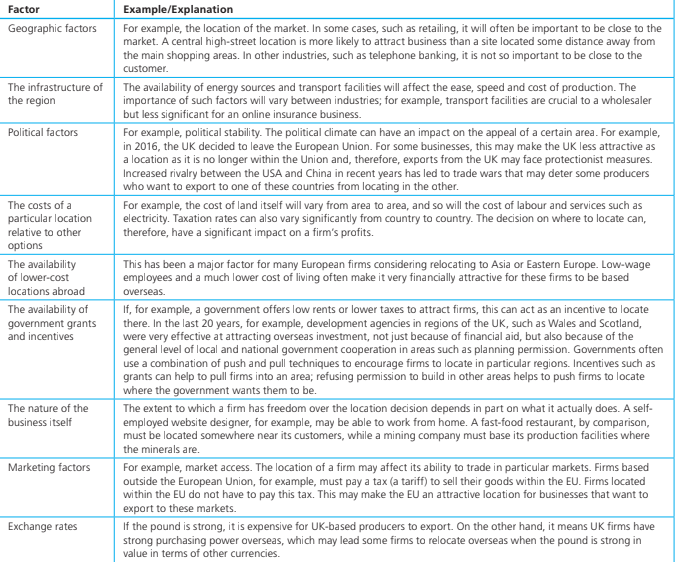
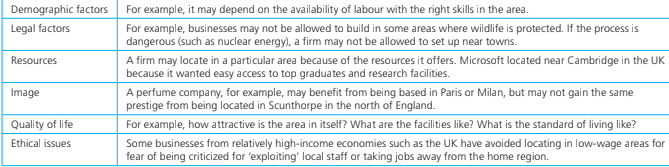
Qualitative Factors Affecting Location
Initial decision of where to set-up the business
Occurs at a time where money is tight and the firm will be heavily constrained by what it can afford
Key decision is desired capacity level
Once a firm is established it may consider relocating at some point in its development
May be necessary bc the initial reasons for choosing a place are now gone or bc the firm has outgrown its premises
Relocating may bring problems:
Staff who don’t want to move
Be a period of lost production time during the move
Costs of notifying customers and suppliers and administrative consts like changing the firm’s literature to include the new address
Ways of Re-organizing Production, Nationally and Internationally
Globalization happens when countries become more open to trade and the movement of money, people, goods, and services across borders
Globalization has increased bc of things like:
Better communications
Lower transport costs
Fewer trade barriers
Outsourcing
Occurs when a business uses other producers to undertake some of its operations
May outsource some aspects of its operations which it doesn’t see as critical to what it does/where it may benefit from the experties and scale of others
Might outsource catering and security
May outsource its customer enquiry helplines to specialist call centres
May be times when a business outsources key parts of its process to help expand its capacity and ability to deal w/ customer orders
Outsourcing may enable a business to:
Use the specialist services of another business
Benefit from lower costs
Increase its capacity
When outsourcing, a business should consider:
Overall impact on costs
Impact on quality
Reliability of delivery
Response of the existing workforce
Any ethical issues
Offshoring
Happens when a business moves production out of its own country and to another
A business will offshore to make use of the resources elsewhere, and benefit from lower costs
Differences in wage levels mean that businesses that are labour-intensive look to locate production in low-wage economies
Producers may use offshoring to benefit from:
Less strict health and safety, environmental protection, and employee rights regulations
Government incentives like tax advantages
Being closer to markets where products are sold
More skilled workforce
All operations may be offshored, or only some of them
Can increase the competitiveness and profiatbility of a business, but moving production overseas can raise ethical issues
Problems include:
Greater risk of delay w/ products having further to travel
May be more difficult to manage operations overseas
May be an exchange rate at risk if there’s a diff currency in the overseas location
May be a risk of political change in overseas country
Reshoring
Happens when a business brings back production into the country from an overseas location bc:
Cost advantage of overseas location has been reduced
Domestic government provides incentives to businesses that bring back production
May have been quality problems and the business thinks it’ll be easier to monitor and control quality if production is nearby
Changes in the region overseas making it less attractive, like political instability
Insourcing
Refers to when a business retains or brings back a particular task in the business instead of outsourcing it
May be bc it’s cheaper and easier to undertake the task in the organization instead of paying someone else outside to provide it
May also be bc of a worry ab quality and wanting to keep these tasks in the organization so it can keep close control over them