Neuromuscular system
TYPE 1
Slow oxidative
Slow twitch
→ contract slowly but sustain activity for long periods due to high aerobic metabolism and rich blood supply.
→ very fatigue resistant
Dense with mitochondria and myoglobin = red color.
Used for endurance activities (long distance).
TYPE 2a
Fast oxidative glycolytic
Fast twitch
→ combines aerobic capabilities with a faster, high tension contraction speed.
→ moderate fatigue resistance
Rich in mitochondria = pinky color.
Intermediate fiber type, good for sustained high intensity activities (swimming)
TYPE 2b
Fast glycolytic
Fast twitch
→ fast glycolytic fibers that produce powerful, high tension contractions using anaerobic metabolism.
→ fatigue quickly
Less dense with mitochondria and myoglobin = paler white appearance.
Specialized for short, explosive movements (sprinting/ jumping).
NERVOUS SYSTEM:
The Parasympathetic and Sympathetic nervous system are all part of the Autonomic nervous system which is responsible for involuntary functions of the body.
Sympathestic ns- affects several functions in the skeletal muscle fibers (metabolism, ionic transport) across the membrane and contractility = muscles contract.
Parasympathetic ns- controls bodies respond while at rest = muscles relax.
Proprioreceptive Neuromuscular Facilitation is an advanced stretching technique (CRAC- contract, relax, antagonist, contract) and is one of the most effective forms of flexibility training.
Muscle spindles- detect how far/ fast a muscle is being stretched and produce the stretch reflex.
Golgi Tendon organs- activated when there is tension in a muscle.
Isometric contraction- when there is tension in a muscle but no visible movement.
Autogenic inhabitation- sudden relaxation of the muscle in response to high tension (receptors involved is the GTO).
Muscle contractions occur when electrical impulses travel down the spinal cord, along the motor neurons, to the muscle fibers.
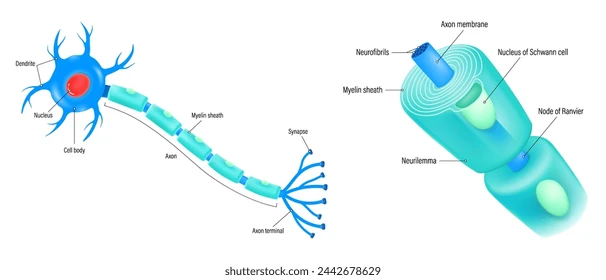
To protect the signal, an insulator surrounds the axon, called the Myelin Sheath that is made out of fatty material.
→ The Myelin sheath has breaks along the axon, called the Nodes of Ranvier. This results in it traveling quicker to the muscle.
→ The thicker the Myelin sheath, the faster the impulse conducted.
All or nothing law- no such this as a partial contraction for a single motor. It is either fully engaged/ fully inactive.
Gradation of conception- refers to the strength of force exerted by a muscle and is dependent on Recruitment; Greater number of motor units, the greater number of muscle fibers that will contract.
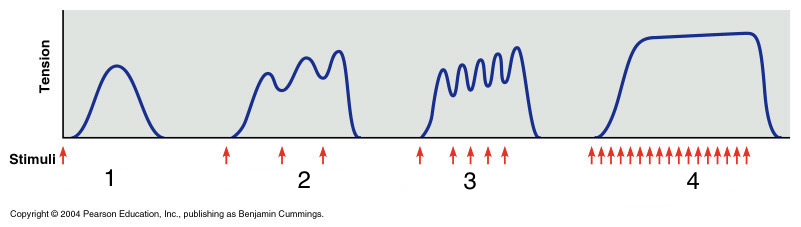
Twitch (1) eg. bicep curl
Wave summation- repeated activation of motor neurons stimulating a muscle fiber. No time to fully relax. (eg. Bulgarian split squats).
Titanic contraction- if stimuli is delivered at a high frequency without rest, twitches will overlap (repeated stimulation).
Spatial summation- if all motor units are stimulated at the exacts same time, then all max force can be applied.