A: 1.2 The Silk Road
Understand the context
(1200-1450)
Economic activity along existing trade routes increased in volume and scope. Technological and commercial innovation, imperial expansion, and demand for luxury goods were the sky factors of the ongoing expansion of trade.
B/c of the growing trade network, it accelerated cultural, biological, and technological diffusion across Afro-Eurasia.
(Factors and Expanded Trade)
The rise of powerful states and empires played a critical role in increasing the voile and geographical reach of existing trade network.
The Mongol Empire promoted trade along the Silk Roads.
B/c they created a vast commercial network across Eurasia. Trade routes across the Sahara and in the Indian Ocean added both west and east Africa to this network. Improvement to previously existing commercial practices.
Included forms of credit, facilitated larger networks of exchange. Allowing the growth in trade was a growing demand for luxury goods, such as silk and proclaim from China and gold from Africa.
(Consequences of Trade)
The growing trade, powerful new trading cities emerged scattered across Africa and Eurasia provided the setting for significant cross-cultural exchanges.
As merchants and other travelers moved from place to place, they introduce religious beliefs such as Islam and the development in technology such as paper making and gunpowder to new communities.
B/c of this, came a rapid spread of deadly diseases, most notably the bubonic plague.
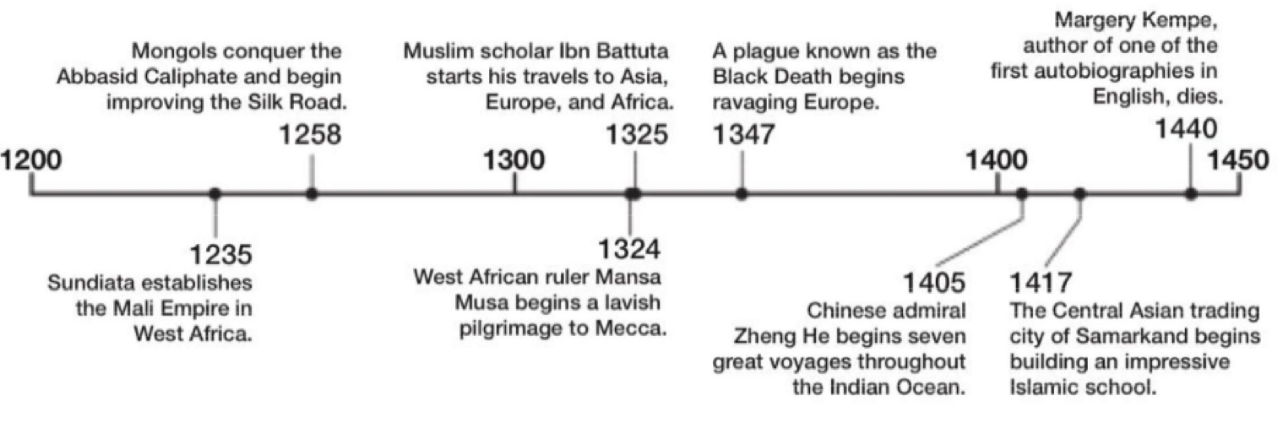
The Silk Road
Essential Question: What were the causes and effect of the growth of bưởi of exchange after 1200?
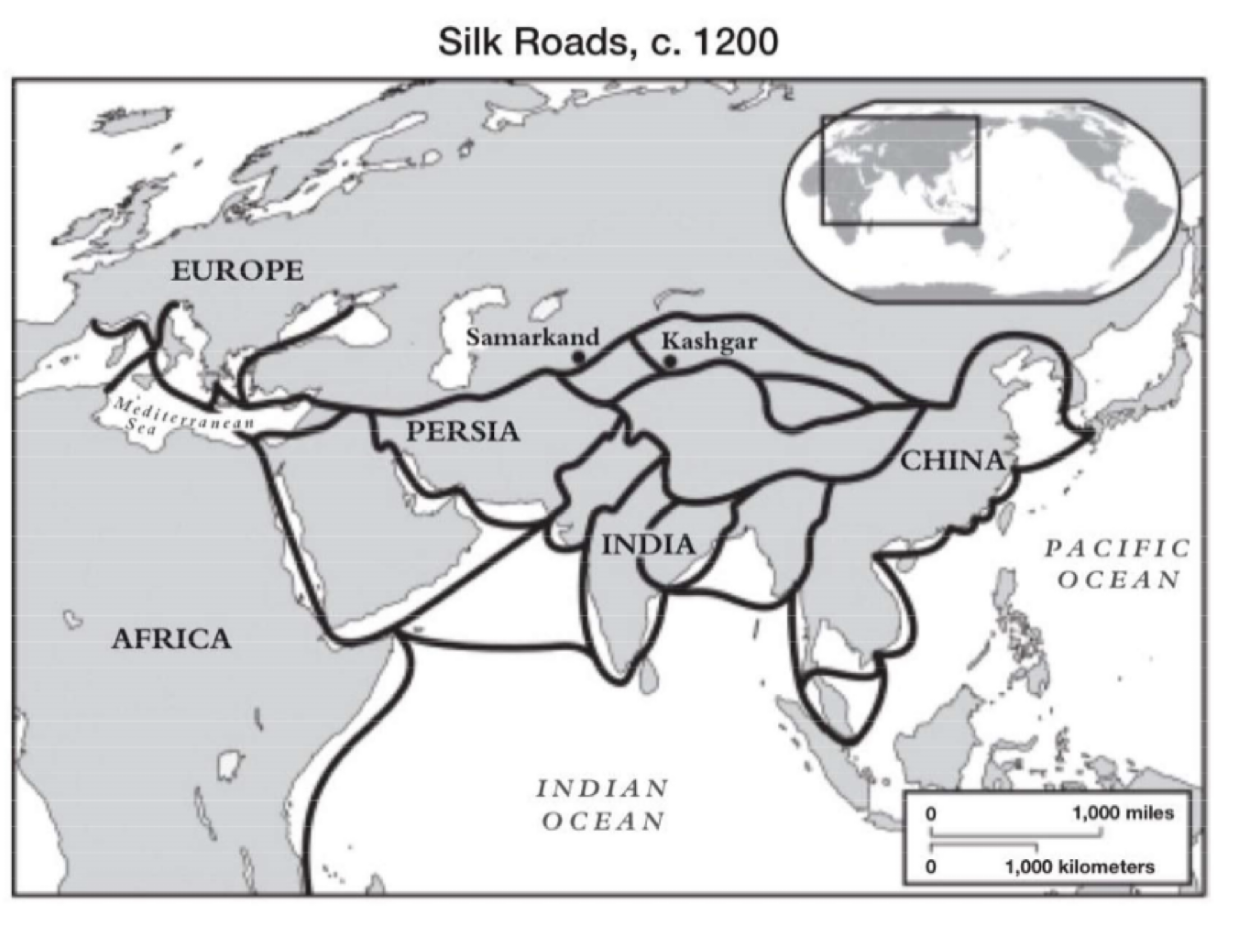
The land route of the Silk Road was vibrant and essential to inter regional trade.
The demand for luxury goods increased in Europe and Africa, Chinese, Persian, and Indian artisans and Merchant expanded their production of textiles and porcelains for exports
Caravans made travel safer and more practical, and the Chinese developed a system using paper money to manage increasing trade.
Inter regional trade on the Silk Roads flourished
Causes of the Growth of Exchange Network
The Crusaded helped pave the way to expanding networks of exchange, as lords and their armies of knights brought back fabrics and spices from the East.
Despite the inroads on the Byzantine Empires by the Ottoman Turks, The Silk Roads trade routes remained in operation, as did sea routes across the Mediterranean Sea and the Indian Ocean.
China was was still eager for Europe’s gold and silver, and Europe was growing more eager than ever for silk, yea and rhubarb.
(Rise of New Empires)
After the collapse of the classical civilization such as the Roman and Han empires, the first Golden age of the Silk Road came to an end, and activity declined dramatically.
The Arab merchants from the Abbasid Empires revived the land route of the Silk Roads as well as sea routes in the Indian Ocean.
B/c of the revival of the Silk Road, Tang China had much to offer the newly revived global trade networks, such as the compass, paper, and gunpowder.
China exported porcelain, tea, and silk.
China imported cotton, precious stones, pomegranates, dates, horses, and grapes.
These luxury goods appealed to the upper class of Chinese society. This period marked the second golden age of the Silk Road.
An Empire that had a significant impact on the expansion of the trade was the rise of the Mongol Empire. The Mongols conquered the Abbasid Caliphate in 1258 and in the 14th cen. China was under their control.
For the first time, unified in a system under the control of n authority that respected merchants and enforced laws.
B/c of this, The Mongols improved roads and punished bandits, both of which increased the safety of travel on the Silk Roads.
New trade channels were also established between Asia, The Middle East, Africa, and Europe.
(Improvements in Transportation Technologies)
The expansion of exchange networks was the improvement of transportation.
Travelers on the overland Silk Roads learned that traveling with others in caravans was safer than traveling alone.
They learned how to design saddles for canals that greatly increased the weight of the load of animals could carry
China played a big role such as advances in naval technology. Which allowed it to control sea-based trades routes in the South China Sea.
They developed the magnetic compass and improve rubber Which aid navigation and ship control along the sea.
Chinese junks were developed and made for rough voyages at sea and less likely to sink.
Effects of the Growth of Exchange Network
Two significant effects of the expansion and stability of the Silk Roads were the series of oases that developed along the routes, including thriving cities, and commercial innovation that greatly helped to manage the increasing trade
(Cities and Oasas)
Long stretches of the overland Silk Roads passed through inhospitable terrain - hot arid lands where water was scarce.
Ex. The city of Kashgat is located at the western edge of China where northern and southern routes of the Silk Road cross.
It sits where the Taklamakan Desert meets the Tian Shan Mountains and it watered by the Kashae River, which has made the lands along it fertile for crops such as wheat, rice, fruits, and cotton.
B/c of this, Traverls became dependent on Kashgar for its abundance of water and food.
Artisans in Kashgar produced Textiles, rugs, leather goods, and pottery.
Food and handicrafts were sold in bustling market.
Once primarily Buddhist city also became a center of Islamic scholarships.
Ex. Samarkand was a stopping point on the Silk Roads between China and the Mediterranean.
It was a center on cultural exchange and trading goods.
It was diverse in religion such as Christianity, Buddhism, Zoroastrianism, and Islam.
It was also known as the center of Islamic learning and magnificently decorated mosques.
(Caravanserai)
Are large flourishing trading cities such as Kashgar and Samarkand, were not the only oases along the arid Silk Road.
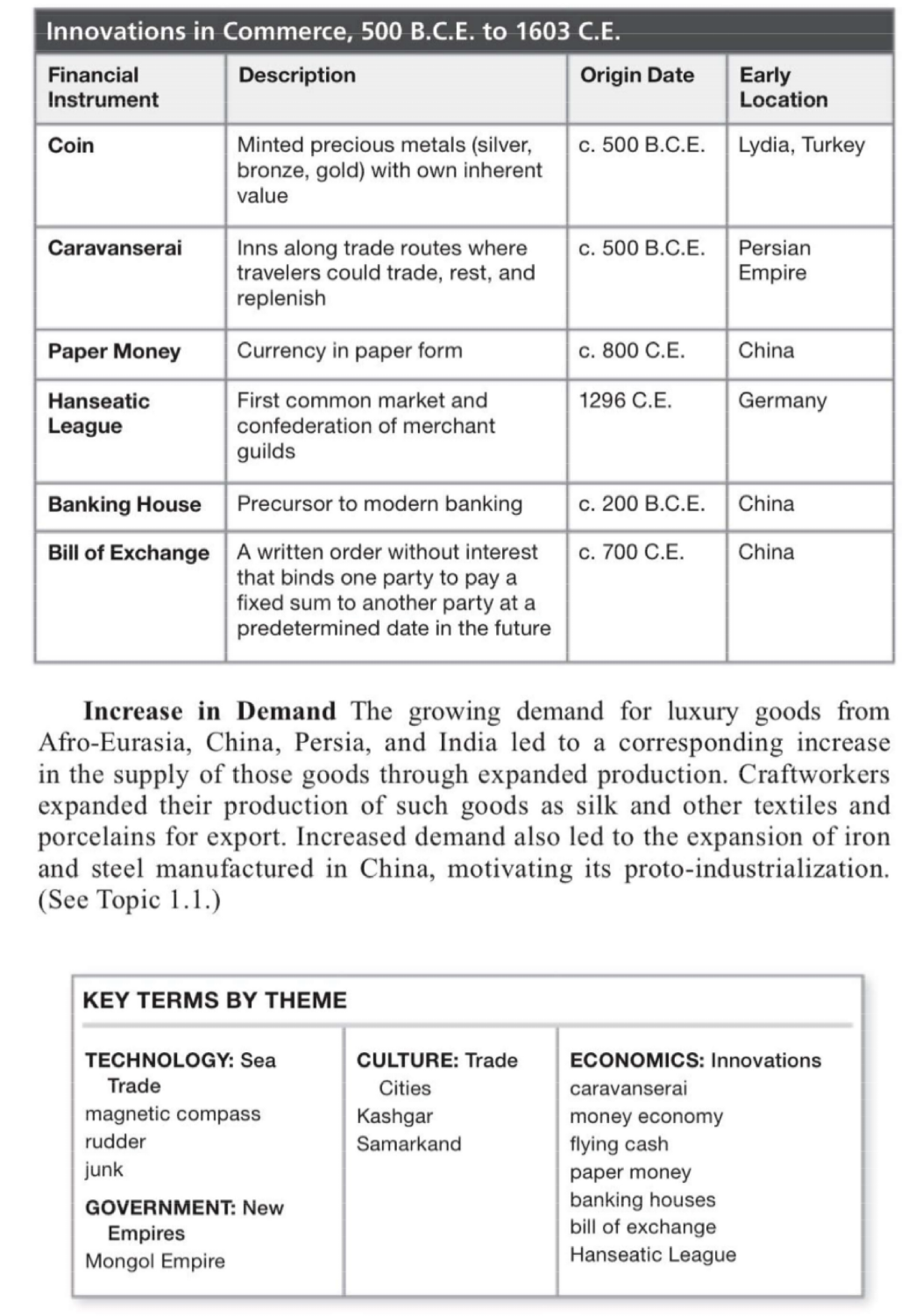
Once the routes of the Silk Roads became stabilized, inns known as caravanserai sprang up,
Caravanserai allowed both travelers and animals to rest themselves and sometimes trade their animals for fresh ones.
(Commercial Innovations)
To manage the increasing trade, China developed new financial system.
B/c China had been a money economy- using money rather than bartering with such commodities as cowrie shells or salt.
They replaced copper coins with paper money.
The government developed a system of credit known as flying cash.
This allowed a merchant to deposit paper money under hid name in one location and withdraw the same amount at another locations
The locations for the exchanging flying cash became banking houses.
Banking houses, a person could present a bill of exchange and receive that amount of money in exchange.
The Crusades awakened European’ interest in luxury goods from Asia so in order to acquire them, they organized the trade of European resources.
They created a commercial alliance called the Hanseatic League.
Their main purpose was to drive out pirates and monopolize trade in goods such as timber, grain, leather, and salted dish.
This league lasted until the mid-17th cen, when national government became strong enough to protect their merchants.
Summary:
Certainly, I can provide a Cornell format summary for your second set of notes:
Main Topic: Growth of Exchange Networks (1200-1450)
I. Economic Expansion and Factors
A. Background and Context
- Economic activity along existing trade routes increased.
- Technological innovation, demand for luxury goods, and imperial expansion were key factors.
- Expansion of trade accelerated cultural, biological, and technological diffusion across Afro-Eurasia.
B. Factors and Expanded Trade
- Rise of powerful states and empires increased trade's volume and geographical reach.
- The Mongol Empire promoted trade along the Silk Roads, creating a vast commercial network.
- Improvement in commercial practices and growing demand for luxury goods.
- Trade routes across the Sahara and Indian Ocean expanded.
II. Consequences of Trade
A. Emergence of Trading Cities
- New trading cities emerged, promoting cross-cultural exchanges.
- Introduction of religious beliefs, technology, and rapid spread of diseases.
- Land routes, especially the Silk Road, were vital to inter-regional trade.
B. Causes of the Growth of Exchange Network
- The Crusades facilitated expanded exchange networks.
- Silk Roads, Mediterranean Sea, and Indian Ocean routes remained operational.
- The mutual demand for goods, such as Europe's interest in silk and China's desire for gold and silver, drove expansion.
- Activity declined after the fall of classical civilizations.
C. Rise of New Empires
- The Arab merchants from the Abbasid Empire revived the Silk Roads.
- Tang China contributed technologies like the compass, paper, and gunpowder.
- Export of goods from China and the Mongols' role in supporting trade.
- The Mongols improved roads, enhancing safety for travelers.
- New trade channels established between Asia, the Middle East, Africa, and Europe.
III. Improvements in Transportation Technologies
- Caravans improved travel safety on the Silk Roads.
- Designing saddles for animals and advancements in naval technology.
- China's role in developing the magnetic compass, naval architecture, and improved rubber.
- The effectiveness of Chinese junks in sea voyages.
IV. Effects of the Growth of Exchange Network
A. Cities and Oases
- Oases along the Silk Road's inhospitable stretches, e.g., Kashgar.
- These areas provided water and fertile lands, fostering trade and cultural exchanges.
- Prosperous cities like Samarkand became centers of religious diversity and Islamic scholarship.
- Introduction of caravanserais, inns that offered rest for travelers and animals.
B. Commercial Innovations
- Introduction of paper money, replacing copper coins in China.
- Development of the flying cash system for managing trade finances.
- Growth of banking houses to exchange flying cash.
- Formation of the Hanseatic League in Europe to organize and protect trade.