Economics Unit 4: Macroeconomics
Aug 31 The Macroeconomic Aims of the Government:
- High/full employment
- Level of employment where there is no demand deficient unemployment (meaning there isn’t enough demand for goods and services, corresponding in reduction in employment.)
- All available labour resources are being used in the most economically efficient way.
- Price stability
- Where prices of g/s are changing slowly
- Prolonged inflation and deflation can harm the economy.
- Economic growth
- Increase in g/s produced by people in the population over a period of time.
- Economic growth is measured in GDP per capita
- Balance of payments stability
- Record of economic transactions between country citizens and rest of the world over a period of time.
- Maintaining a balance in the inflows and outflows of a country.
- Redistribution of income
- Achieving a level of equity in the distribution of income
Sep 4 The Circular Flow of Income
The Circular flow of Income (CFI): The cycle in which income travels, from being earned by producing output, to becoming income and then to being spent on expenditure.
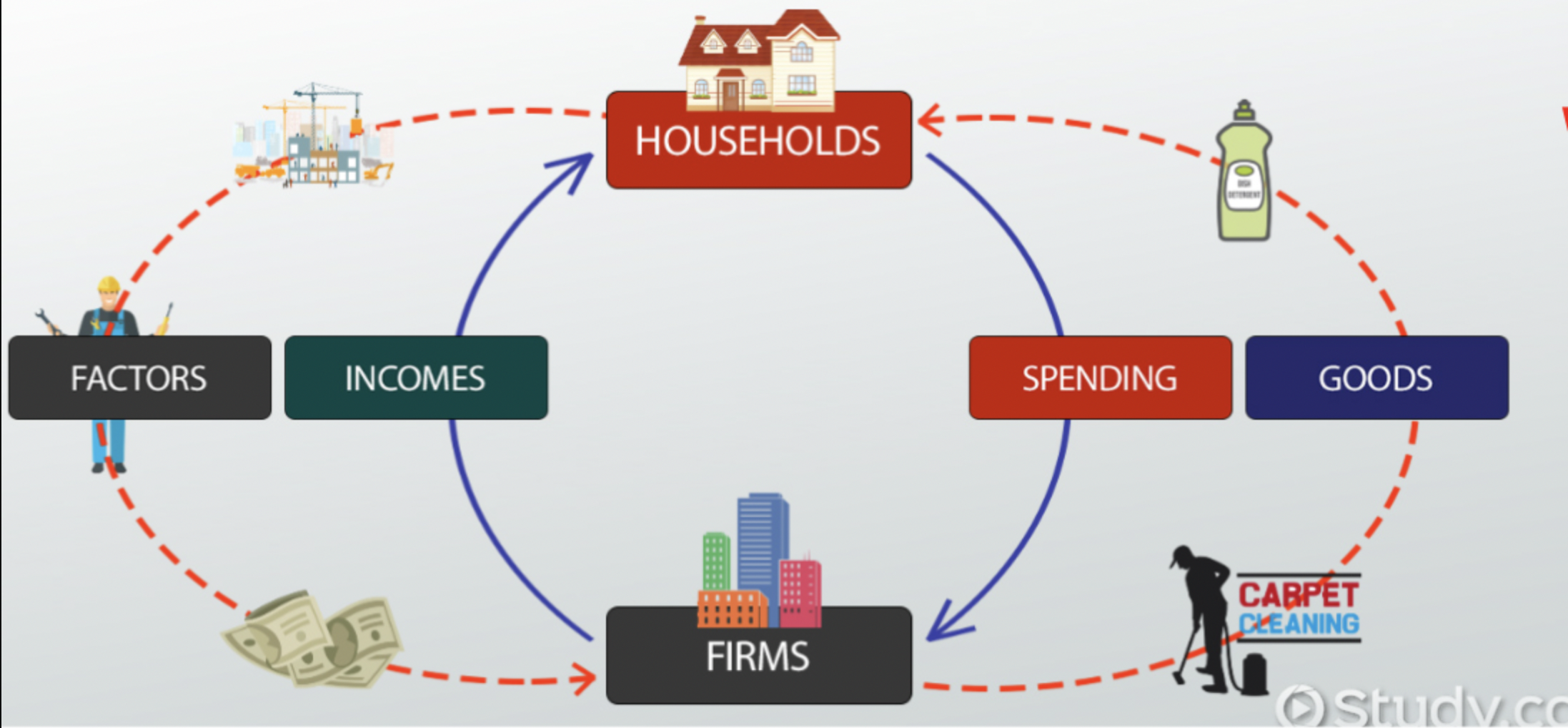
Injections (speeding up the levels of consumer spending): Investment, Government spending, Exports
Injections are money coming from outside the country, E.g exporting goods to a foreign country and getting money in return. This money from outside the country will go into a CFI in the current country. Injections increase the GDP
Withdrawal (slowing down the level of consumer spending) : Withdrawals is taking money out of the country or out of the CFI. Withdrawals can be savings because your not spending or using the money, or importing, getting goods from a foreign country so that money goes into a CFI somewhere else.
M>X means increased GDP
Fiscal Policy: When the government decides to spend either more or less from the taxes. The government does this when they want to increase economic growth or they want to slow down the economy.
Monetary Policy: For example when the GDP falls, they might decrease the interest rates
Sep 7: GDP
Gross Domestic Product (GDP): The measure of the value of all the goods and services in an economy.
GDP is made up of 4 things: Consumer spending, Investment, Government spending, and net exports.
What affects Aggregate demand:
Aggregate demand= C+I+G+(X-M)
Consumer spending: Consumption by households on durable and non-durable goods. (durable: cars nondurable: food.)
Investment: Total spending by firms and capital stock(man made goods used to produce other g/s in the economy.)
Govt Spending: Roads, schools, healthcare, defence.
Net exports: Exports minus imports eg, UK spends 1 billion on coffee in imports, and exports 315 million in coffee, net export is negative.
What affects Aggregate supply:
Sep 11: Taxes and Fiscal Policy 1
Government budget and taxation
Budget: An estimate of expenditure for a set period of time.
A government budget is an annual financial statement presenting the governments proposed revenues and spending for the year.
Balanced Budget (govt) means that the revenue is equal to the expenditure.
Budget surplus: when the govts revenue is greater than the spending
Budget deficit: when teh govts spending is greater than the revenue.
Government Revenue:
- Corporation Tax / Income Tax
- VAT / GST
- Drink and Gambling Duty
- Tobacco Duty / Petrol Duty
- Rents - Government Owned Building
- Business Charges
- Social Security Contributions
- Tariffs on Imports
Government spending:
- Healthcare
- Social security
- Defense
- Infrastructure and transportation.
Direct tax: Paid directly to the government from income wealth or profit, examples are wage tax, inheritance tax, salary tax (reduce your ability to spend)
Indirect tax: Paid on spending g/s to producer
Indirect tax is a reason for a shift on a supply/demand diagram
Indirect tax on a supply and demand diagram:
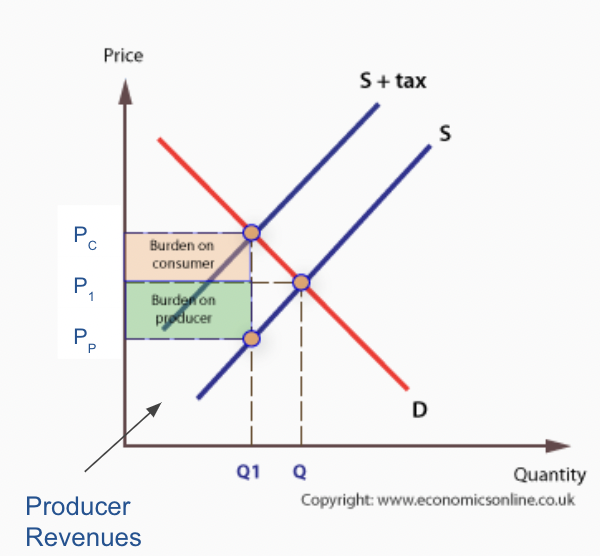
(Pc-Pp)*Q1= government revenue.
Distance of S+tax and S is the tax charged
Sep 14: Taxes and Fiscal Policy 2
Corporate tax: the tax charged on income of company
Types of taxes:
- Progressive tax - affect those with higher income more
- Proportional tax - affect those with lower incomes more
- Regressive tax- affects all levels of income earners equally (mostly indirect tax)
Calculating Progressive tax:
To calculate income tax you must consider all the income brackets. Each income bracket (eg between 0 and 14,000) you have a tax rat, for each of them you have to pay each tax rate based on how much income you earn.
The more income you get the higher tax bracket you jump into. This makes it so that if you earn very little, you pay very little tax.