Evidence for Evolution
Observable Evidence for Evolution
Evolution is not merely a historical theory but a measurable process visible across multiple scientific disciplines. This lecture explores the physical evidence for evolution, including the results of selective breeding, similarities in anatomy and development, molecular consistency across species, and the progressive changes documented in the fossil record. By examining these diverse lines of inquiry, we can understand the mechanisms of 'descent with modification' and the shared ancestry of all life forms.
Artificial Selection:
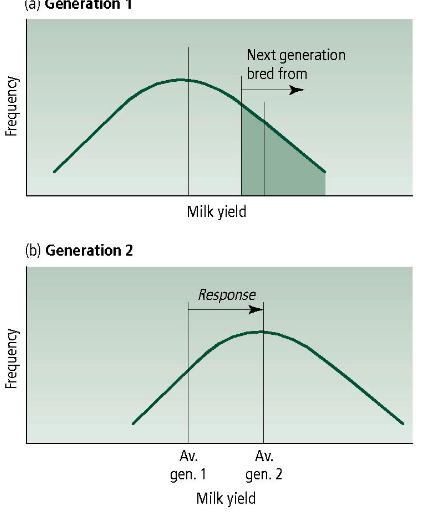
Artificial selection is a process by which humans breed plants and animals for desired traits.
Displays the role of human interference in shaping the traits of these plants.
Frequency Analysis:
Plots comparing the average milk yield across generations illustrate how artificial selection results in significant changes over successive generations.
Displays a notable increase in production capabilities, highlighting the impact of selective breeding.
Human-Induced "Natural Selection"
Red allele is fixed as it is 100% survival
The green allele being dominate
The variability can be revised if selection pressures change
Key Factors
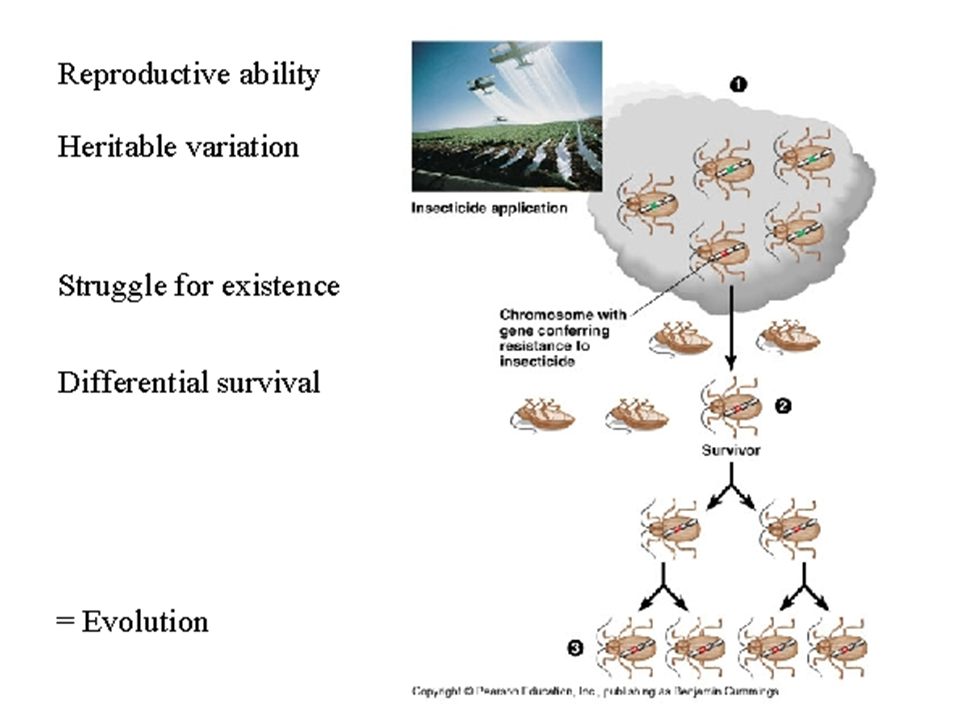
Reproductive Ability: Not only does human intervention occur in breeding, but also in environmental changes (like pollution) that change the dynamics of survival.
Heritable Variation: Variability in traits exists among individuals within a population.
Struggle for Existence: Species compete for limited resources.
Insecticide Application: The use of insecticides can lead to differential survival among insects.
Chromosome: Certain genes conferring resistance to insecticides can lead to population evolution as those with the resistance survive and reproduce.
The Peppered Moth Case Study
This example serves as a classic illustration of natural selection.
Population Changes:
Data series depict the population number of the peppered moth before and after industrialization, how variation can change if selection pressures change.
The change in coloration of the species serves as a clear visual marker against predation in different pollution contexts.
Common Descent and Phenotypic Similarities
The prediction of common descent suggests that species share physical characteristics that indicate a shared ancestry.
Analogous Similarities:
Describes similarities arising from convergent evolution rather than shared ancestry.
Examples:
Sharks, Dolphins, and Whales: All have hydrodynamic shapes due to similar environmental pressures, not due to a common ancestor.
Insects, Birds, and Bats: All evolved wings for flight, highlighting convergence upon similar ecological niches.
Homologous Structures
This section elucidates homologous structures that indicate common ancestry through not functional requirements.
Examples of homologous structures :
Having you “fathers” nose, this has no evolutionary advantage to the size of your nose
Fish from the Devonian period exhibited limbs with varying digits.
No evidence suggests a functional advantage for five digits; their presence supports common ancestry and evolutionary fluke status.
Examples of Adaptations in Plants
Pitcher Plant: Leaves modified to trap insects for nutrients.
Venus Flytrap: Leaves modified into jaws to catch insects.
Poinsettia: Bright red leaves that mimic flower petals, aimed at attracting pollinators.
Cactus: Leaves modified into spines for water retention and protection.
Examples of Vestigial Structures
Wisdom Teeth: Though often problematic, these are remnants of ancestral adaptations.
Appendix: Commonly considered a vestigial structure with no essential function in modern humans.
Coccyx: Remnant of a tail in human evolution.
Palmar Grasp Reflex: A baby reflex that signifies ancestral adaptations.
Comparative Embryology
Insight from Embryology:
Ernst Haeckel's observations point to embryonic similarities
Looked at comparative anatomy
Looking at stages of various species shows shared pathways and development, indicating common descent.
Molecular Homology
Universal Code:
In the context of molecular homology, these points further illustrate the idea of shared ancestry and the haphazard nature of evolutionary development:
The "Frozen Accident" Hypothesis:
This concept, famously proposed by Francis Crick, suggests that the genetic code—the specific way that three-letter DNA codons correspond to amino acids—is largely arbitrary. There is no fundamental chemical reason why the codon GCAGCA must code for Alanine instead of another amino acid.
It is called a "frozen accident" because once this specific code was established in a common ancestor billions of years ago, any mutation that changed the meaning of a codon would have altered every single protein in the organism, which would almost certainly be lethal. Thus, the code became "frozen" in place.
Scientists have successfully manipulated E. coliE. coli to use different or synthetic codons, proving that the standard genetic code isn't the only way life could work; it’s just the one that did happen and was passed down.
STOP Codons and Evolutionary History:
STOP codons (UAAUAA, UAGUAG, and UGAUGA) serve as the "punctuation marks" of the genetic code, telling the cell's machinery where to stop building a protein chain.
These are considered to have "no function" in terms of adding amino acids to a protein. Their existence, along with other non-coding regions of DNA, suggests that the genome is not a perfectly or intentionally designed sequence. Instead, it is a collection of functional instructions and historical "leftovers."
The consistency of these STOP codons across vastly different species provides strong evidence for common descent, as it shows that all life uses the same regulatory mechanisms inherited from a distant ancestor.genetic code is often referred to as a “frozen accident,” which when manipulated in organisms like E. coli, suggests there is no imperative for the current state of genetic coding.
Many codons serve no function (STOP codons), revealing evolutionary history and variability.
Genetic Similarity Across Species:
Humans share approximately 99.9% of their DNA with each other.
Comparisons reveal the genetic continuity across species:
90% with cats
94% with dogs
98.8% with chimpanzees (closest relatives)
60% with fruit flies and bananas.
Only 2% of DNA consists of genes; thus, genetic similarity does not directly equate to physical or functional similarity.
Paleontological Evidence
Fossil Record:
Fossils serve as critical evidence in understanding evolutionary processes, revealing progressive change over geological epochs—from the Paleozoic to the Mesozoic and Cenozoic eras.
Evolution of the Horse:
Detailed evolutionary lineage depicting horses from Hyracotherium (dawn horse) to modern species like the Thoroughbred highlights morphological developments over time.
The timeline illustrates significant evolutionary adaptations aligning with environmental changes throughout epochs, with dates stretching back as far as 55 million years.
Graphical Representation
Illustrated charts reflecting sizes and diversity of equine species project the scaling evolutionary development from ancestral forms to contemporary horses.