Psychological explanations : Psychodynamic explanation
Key terms
Psychodynamic explanations - A group of theories influenced by the work of Sigmund Freud which share the belief that unconscious conflicts, rooted in early childhood and determined interactions with parents, drive future and in this case criminal behaviour.
Psychodynamic Explanations of Offending
The inadequate superego
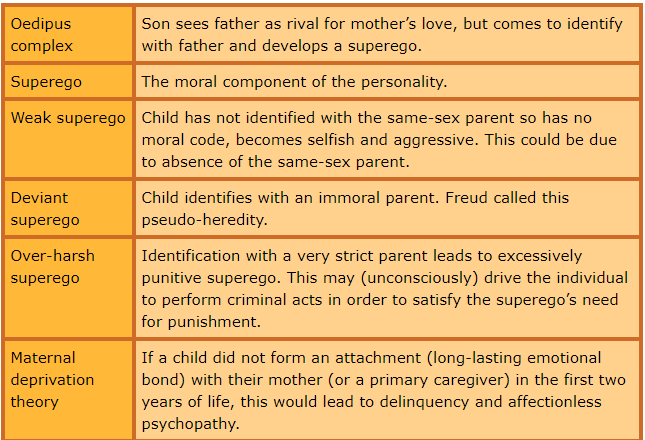
Superego, id and ego make up the tripartite structure of personality. The superego is formed at the end of the phallic stage of development when the children resolve the Oedipus Complex.
The superego works on the morality principle and exerts its influence by punishing the ego through guilt for wrongdoing, whilst rewarding it with pride for moral behaviour.
Ronald Blackburn (1993) argued that if the superego is somehow deficient or inadequate than criminal behaviour is inevitable because the id if given ‘free-rein’ and not properly controlled. Three types of inadequate superego have been proposed.
The weak superego - if the same sex parent is absent during the phallic same, the child cannot internalise a fully-formed superego as there is no opportunity for identification. This would make immoral or criminal behaviour more likely.
The deviant superego - If the superego that the child internalises has immoral or deviant values this would led to offending behaviour. For instance a boy that is raised by a criminal father is not likely to associate guilt with wrongdoing.
The over-harsh superego - A healthy superego is like a kind but firm internal parent: it has rules, but it is also forgiving of transgressions. In contrasts, an excessively punitive or overly harsh superego means that the individuals is crippled by guilt and anxiety. This may (unconsciously) drive the individuals to perform criminal acts in order to satisfy the superego’’ overwhelming need for punishment.
The maternal deprivation theory
John Bowlby (1944) argued that the ability to form meaningful relationships in adulthood was dependant upon the child forming a warm, continuous relationship with a mother-figure. The maternal bond was been by Bowlby as unique, superior to any other and vital to the child’s well-being and development. Failure to establish such a bond during the first few of life means that the child will experience a number of damaging and irreversible consequences in later life. One of these development of a particular personality type, known as affectionless psychopathy, characterised by a lack of guilt, empathy and feelings for others. Such maternally deprived individuals are likely to engage in acts of delinquency and cannot develop close relationships with others as they lack the necessary early experience to do so.
44 Juvenile thieves
John Bowlby (1944) supported his claims with his own investigation of 44 juvenile thieves.
He found that through interviews with the thieves and their families, that 14 of the sample he studied showed personality and behavioural characteristics that could be classified as ‘affectionless psychopathology’.
Of this 14, 12 had experienced prolonged separation from their mothers during infancy (in particular, the first two years of their lives). In a non-criminal group, only two had experienced similar early separation. Bowlby concluded that the effects of maternal deprivation had caused affectionless and delinquent behaviour among the juvenile thieves.
Evaluation
Gender bias
An implicit assumption within Freudian theory is the idea that girls develop a weaker superego than boys. Having not experienced castration anxiety, girls are under less pressure to identify with their mothers (more than boys are with their fathers) so their superego - and consequently their sense of morality - is less fully realised. The implication of this is that females should be more prone to criminal behaviour than males. This is simply not supported by evidence - not least, statistics of the male-female ratio of inmates in prison. In a study where children were required to resist temptation, Martin Hoffman (1975) found hardly any evidence of gender differences, and when there was, little girls tended to be more moral than boys.
Contradictory evidence
There is little evidence that children raised without a same-sex parent are less law-abiding as adults (or fail to develop a conscience). This contradicts Blackburn’s weak superego argument.
Similarly, if children who are raised by parents with pro-crime attitudes go on to commit crime themselves, this could be due to the influence of genetics or socialisation, rather than the formation of deviant superego. Finally, the idea that criminal behaviour reflects an unconscious desire for punishment seems implausible, as most offenders go to great lengths to conceal their crimes which suggest they want to avoid punishment at all costs.
Unconscious Concepts
Psychodynamic explanations in general suffer from a lack of falsifiability. There are many unconscious concepts within Freudian theory mean that applications to crime, such as those considered here, are not open to empirical testing. In the absence of supporting evidence, arguments such as the inadequate superego can only be judged on their face value rather than their scientific worth. For this reason, psychodynamic explanations are regarded as pseudoscientific and may contribute little to our understanding of crime or how to prevent it.
Extra
Methodological issues with Bowlby’s research
Bowlby’s 44 thieves study has been heavily criticised, He has been accused of researcher bias insofar as his preconceptions of what he expected to find may have influenced the responses of his interviewees. Bowlby also failed to draw a distinction between deprivation and privation within his research. Many of the thieves he studied had experience privation, which many commenters consider to be more damaging then deprivation.
Deprivation refers to the loss of attachments through separation (the child has had an attachment).
Privation refers to the lack of attachment (no attachment was ever formed between the infant and his/her mother).
Correlation not causation
Hilda Lewis (1954) analysed data draw from interviews with 500 young people and found that maternal deprivation was a poor predictors of future offending and the ability to form close relationships in adolescence.
Even if there is a link between children who have experienced frequent or prolonged separation from their mothers and committing crime later in life, this does not necessarily indicate a causal link between deprivation and delinquency. There are countless other reasons for this apparent link such a genetic factors and the influence of other people - see as differential association theory. Maternal deprivation may be one of these reasons, but it many not be the only reason.
Confounding variables or third variables are variables that the researcher failed to control, or eliminate, damaging the internal validity of an experiment or correlation.
A third variable is a type of confounding variable, which leads to a mistaken causal relationship between two others. For instance, prolonged periods of deprivation lead to higher rates of delinquency. However, prolonged periods of deprivation do not lead to more crime, but instead the third variable, e.g. having a weak superego or a different brain structure, leads to more crime.