AP Psychology: Modules 22 & 23
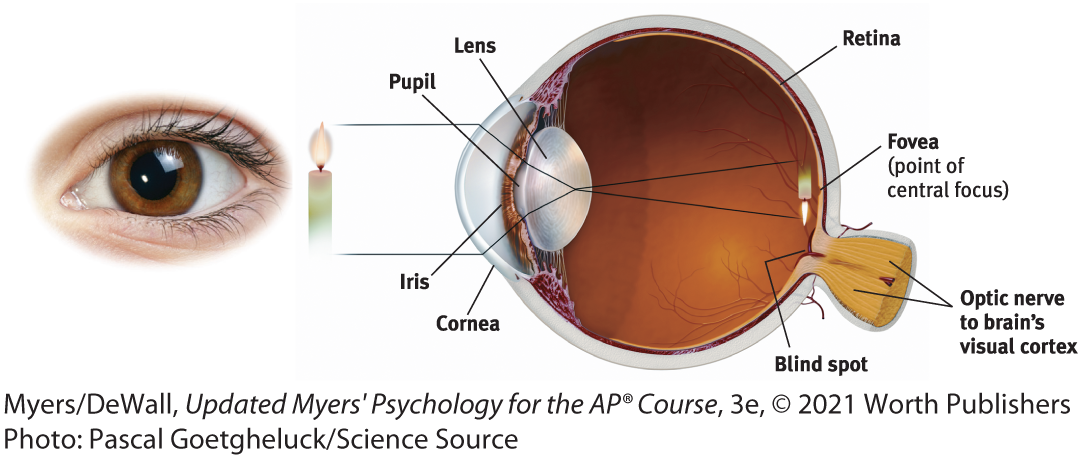
The cornea is the clear, protective outer covering of the eye, covering the pupil and iris.
The pupil is the adjustable opening in the center of the eye through which light enters.
The iris is a ring of muscle tissue that forms the colored portion of the eye around the pupil and controls the size of the pupil opening.
It dilates or constricts in response to changing light intensity.
The lens is the transparent structure behind the pupil that changes shape to help focus images on the retina.
The retina is the light-sensitive inner surface of the eye, containing the receptor rods and cones, along with layers of neurons that begin the processing of visual information.
Transduction!!!
It does not “see” a whole image, but rather its millions of receptor cells convert particles of light energy into neural impulses, which are forwarded to the brain—this forms the images we see.
Accommodation is the process by which the eye’s lens changes shape to focus near or far objects on the retina.
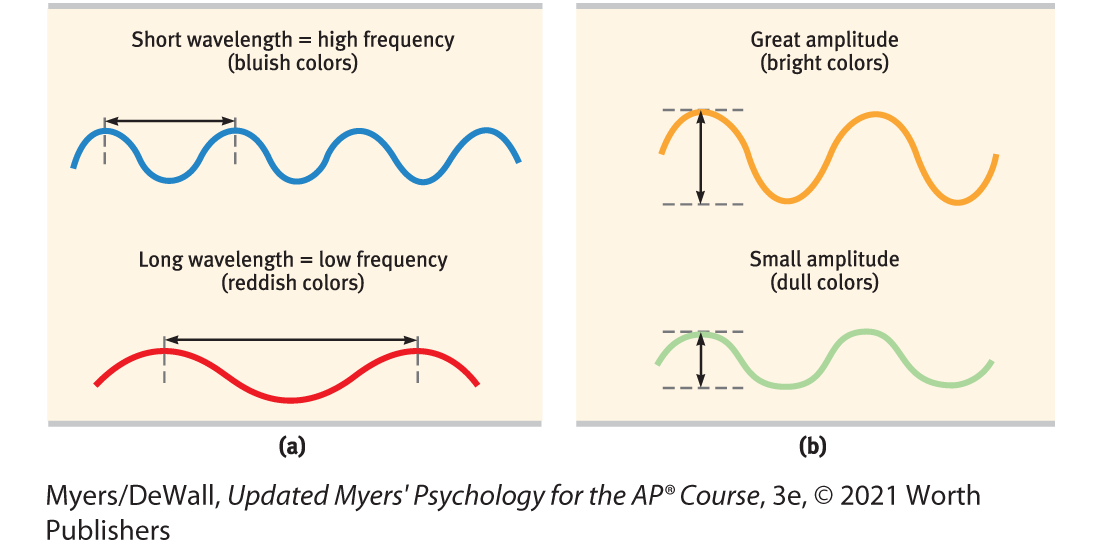
A wavelength is the distance from the peak of one light or sound wave to the peak of the next.
Electromagnetic wavelengths vary from the short blips of gamma rays to the long pulses of radio transmission.
A hue refers to the dimension of color that is determined by the wavelength of light.
It is what we know as blue, green, etc.
Intensity is the amount of energy in a light wave or sound wave, which influences what we perceive as brightness or loudness.
Intensity is determined by the wave’s amplitude (height).
There are two types of receptor cells in the eye: rods and cones.
Rods detect black, white, and gray, and are sensitive to movement; they are necessary for peripheral and twilight vision when cones do not respond.
Cones are concentrated near the center of the retina and function in daylight and well-lit conditions; they detect fine details and give rise to color sensations.
The optic nerve is a nerve that carries neural impulses from the eye to the brain.
A blind spot is the point at which the optic nerve leaves the eye, creating a “blind spot” because no receptor cells are located there.
The fovea is the central focal point in the retina, around which the eye’s cones cluster.
The Young-Helmholtz trichromatic (three-color) theory states that the retina contains three different types of color receptors—one most sensitive to red, one to green, and the other to
blue—which when stimulated, in combination, can produce the perception of any color.
This theory has been confirmed by research years later.
Color blind people lack the ability to process certain color light waves that pass through the retina.
The opponent process theory states that opposing retinal processes (red-green, blue-yellow, white-black) enable color vision.
For example, some cells are stimulated by green and inhibited by red; others are stimulated by red and inhibited by green.
Feature detectors are nerve cells in the brain’s visual cortex that respond to specific features of a stimulus, such as its shape, angle, or movement.
Parallel processing refers to when one processes many aspects of a problem simultaneously; it is the brain’s natural mode of information processing for many different functions, including vision.
The four steps of visual information processing are:
Retinal Processing
Receptor rods and cones —> bipolar cells —> ganglion cells
Light waves reflect off the person and travel into your eyes
Feature Detection
The brain’s detector cells respond to specific features—edges, lines, angles
Receptor cells in your retina convert the light waves’ energy into millions of neural impulses sent to your brain.
Parallel Processing
the brain cell teams process combined information about color, movement, form, and depth
Recognition
the brain interprets the constructed image based on information from stored images.
Gestalt is a German word that means a “form” or “whole” that describes something as an organized whole.
Gestalt psychologists emphasized our tendency to integrate pieces of information into meaningful wholes; they focused on how we group objects together.
Innately, would look at things in groups, not as isolated elements.
Grouping refers to the perpetual tendency to organize stimuli into coherent groups.
Proximity: group objects that are close together as being part of the same group.
Continuity: Objects that form a continuous form are perceived as the same group.
Similarity: objects similar in appearance are perceived as being part of the same group.
Closure: like top-down processing, we fill gaps in if we can recognize it.
Figure-ground refers to the organization of a visual field into objects (figures) that stand out from their surroundings/background (the ground).
Depth perception refers to our ability to see objects in three dimensions although the images that strike the retina a two-dimensional; it allows us the judge distance.
A “visual cliff” is a laboratory device for testing depth perception in infants and young animals.
A binocular cue is a type of depth cue, such as retinal disparity, that depends on the use of two eyes.
Retinal disparity is a binocular cue for perceiving depth—by comparing retinal images from the two eyes, the brain computes distance. The greater the disparity (difference) between the two images, the closer the object.
A monocular cue is a depth cue, such as interposition or linear perspective, available to either eye alone.
The Phi Phenomenon is an illusion of movement created when two or more adjacent lights blink on and off in quick succession.
Perceptual constancy is perceiving objects as unchanging (having consistent color, shape, brightness, and size) even as illumination and retinal images change.
Color constancy is perceiving familiar objects as having consistent color, even if changing illumination alters the wavelengths reflected by the object.
Perceptual adaptation is the ability to adjust to changed sensory input, including an artificially displaced or even inverted visual field.