Muscle contraction
Describe the processes involved in the shortening of.a sarcomere during contraction in a skeletal muscle. Start your answer at which calcium ions are released within the muscle. In your answer you should include an explanation of the roles in calcium ions and ATP.
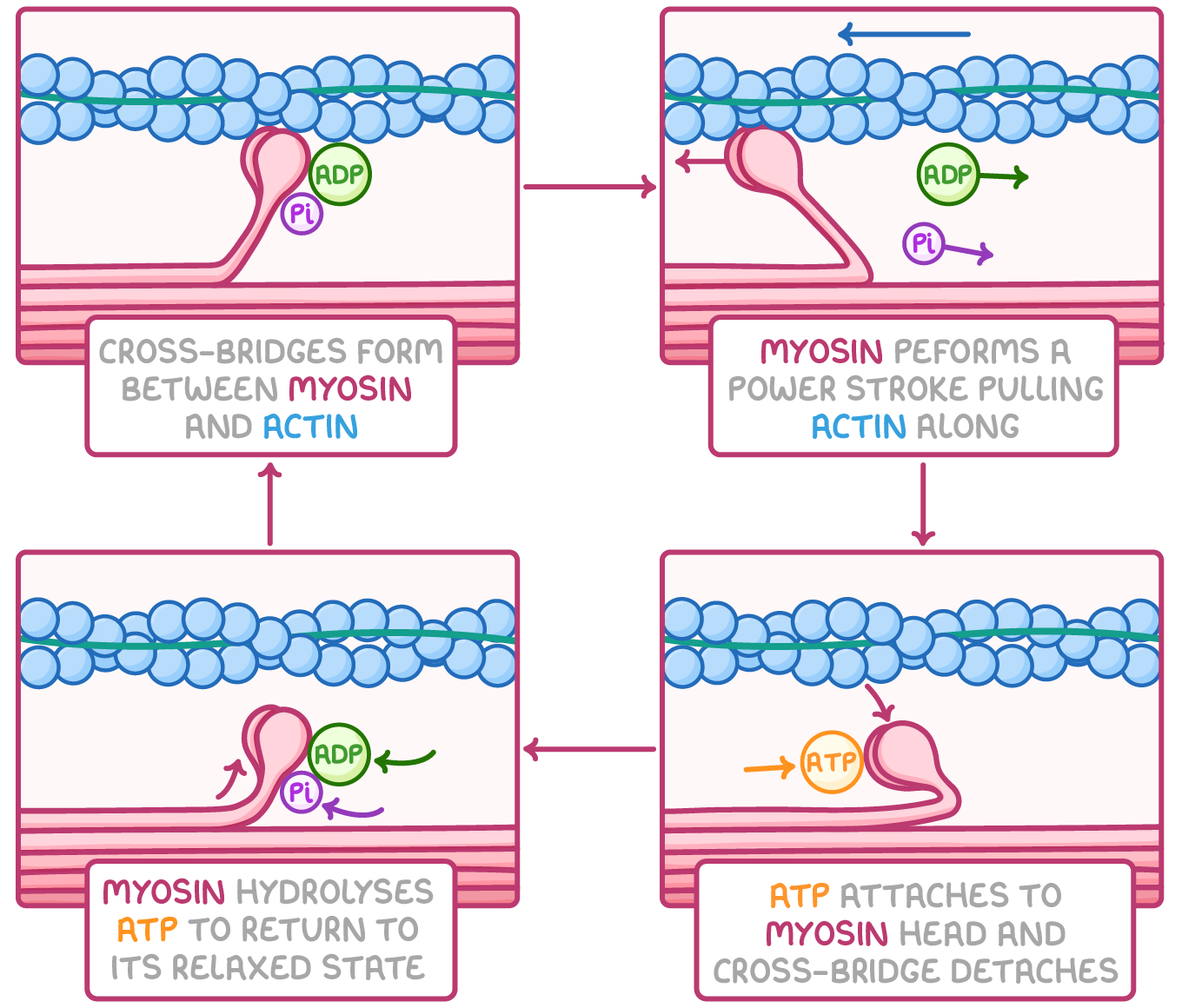
An action potential arrives at the neuromuscular junction. Calcium ions are released from the sarcoplasmic reticulum into the sarcoplasm by diffusion, and they bind to troponin molecules, stimulating them to change shape. This causes troponin and tropomyosin proteins to change position on the actin filaments. Myosin binding sites are exposed on the actin molecules. The globular heads of the myosin molecules bind with these sites, forming cross-bridges between the two types of filament. They then bend and pull the actin filaments towards the centre of the sarcomere, causing the muscle to contract a very small distance. The movement of the myosin heads is known as the power-stroke, and when they bend, it releases a molecule of ATP. ATP then binds to the myosin head, allowing it to detach from actin. The myosin head acts as an ATPase enzyme, hydrolysing ATP into ADP and Pi; the energy released during this reaction allows the myosin head to return to its original position; it can now bind to a new binding site on the actin filaments. They move again, pulling the actin filaments even closer to the centre of the sarcomere and causing the sarcomere to shorten further. As long as troponin and tropomyosin are not blocking the myosin binding sites and the muscle has a supply of ATP, this process repeats until the muscle is fully contracted.