Heart Failure
General
Heart muscles weaken, dilated ventricles swell and can’t pump blood efficiently, heart muscles stiffen due to cardiac and vascular remodeling.
Perfusion (cool) - insufficient delivery of oxygenated blood cells shown by fatigue or decreased cognition. Since no blood flow, affected areas are cool to touch
Congestion (Wet) - insufficient return of blood to heart causes pooling in veins and leakage.Fluid accumulates as peripheral edema or pulmonary edema (lungs SOB) limiting ability of heart to expand
Impaired circulation causes increase in RAAS and sympathetic nervous system straining the heart and causing further damage from attempt to increase circulation and blood pressure
Acute
crisis situation from new or exacerbating factors, develop CHF over time
body is unable to compensate sufficiently to maintain function
goal to prevent immediate death, increase CO and deal with fluid imbalance
Chronic
ongoing situation from (CHF) as a result of overwork and injury
body can compensate to maintain function, but decreases over time
goal protect the heart, decrease CO and damage and deal with fluid imbalance
Acute Decompensated Heart failure
immediate emergency
goal keep patient alive by addressing underlying causes and surgical intervention
decrease fluid accumulation
loop diuretics furosemide, bumetanide, torsemide, ethacrynic acid
high ceiling high doses big response
vaptans conivaptan or tolvaptan → hypernatremia risk
lack of hemoperfusion with inotropes IV agents short ½
milrinone PDE 3 inhibitor
protect and increase cAMP to raise contractility via Ca
dopamine or dobutamine sympathomimetics
B1 and other receptors to raise cardiac activity
nitroglycerin or nitroprusside vasodilators
stimulate heart to maintain perfusion
Treatment Goals
Fluid Removal to reduce congestion and edema, since less fluid to pump and less pressure to push against
diuretics also some minor vasodilation and cardiac remodeling prevention
spironolactone mineralocorticoid receptor antagonist for heart failure
SGLT-2 inhibitors good for heart failure due to control of Ca levels, decreased kidney sympathetic activity, increased RBC production and production of mitochondria
Increase vasodilation to decrease cardiac workload (more heart room)
ACEs/ARBs (anti-RAAS)
Vasodilators
Brain natriuretic peptide (BNP) compensatory anti-RAAS body system. Increase BNP by inhibiting neprilysin enzyme with sacubitril
produced in response to increased BP (ventricular stretching)
Slow Heart rate to reduce stress on the heart and give more time for ventricular filling (more efficient)
ivabradine blocks HCN channel to slow SA node pacemaker thus more effective in rapid heart rate with no contractility affects
beta-blockers
digoxin increases vagal (parasympathetic) effects on AV node, but inotropic (stronger contractions) at higher concentrations
Cardiac Remodeling protection (harmful structural changes)
Anti-RAAS, beta blockers, aldosterone agonists, neprilysin inhibitors, SGLT-2 inhibitors
Neprilysin
Synthetic BNP tried, but not effective
Neprilysin breaks down BNP, angiotensin II, bradykinin and other peptides
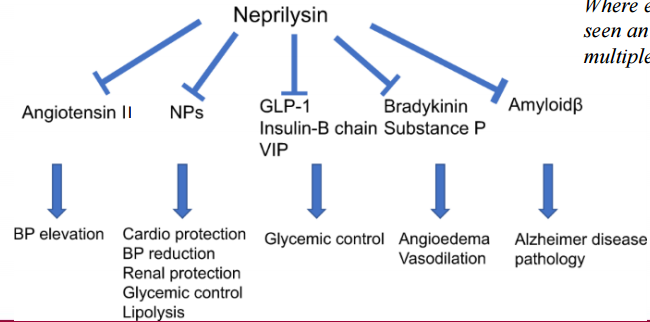
increased Neprilysin will decrease BNP (harmful) and decrease angiotensin II (helpful)
decreased Neprilysin will increase BNP (helpful) and increase angiotensin II (harmful)
co-admin sacubitril with valsartan to counter undesirable angiotensin II increase
Entresto ( ARNI) angiotensin receptor/neprilysin inhibitor