Wk 3: visual search + attentional bottlenecks
3a
visual search
aspect of spatial attention
involves shifts of attention
visual search efficiency can also impact attentional breadth
terms:
serial processing
one process commences only when the previous is finished
sequential
parallel processing
multiple processes occur simultaneously
dimension
complete range of variation which is separately analysed by some funcitonally independent perceptual system
e.g. colour, orientation
feature
a particular value along a dimension
e.g. red, vertical
binding problem
putting together dimension and feature into something meaningful
feature integration theory
pre-attentive processing of single features
basic visual features are processed automatically (without focused attention) and in parallel across the visual field. (e.g. colour, orientation)
features are encoded in separate “feature maps”
analogy: photoshop, separate layers for colour, edges, motion blue. each layer highlights different aspects of the image. to understand the full object, you need to focus on a location and combing layers. attention=glue
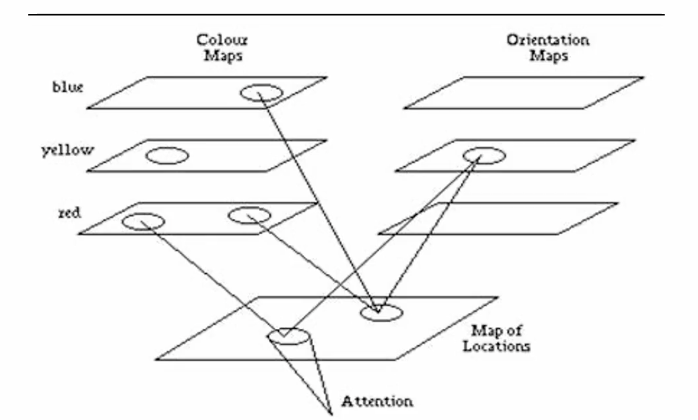
visual search array
targets: searched-for
other items: distractors or non-targets
common dv: RT to detect or identify the target
set size (total no. of items) allows us to infer whether processing is serial or parallel
set size increase=long processing for serial RT
set size change and not processing time change = parallel processing
search for:
single feature (i.e. just red) = parallel
conjunction of features (i.e. red and square) = serial
RT increases with set size and target-absent trials
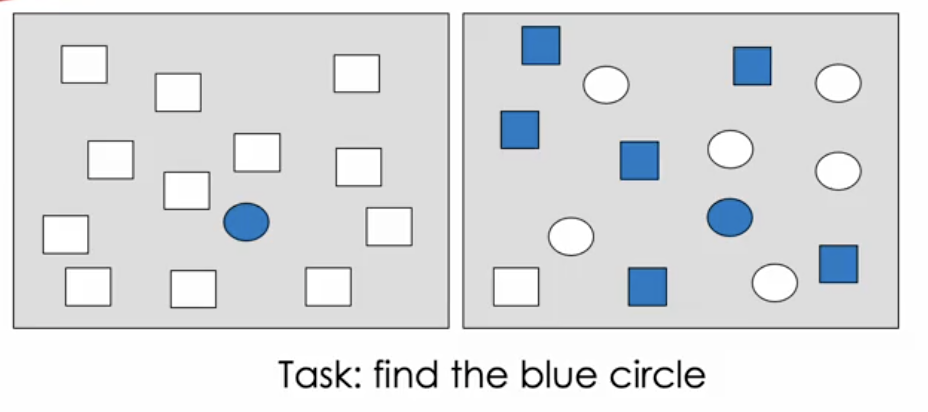
modern: but how similar are distrators from each other
modern: degrees of efficiency, rather than serial vs parallel
Guided search
search is guided by a priority map
what you search for previously, influences what you’re searching for currently
sources combine to form priority map:
top-down - goals and expectations (e.g. I’m looking for a red book)
bottom-up - salient features in the env (e.g. brigh colours, sudden motion)
prior history
reward - learned associations with value
scene syntax and semantics - knowledge of how scenes are typically structured
applied context of visual search
diagnostic medical imaging
baggage screening
humans are much more likely to miss the same target when it occurs in a low-prevalence context than when the same targeam occurs in a high-prevalence context.
i.e. we are more likely to miss a target when it’s chance of appearing is 1%
vs target has a chance of 99% of appearing
questions
how do you think that visual search efficiency impacts attentional breadth?
what attentional breadth would a parallel (more efficient) search induce?
what attentional breadth would a serial (less efficient) search induce?
3B: attentional bottlenecks
attention across time.
attentional blink (AB)
a brief period of impaired perception
occurs after detecting a target in a rapid stream of visual stimuli
a “blink” in attention
experimental setup:
rapid serial visual representation (RSVP)
items flash one at a time at the same location every ~100ms
participants are asked to detect 2 targets in the stream
when you detect T1, resources is taken up
T2 appears ~200-500ms after T1, you’re more likely to miss this
conditional accuracy
T1 can be reliably detected, accuracy high
T2 accuracy low
therefore, temporal bottleneck (limitation in cognitive processing capacity over time)
Stimulus Onset Asynchrony (SOA): time interval between the appearance of T1 and T2
short SOA = bad T2 accuracy (brain still processing/blink period)
long SOA = T2 accuracy recovers
Is the AB an attentional or sensory limitation in processing?
T1 presence influences T2 accuracy
hence it is is in attentional limitation, not perceptual
AB: two-stage model
stimulus detection, holds multiple items but fragile and temporary representation
encoding into a durable, explicity, conscious representation (e.g. short-term memory)
encoding is slow and creates a “bottleneck”
T2 accuracy bad due to encoding stage (stage 2)
how does emotion impact temporal attention
emotional attentional blink
T1 and T2 are both emotionally-salient
threatening stimuli as T2 are less affected by the blink, especially with high anxiety traits
threatening stimuli as T1 can increase the blink, only when participants are asked to judge the emotion (task relevance matters)
emotion-induced blindness (EIB)
T1 and distractor, both emotionally salient
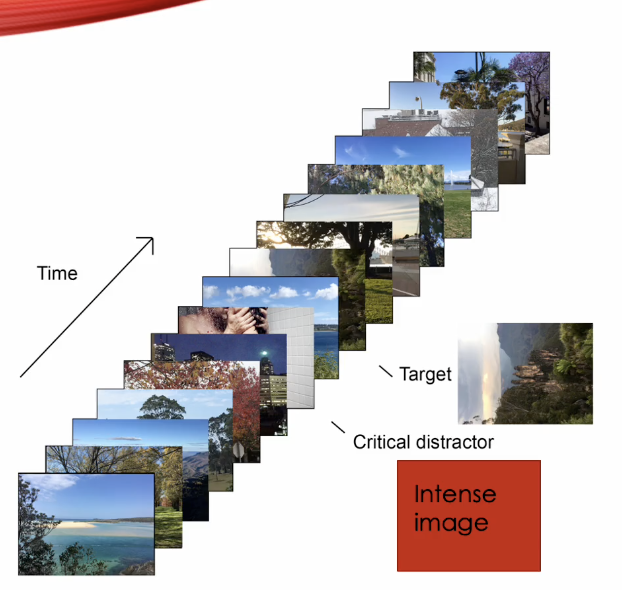
also involves RSVP of images in a single spatial location
lag 2 ~200ms after distractor target appears, accuracy low
lag 8 ~800ms after distractor target appears, accuracy high, similar to emotionally-neutral