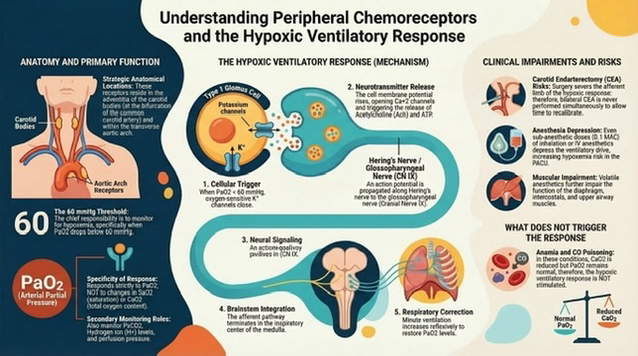
Lesson 21: Peripheral Chemoreceptors Overview
Lesson 21: Peripheral Chemoreceptors
Location: Carotid bodies (common carotid artery bifurcation), transverse aortic arch.
Chief Responsibility: Monitor hypoxemia (PaO2 < 60 mmHg).
Do not respond to SaO2 or CaO2.
Secondary Responsibilities: Monitor PaCO2, H+, and perfusion pressure.
Hypoxic Ventilatory Response
Mechanism:
PaO2 < 60 mmHg closes K+ channels in Type 1 Glomus cells.
Increases resting membrane potential and opens Ca2+ channels.
Increases neurotransmitter release (ACh and ATP).
Action potential propagated via Hering's nerve to glossopharyngeal nerve (CN IX).
Terminates in medulla's inspiratory center; increases minute ventilation to restore PaO2.
Conditions that Impair Hypoxic Ventilatory Response
Carotid Endarterectomy: Severing of the afferent limb leads to recalibration time.
Anesthetics (0.1 MAC): Depress hypoxic ventilatory drive; risk postoperative hypoxemia.
Volatile Anesthetics: Impair diaphragmatic, intercostal, and upper airway muscle function.
Conditions that Do NOT Impair Hypoxic Ventilatory Response
Anemia and Carbon Monoxide Poisoning: Cause reduced CaO2 but typically maintain normal PaO2, thus do not stimulate hypoxic response.