22.2 Enthalpy changes in solution
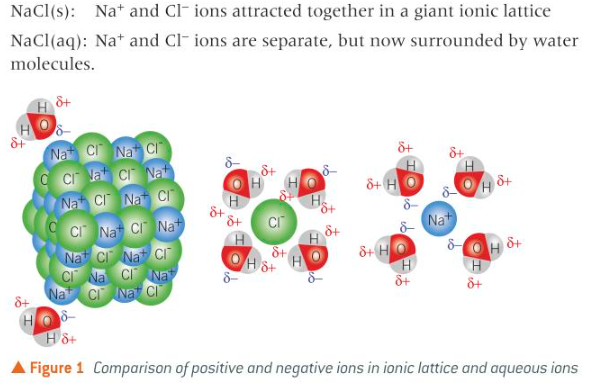
Dissolving ionic compounds - water molecules are able to break up the giant ionic lattice structure and overcome the strong electrostatic attractions between oppositely-charged ions (this happens when salt dissolves in water)
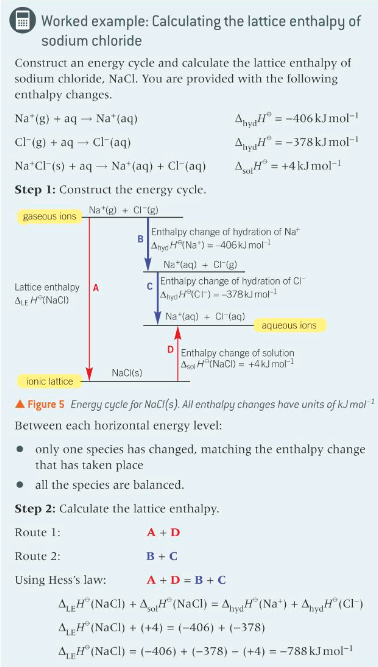
Enthalpy change of solution - the overall energy change associated with the dissolving process.
The standard enthalpy change of solution - is the enthalpy change that takes place when one mole of a substance dissolves in a solvent. If the solvent is water, the ions from the ionic lattice finish up surrounded with water molecules as aqueous ions.

The enthalpy change of solution can be exothermic or endothermic.
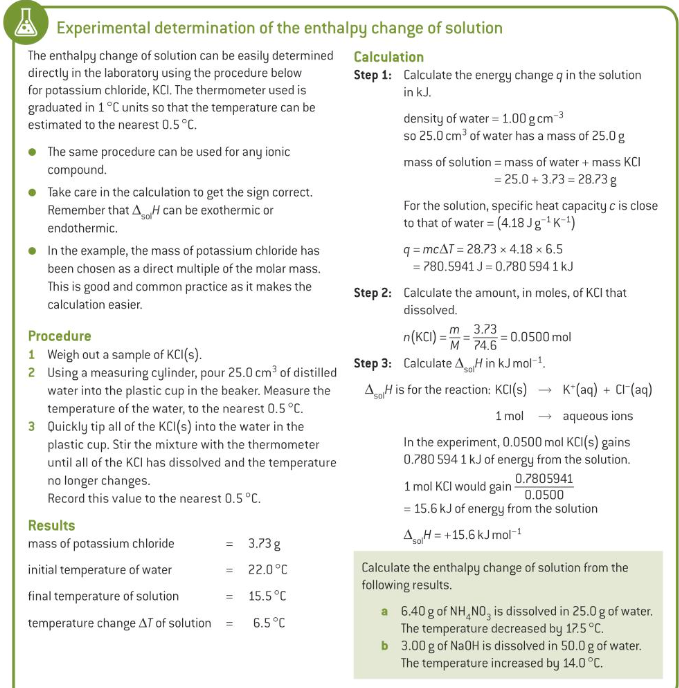
What mass is used in enthalpy calculations?
When using the equation q=mcT, m is the mass that is changing temperature therefore it should be the mass of the solution. e.g. water + dissolved mass
Dissolving process
When a solid ionic compound dissolves in water, 2 processes takes place
the ionic lattice breaks up
water molecules are attracted to and surround the ions
2 types of energy change are involved
1) The ionic lattice is broken up forming separate gaseous ions
this is the opposite energy change from lattice energy, which forms the ionic lattice from gaseous ions.
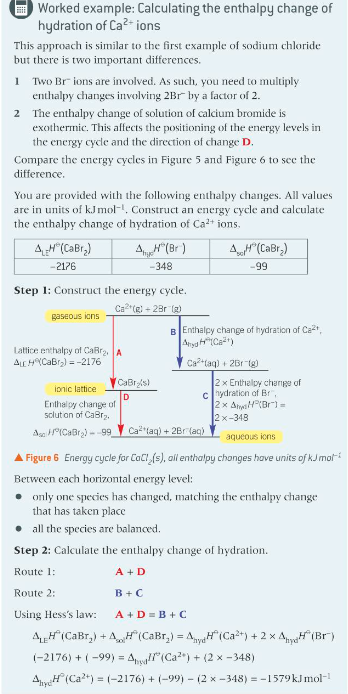
2) The separate gaseous ions interact with polar water molecules to form hydrated aqueous ions. The energy change involved in enthalpy change of hydration.
The enthalpy change of hydration - is the enthalpy change that accompanies the dissolving of gaseous ions in water to form one mole of aqueous ions.
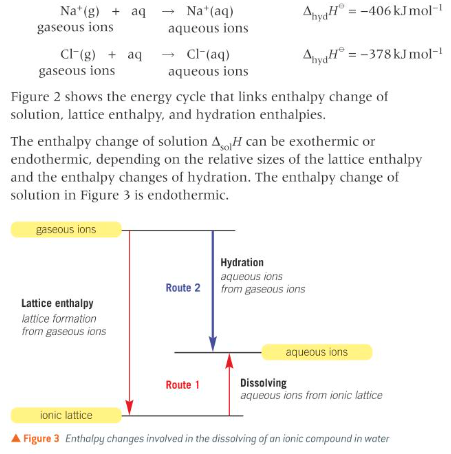
Enthalpy change can be exothermic or endothermic, depending on the relative sizes of the lattice enthalpy and the enthalpy changes of hydration.
Determination of unknown enthalpy changes