MLU test
MLU (Mean Length of Utterance) is a measure used to assess a child's language development by calculating the average number of morphemes per utterance.
What counts as 1 morpheme
Free words: cat, run, the, Mommy
Compound words (learned as one unit): railroad, hotdog, basketball
Proper names (even if 2 words): Big Bird, New York
Diminutives: doggie, horsie, kitty
Irregular past tense (no -ed): went, ate, fell
Irregular plurals: men, children, mice
Catenatives (learned as one chunk): gonna, wanna, gotta
Bound morphemes (add +1 each)
Plural -s: cats (cat + -s)
Possessive ’s: Mommy’s (Mommy + ’s)
Third person singular -s: runs (run + -s)
Regular past -ed: walked (walk + -ed)
Progressive -ing: running (run + -ing)
Comparative -er / superlative -est: bigger (big + -er), biggest (big + -est)
Derivational prefixes/suffixes: unhappy (un- + happy), teacher (teach + -er), kindness (kind + -ness)
Contractions (common rules)
Copula/aux contractions = 2 morphemes: he’s (he + is/has), they’re (they + are), I’m (I + am), we’ve (we + have)
Negative contractions = 2 morphemes: don’t (do + not), can’t (can + not), isn’t (is + not), won’t (will + not)
Let’s = 2: let + us
Don’t count
Fillers/interjections: um, oh, mhm
False starts/mazes: I w- w- want… (count only the final form)
Imitations/rote forms (ABC song, memorized counting) if not spontaneous
Repetitions for emphasis: “No no no!” = 1 morpheme (“no”) unless each adds new meaning
Tricky cases (quick rulings)
“Ice cream”: if treated as a single lexical item by the child, count as 1; if clearly two words, count 2
“All gone/All done”: usually 2 morphemes (all + gone/done), unless transcribed as the unanalyzed form “allgone” and used that way consistently (then 1)
Numbers/dates/names spelled out: each word = 1 morpheme (twenty-one = 1 if written as a lexicalized compound; “twenty one” often 2)
Stutters/part-word repetitions: don’t count the fragments
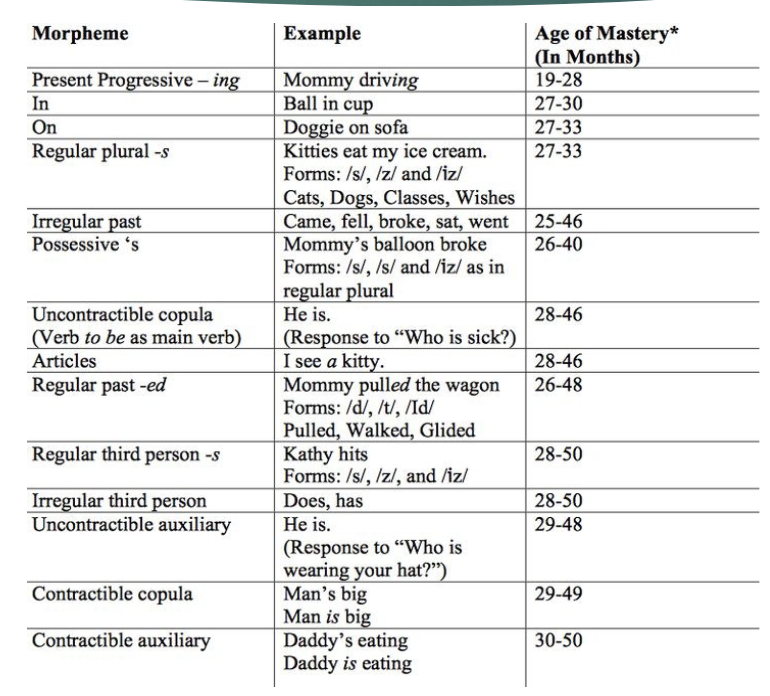
Brown’s classic 14 (helpful for development tracking)
-ing (present prog.)
in
on
plural -s
irregular past (went, came)
possessive ’s
uncontractible copula (He was happy.)
articles (a, the)
regular past -ed
3rd person -s (she runs)
3rd person irregular (does, has)
uncontractible auxiliary (He was running.)
contractible copula (He’s happy.)
contractible auxiliary (He’s running.)
“Mommy’s cookies are baking.”
Mommy + ’s (2) | cookie + -s (2) | are (1) | bake + -ing (2) → 7 morphemes
What belongs in each stage and MLU range for that age:
Stage I (1-2 years, MLU 1.0-1.5): Simple two-word combinations (e.g., "more juice," "big truck")
Stage II (2-2.5 years, MLU 1.5-2.0): Emergence of grammatical morphemes (e.g., present progressive, plural)
Stage III (2.5-3 years, MLU 2.0-2.5): Use of auxiliary verbs and beginnings of complex sentences (e.g., "I am going")
Stage IV (3-3.5 years, MLU 2.5-3.0): More advanced verb forms and compound sentences (e.g., "I want cookies and milk")
Stage V (3.5-4 years, MLU 3.0-4.0): Use of conjunctions and complex sentence structures (e.g., "She said that she is coming").
MLU transcription
My/ want/ kitty mama - 4
yeah- 1
no hamid, he mine doggy- 5
me play dog mama - 4
(cries we dont count it as an utterance)
I wuv peppa -3
Peppa best friend name zoey -5
zoey a zebra -3
Mama, I need go poo-poo now - 6 (she thinks poo-poo, night-night, bye-bye as one)
actually my pooped in my pants - 7 pants are one
nope, my toot/ed - 4
giggled pause
my playing trick on you mama - 7
we count it as a coun because in her lanagueg it is one word such as doggy or peppa or nope
49/11 = 4.5
Don’t is one morpheme
Ten points
PowerPoint slides MLU
Expressive Milesomes
On a Test: from our expressive milestones and what it is, she will say it on the test
Expressive Language Milestones
Birth–3 months: different cries for different needs; cooing, gurgle sounds
3–6 months: vocalizes in response to caregiver imitation; engages in conversational turns; transitional babbling
6–12 months: babbling continues; first word around first birthday; milestone: 1 word (average 5+ words); imitates sounds
12–18 months: adult-like intonation; shows desire by pointing; 3–20 words (early vocabulary growth)
18 months: ~10 words (average 50+ words by later timepoints)
18–24 months: 50–100 words; 24 months: ~50 words; average ~300+ words; 2-word utterances; begin combining words; use pronouns more
Browns stages of development
Brown’s Stages of Development
Stage 1 (12–26 months)
Early: First words (MLU 1.0–1.5)
Late: Word-to-word combos (MLU 1.5–2.0)
Stage 2 (27–30 months)
Elaborating structure, refining meaning (MLU 2.0–2.5)
Stage 3 (31–34 months)
Longer, more adult-like sentences (MLU 2.5–3.0)
Stage 4 (35–40 months)
Phrases & clauses, embedding (MLU 3.0–3.75)
Stage 5 (41–46 months)
Polishing language (MLU 3.75–4.5)
Nuance
> means abandoned: one day my mom wanted to.. oh a butterfly
^ means interrupted: my mom wanted to, omg, there is a fire
x unintelligible: Gibberish words