Chapter 4: Taxonomy and Phylogeny of Animals
[[Linnaeus and Taxonomy[[
Taxonomy: The study of the principles of systematic ordering and naming of organisms
- Part of a broader science of systematics
- Study of variation among animal populations to reveal their evolutionary relationships
- Provides evolutionary biology
- Adjusting system to accommodate evolution has produced many problems
- Carl von Linne
- (Latin pen name: Carolus Linnaeus) (1707-1778)
- Produced extensive system of taxonomy for both plants and animals
- Binomial Nomenclature
- 2 names: genus name + species epithet/name
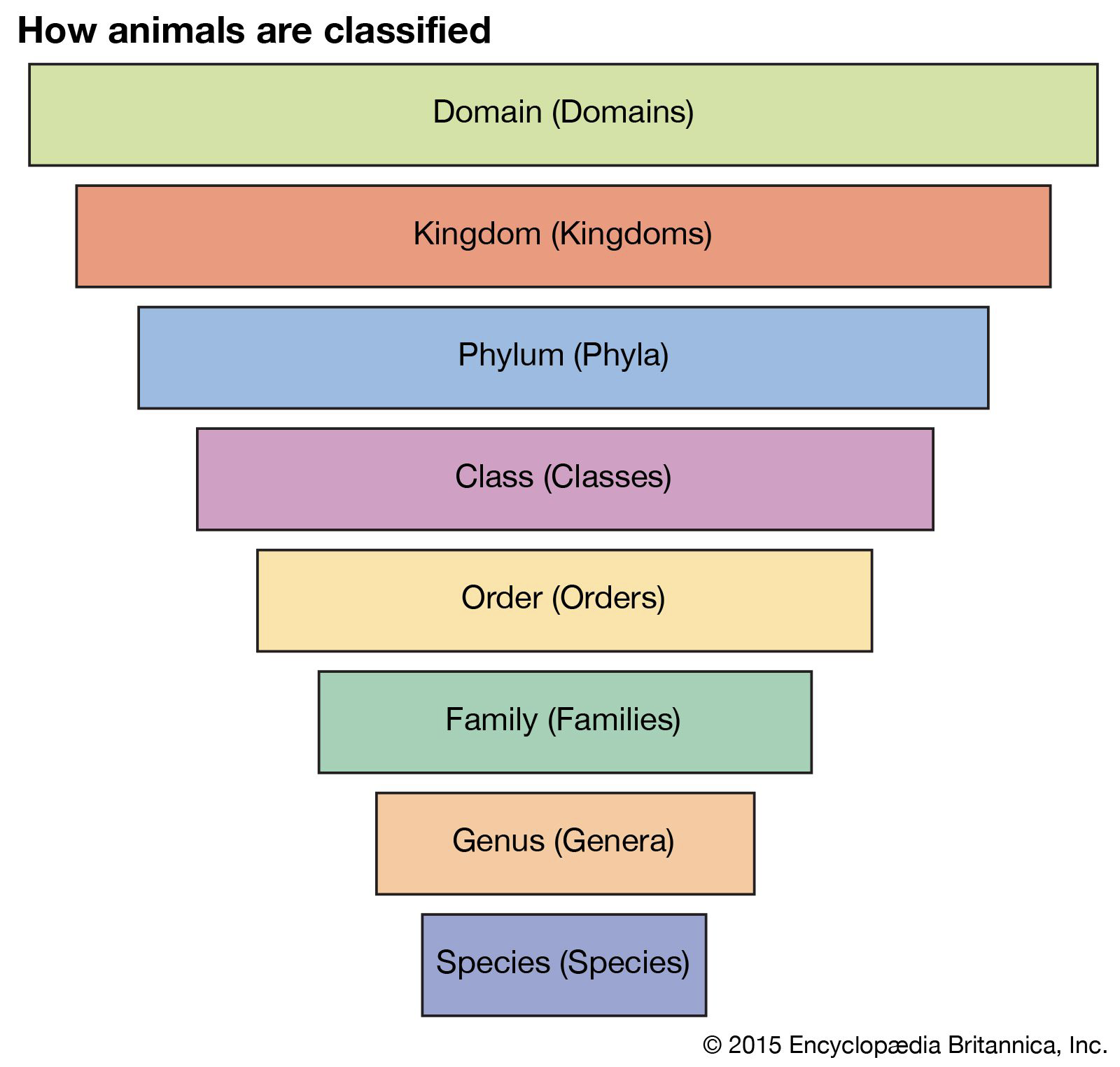
- Species grouped in hierarchical categories
- Taxa (singular: taxon)
# [[Species[[
- Difficult to define
- Important criteria for recognition of species
- Common Descent
- Members of a species must trace their ancestry to a common ancestral population
- Species must be the smallest distinct groupings of organisms sharing patterns of descent and ancestry
- To ID such groupings:
1. Morphological characters 2. Chromosomal characters 3. Molecular characters
- Members of a species must form a reproductive community that excludes members of other species
==Concepts of Species:==
- Most influential: Biological Species Concept
- Inspired by Darwinian evolutionary theory
- “A species is a reproductive community of populations (reproductively isolated from others) that occupies a specific niche in nature.” - Ernst Mayr, 1983
- Species = interbreeding population of individuals having common descent
- Not based on organismal morphology
- But can still help to diagnose biological species
- Variation should be relatively smooth and continuous within species and discontinuous between them
- Criticisms
- Refers to contemporary populations
- How can we trace the temporal duration of a species’ lineage through its past history?
- Example: Humans
- When are human fossils no longer Homo sapiens, but different species?
- Species do not exist in groups of organisms that reproduce only asexually
- How much reproductive divergence is necessary to consider two populations separate species?
Evolutionary Species Concept
- Proposed by George Gaylord Simpson in the 1940s
- Adds evolutionary time dimension to the biological species concept
- “A single lineage of ancestor-descendant populations that maintains its identity from other such lineages and that has its own evolutionary tendencies and historical fate”
- Applies both to sexually and asexually reproducing organisms
- Abrupt changes in diagnostic features mark a boundary between different species in evolutionary time
- Updated in 1989 by Alan Templeton
- Population geneticist
- Included the expectation that populations of a species evolve as a genetically cohesive unit by natural selection and genetic drift
- Cohesion Species Concept
- Any individual in a species is a possible common ancestor of the entire species at some future time
Phylogenetic Species Concept
- Irreducible (basal) grouping of organisms diagnosably distinct from other such groupings and within which there is a parental pattern of ancestry and descent
- Emphasizes common descent
- Both asexual and sexual groups covered
- Any spatially separated population that has undergone character evolution that distinguishes it is recognized as a species
- Would describe a larger # of species than would any other concept
Current disagreements about species definitions are exciting.
- Will lead to enormous advances in biology and fundamental reconsiderations of the meaning of species
==DNA Barcoding of Species==
Does not resolve the definition of species
- Useful for Identifying an unknown organism
DNA Barcoding
- Technique for diagnosing organisms to species using sequence information from a standard gene present in all animals
- COI (cytochrome c oxidase subunit 1)
- Mitochondrial gene
- Standard “barcode” region for animals
- Process
- DNA extracted
- Gene targeted
- Many copies made
- Sequenced
- Sequence checked against a public reference library of identified species (database)
- Can ID unknown species
[[Taxonomic Characters and Reconstruction of Phylogeny[[
Once species are named, how do we decide where each one fits on our tree (phylogeny)?
- Based on characters that vary among species
- Any feature that a taxonomist uses to study variation within or among species
- Can be morphological, chromosomal, and/or molecular
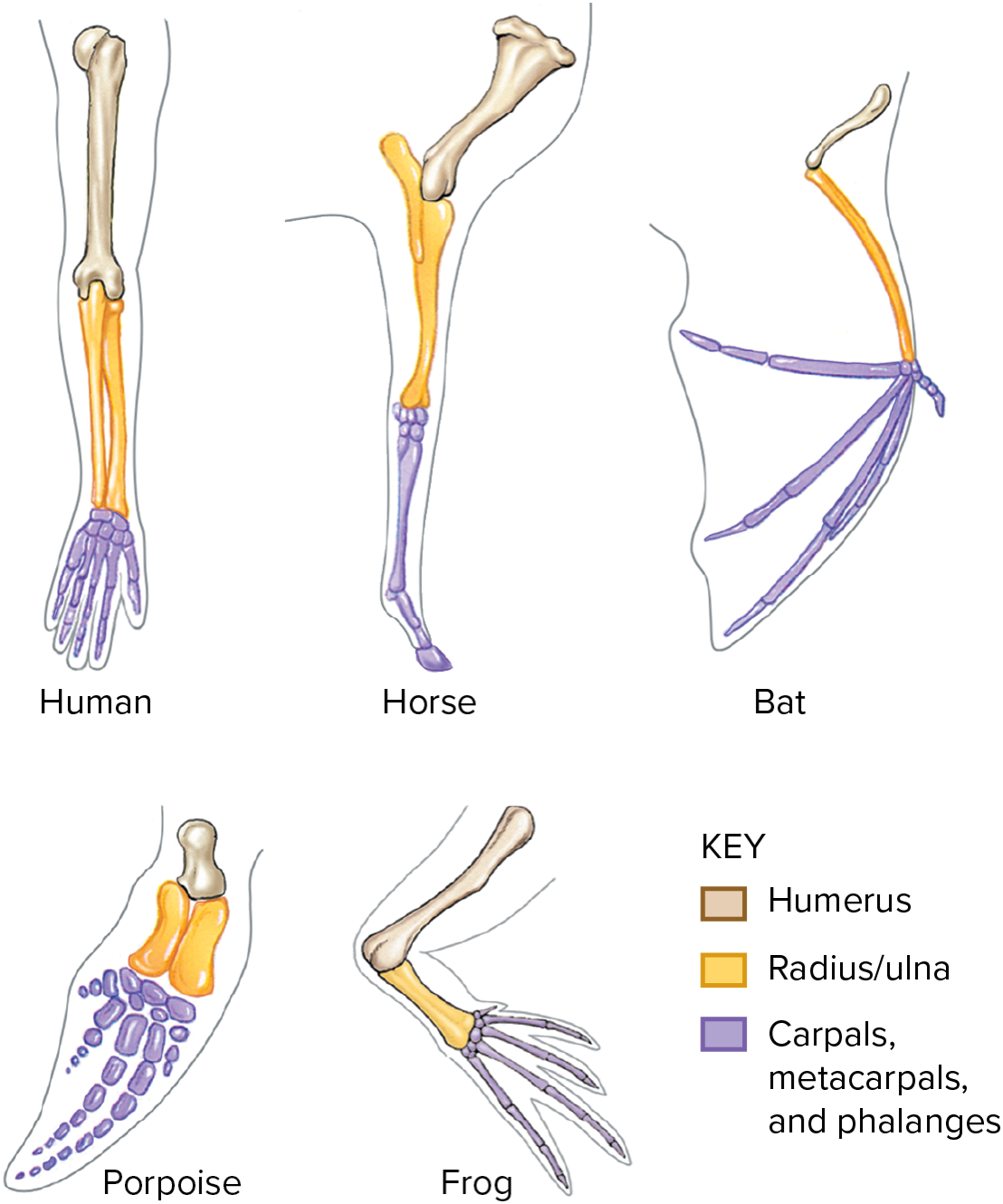
- Homologous characters are useful for constructing phylogenies
- Similar features that are the result of common ancestry
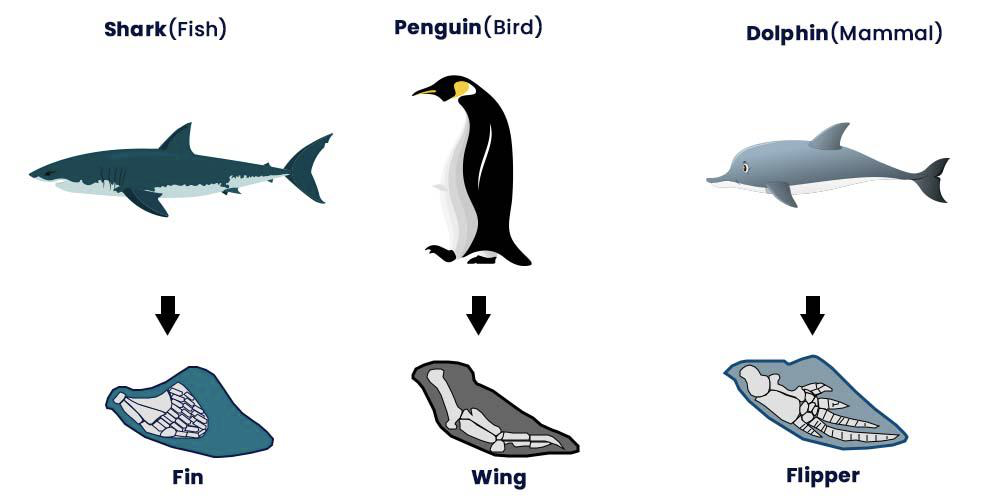
- Similarity does not always reflect common ancestry
- Homoplasy
- Result of independent or convergent evolution
- Analogous Characters
[[Using Character Variation to Reconstruct Phylogeny[[
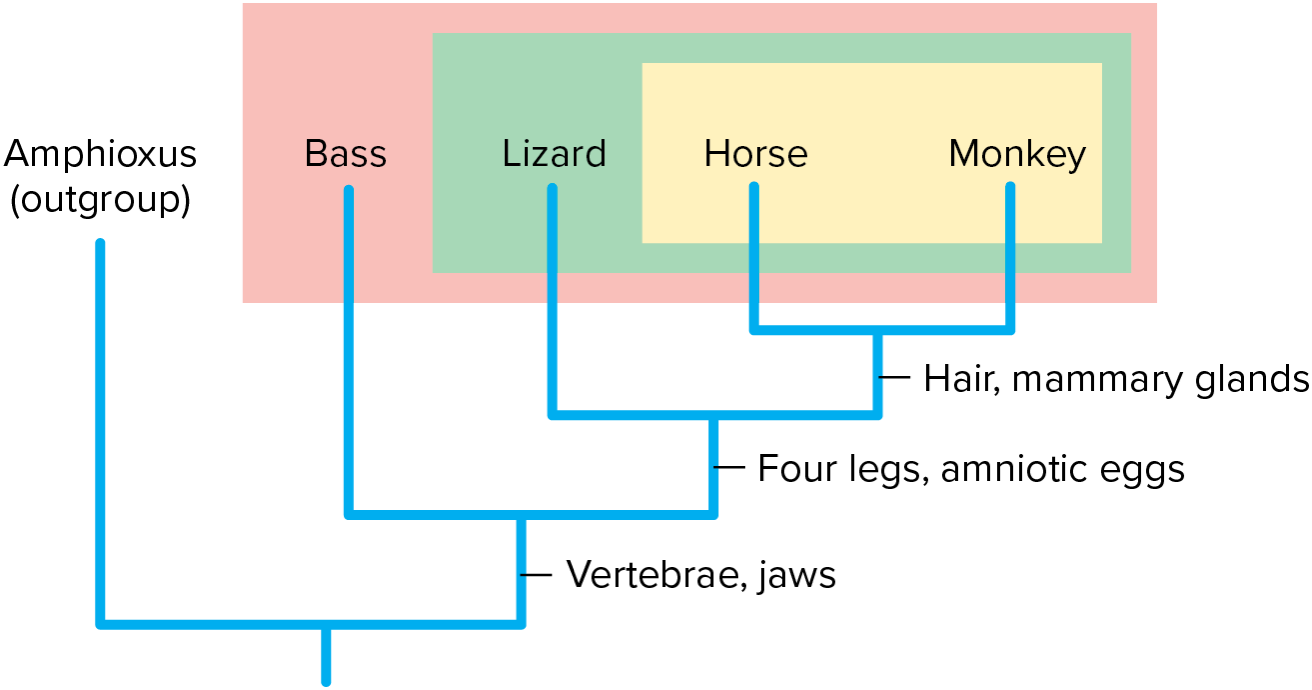
==First Step:==
- For each character, which character state was present in the most recent common ancestor of the entire taxon?
- Ancestral Character State
- Contrasting states = Derived Character States
- Derived characters shared by all members of a clade = synapomorphies
- Clade = fundamental unit of the phylogenetic grouping of species
- Ancestral lineage + all descendants from lineage
- Basic Method
- Compare characters in group of interest (= ingroup) to those of an outgroup
- Reference group
- Known to be related to the study organisms
- Less closely related to any member of the ingroup than the outgroups are to each other
- Ancestral for ingroup
==Next Steps:==
- Use synapomorphies as evidence of homology to infer that a particular group of species forms a clade
- Pattern formed by all synapomorphies within ingroup reveals a nested hierarchy of clades within clades
- Goal: Identify all clades nested within ingroup
- Could reveal the structure of common descent among species
- Diagram = cladogram
- Not the same as a phylogenetic tree
- Needs more info
- Duration of evolutionary lineage, ancestor info, etc.
[[Theories of Taxonomy[[
2 currently popular theories of taxonomy
- Both based on evolutionary and phylogenetic principles
- Difference: how those evolutionary principles are used
- ==Evolutionary Taxonomy==
- Predates phylogenetic systematics
- Retains many aspects of Linnean taxonomy
- Species grouped in a nested hierarchy of increasingly more inclusive higher taxa
- All taxa must:
- Have a single evolutionary origin
- Include the most recent common ancestor of all members of the taxon
- ==Phylogenetic Systematics (cladistics)==
- Developed in the mid-20th century by Willi Hennig
- Emphasizes criterion of common descent
- All taxa must be monophyletic
- Includes common ancestor and ALL descendants
- Members are linked by nested sets of characters that trace the evolutionary history of the group
- These principles underpin cladistics
- Method of investigating evolutionary relationships based on analyses of the distribution of characters
Our Approach:
- Emphasize monophyletic taxa
- Consistent with the criteria of both theories
[[Major Divisions of Life[[
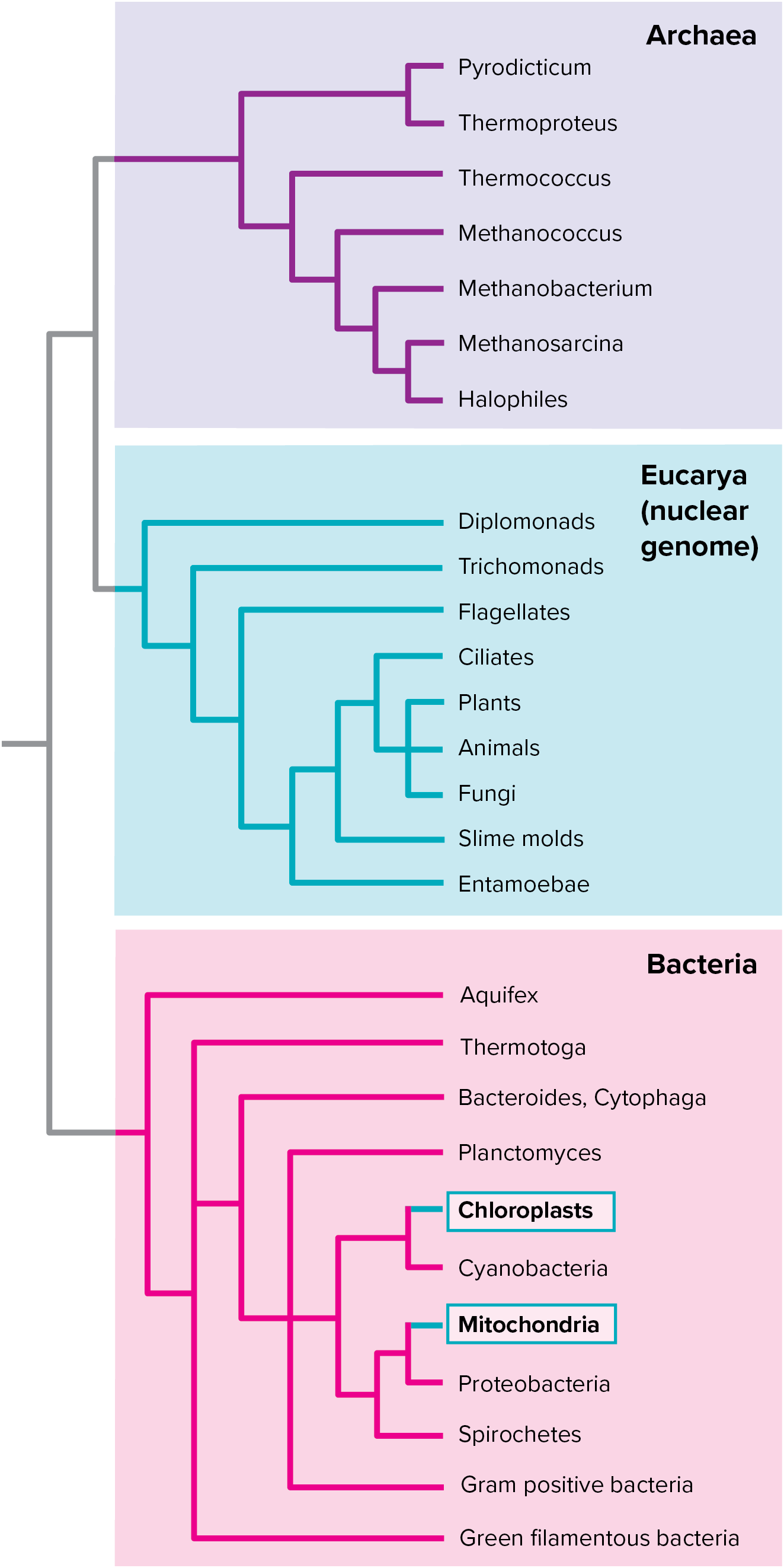
All life is categorized into 3 monophyletic domains:
- Bacteria
- Prokaryotes
- Archaea
- Prokaryotes
- Differ from bacteria in membrane structure and ribosomal RNA sequences
- Eukarya
- All eukaryotes