Derivatives
differentiability and continuity
if f(x) is differentiable, it MUST be continuous
differentiability
f(x) is differentiable at f(s) if and only if…
it is continuous at f(s)
f’(s) exists
f’(s) exists if lim h→s exists; so
lim h→ 0 f(exists
then find the limit of
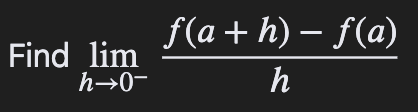
then find the limit of
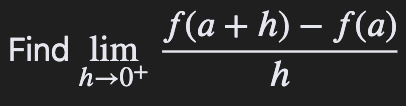
if lim h→ s- = lim h→s+ , then lim h→s exists, and f(x) is differentiable at f(s)
key examples of functions where f’(x) is NOT differentiable
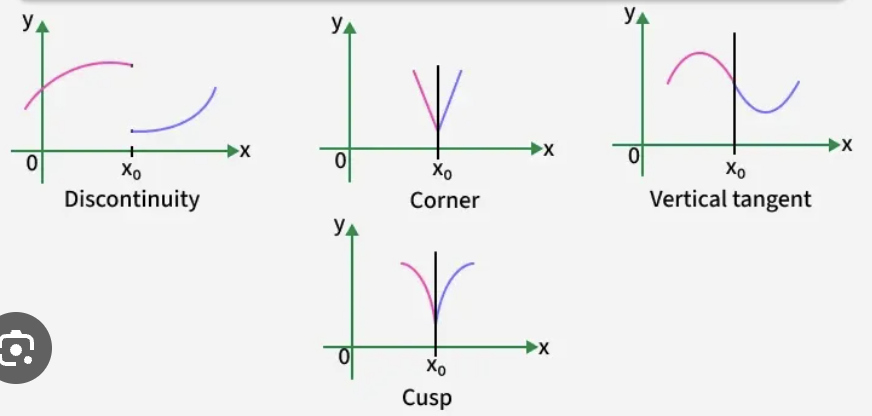
continuity
f(x) is continuous at f(s) if and only if…
f(s) exists; and
lim x→s exists; and
lim x→s = f(s)
derivatives
definition of derivative is…

then add derivative rules from 2/24 lec
notes about exam:
50 minutes
everything from today (2/24) and thursday (2/26) will be on the exam
six questions
multiple choice
each point is about 16.6 points
points are removed for every wrong answer, but less than 16.6 points
there will be a practice exam uploaded today
scientific calculator allowed but not graphing calculator
can bring my own scratch paper
limit definition:
lim x→a f(x)-f(a)/x-a
use this if x is going to a specific point
derivative rules
take notes from lec 2/24; section 2.4
how to compute derivatives
power functions
(xn)’ = nxn-1
also true for fractional and negative powers
example: (x² + 3x5)’ = (x²)’ + (3x5)’ → 2x + 3 × 5x4 → 2x + 15x4
General rules:
f(x) ± g(x))’ = f’(x) ± g’(x)
(sin x)’ = cos x
(cos x)’ = -sin x
notes from lec 2/26
computing derivatives in an efficient way (not using the definition of derivative) cont’d from lec 2/24
section 2.4 i believe
Product rule
(f(x) g(x))’ = f’(x) x g(x) + f(x) x g’(x)
Quotient rule
(f(x)/g(x))’ = (f’(x) x g(x) - f(x) x g’(x))/g(x)2
(lo x d’hi - hi x d’lo)/ lo x lo → lodihi - hidilo/ lolo