Shop and Flight Line Safety
Shop Safety
-Safety is everyone’s responsibility
Safety is everyone’s responsibility. Communication is key to ensuring everyone’s safety. If someone is conducting their actions in an unsafe manner, communicate with them, reminding them of their safety and that of others around them.
Keep the shop, hangars, and flight line clean is essential to safety and efficient maintenance. All areas of the shop should be kept clean and in order.
Signs should designate where any dangerous or hazardous equipment or materials are kept.
Signs should clearly highlight the location of first aid and fire equipment.
Electrical Safety
-Electrical equipment poses inherent hazards
Maintain a healthy understanding of electricity, its use and the potential for hazard. To safely deal with electricity, the technician must have a working knowledge of the principles of electricity and a healthy respect for its capability to do both work and damage.
Fear and overconfidence are major causes of accidents involving electricity. Lack of respect is often due to a lack of knowledge. The technician who does not respect the capabilities of electricity will, sooner or later, become a victim of electricity’s power.
Follow all safety precautions when working on and around electrical components. This can include rubber gloves, glasses, grounded safety mats, etc. Proper protective equipment (PPE) contributes to the overall safety of the technician working on or with electrical equipment.
Electrical Fire Safety
A byproduct of electrical current flow is heat.
Higher heat can cause shorting and fire ignition.
If we use too small of wires, we have too much current going through it, the high heat can cause the installation to break down, which can cause a short circuit.
Prevent fire hazards by:
Keeping workspace uncluttered and clean
Ensure all wires are free from kinks and bends(not small bends but sharp bends)
Closely monitor and repair electrical equipment.
Compressed Gas Safety
-Compressed gas is a strong tool, but it must be used properly.
Inspect hoses for breaks and worn spots before and after use. Unsafe hoses must be replaced immediately.
Keep all connections in a “no-leak condition.”
Maintain in-line oilers, if installed, in operating condition.
Ensure the system has water sumps installed and drained at regular intervals.
Never use compressed air to clean hands, clothing, or spray in the direction of others. Pressure can force debris into the flesh leading to infection.
ALWAYS use proper PPE.
Straighten, coil, and properly store air hoses when not in use.
Use approved pressure regulators and safety cages when servicing tires. Many accidents involving compressed gases occur during aircraft tire mounting. To prevent possible personal injury, use tire dollies and other appropriate devices to mount or remove heavy aircraft tires.
Hazardous Material Safety
-Material safety risk diamonds are important to shop safety
Red=Flammability
Yellow=Reactivity
Blue=Health
White=Special Hazard
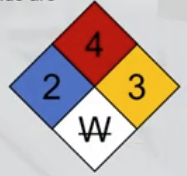
The safety diamond is a four-color segmented diamond that represents flammability (red), reactivity (yellow), health (blue), and special hazard (white). In the flammability, reactivity, and health blocks, there is a number from 0 to 4.
Safety Data Sheet (SDS) is the more detailed version of the chemical safety issues. These forms have the detailed breakdown of the chemicals, including formulas and action to take if personnel come in contact with the chemicals.
All sheets have the same information requirements; however, the exact location of the information on the sheet may vary depending on the SDS manufacturer.
These forms are necessary for a safe shop that meets all the requirements of the governing safety body, the U.S. Department of Labor Occupational Safety and Health Administration (OSHA).
Tool Accountability
Care should be taken to keep tools organized and accounted for.
There is no “best way” and requires a company-wide approach.
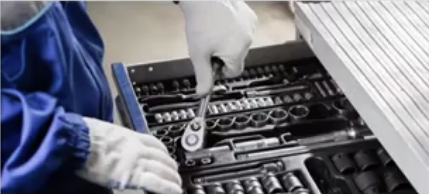
-A shadowed toolbox is one way to achieve organization
Organization Considerations
Precision tools requiring regular calibration should be handled with the utmost care.
Hardware and parts used on aircraft usually require traceability, airworthiness certifications and sometimes have a shelf life.
Parts must be segregated between aircraft, so one part is not inadvertently installed on the wrong aircraft.
Machine Tool Safety
Always wear PPE
Secure the work to prevent movement
Set proper speed
Do not force objects through the machine
Keep loose clothing or long hair tied back
Do not reach around or into moving equipment
When welding, remain aware of the fire hazards
Flight Line Safety
-The flight line can be a dangerous area, it is crucial you are aware of your surroundings.
Always wear proper PPE
NO SMOKING permitted on the flight line
NEVER assume a pilot can see you
Be aware of moving parts on airplanes and helicopters, and support equipment.
Propellers, flight controls, inlets and exhaust
Identify fire hazards and have a plan for fire extinguishment
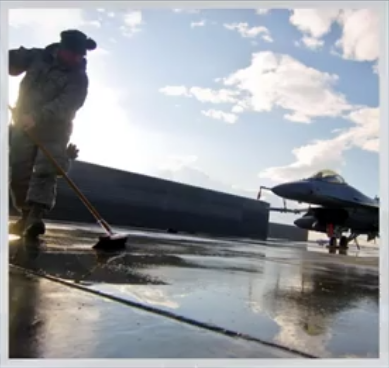
Foreign Object Debris (FOD) and Reporting
Foreign Object Damage (FOD) or Foreign Object Debris is the result of objects that aren’t supposed to be in or around an aircraft.
FOD can cause major damage to an aircraft
FOD Scenarios
-Debris can be ingested via:
Stones, bird, ice, etc.
Poor tool/hardware accountability

FOD Prevention and Reporting
Inspect aircraft operation areas
Misplaced tools
Stones
Trash
If a FOD incident occurs, the aircraft should be fully inspected thoroughly according to manufacturer recommendations