MGT final section b, c
Short Answer Questions (SAQ)
I. Change and Change Management
1. The Calm Water Metaphor (Lewin's Three-Step Change Process):
Changes are planned and happen step by step. It is suitable in stable environment.
Unfreezing: This is the preparation stage for needed change. Old habits, attitudes, or processes are challenged to show why change is necessary.
Example: A company explains to employees that new software is required to keep up with competitors.
Changing: In this step, the actual change is implemented. New processes, systems, or behaviours are introduced.
Example: Training employees to use the new software and starting its use across departments.
Refreezing: After the change is implemented, this step ensures it becomes the new norm. New habits are solidified to prevent reverting to old ways.
Example: Establish guidelines and regular checks to ensure everyone uses the new software correctly.
2. The White-Water Rapids Metaphor:
Changes are constant and unpredictable. It is suitable in dynamic and fast-changing situations. Organizations must be flexible and ready to adapt quickly.
Example: A company in the technology sector must continuously update its products and services to match fast-changing market demands.
Advantages and Disadvantages of The Calm Waters and White-Water Rapids Metaphors
Aspect | Calm Waters Metaphor | White-Water Rapids Metaphor |
Advantage | - Predictable and structured: Emphasizes planning and gradual change, ensuring stability. | - Prepares for uncertainty: Encourages adaptability and quick decision-making in dynamic environments. |
Example: A company in a stable market uses a well-thought-out 5-year plan to introduce new products. | Example: A tech startup in a fast-changing industry constantly adapts its products to market trends. | |
Disadvantage | - Fails in dynamic environments: Struggles to address rapid or unexpected changes. | - Stressful and chaotic: May overwhelm employees and lead to burnout or poor coordination. |
Example: A traditional retail store loses out to e-commerce due to slow adaptation. | Example: Employees in a startup face exhaustion from constant pivoting without clear direction. |
II. Organizational Development (OD)
1. Areas of Organizational Change:
People: Improving employee attitudes, skills, or teamwork through OD (organisational development).
OD (Organizational Development)
change method that focuses on people and the quality of interpersonal work relationships. It increases the effectiveness and efficiency of the company.
The techniques of OD :
Sensitivity Training
What it means: A group of people talk openly to understand and improve how they interact with others.
Example: A manager organizes a workshop where employees discuss how their behaviour impacts others, like being too direct.
Team Building
What it means: Activities help team members understand each other's strengths, weaknesses, and work styles.
Example: A team does a fun activity like a problem-solving game to learn how to cooperate better.
Survey Feedback
What it means: Employees fill out surveys to share their opinions, and the results are discussed to solve issues.
Example: A company surveys employees about job satisfaction, finds complaints about communication, and holds meetings to address it.
Process Consultation
What it means: A consultant observes how a team works and gives advice to improve communication and teamwork.
Example: A consultant notices that meetings are disorganized and suggests a clear agenda and roles for better efficiency.
Intergroup Development
What it means: Helps groups in a company reduce misunderstandings and improve cooperation.
Example: Two departments that often argue about deadlines participate in a session to clarify expectations and improve collaboration.
III. Human Resource Management (HRM)
Human Resource Management (HRM):
The management function focus on getting, training and keeping competent employees. It's about having the right people in the right place at the right time.
Importance of HRM :
Source of competitive advantage.
Important part of organisational strategies, with success achieved through people. Requires a shift in mindset where employees are treated as partners, not just costs.
Significantly impacts organisational performance.
External Factors That Affect the HRM Process (DLLE)
The Economy
The economy affects jobs and salaries.
Example: During the 2008 recession, companies laid off employees to save money. In contrast, businesses may struggle to hire skilled workers when the economy is strong. The COVID-19 pandemic also caused many job losses when businesses shut down.
Labour Unions
Unions represent workers and negotiate terms like pay, promotions, and work conditions.
Example: In unionized workplaces, HR must follow rules set by collective agreements, such as who gets hired or promoted.
Laws and Regulations
HR practices must follow laws to avoid discrimination and legal trouble.
Example: Companies must treat all employees fairly, regardless of race, gender, age, or disability, in hiring, pay, or training decisions.
Demographics
Changes in workforce characteristics affect how HR manages employees.
Example: As more older workers (like the baby boomer generation) stay in jobs, companies like BMW redesign workplaces to make tasks easier, such as using tools that reduce physical strain.
Traditional Training Methods (MJWCO)
On-the-job training: Employees learn by doing tasks after a brief introduction.
Example: A cashier learns by working at the register.
Job rotation: Employees work in different roles to learn various tasks.
Example: A new manager works in sales, customer service, and inventory to understand all areas.
Mentoring and coaching: An experienced employee guides and supports a new employee.
Example: A senior engineer teaches a junior engineer how to handle projects.
Experiential exercises: Employees engage in activities like role-playing or simulations.
Example: Sales staff practice pitching to customers in a simulation.
Workbooks/manuals: Employees use printed materials to learn.
Example: Reading safety guidelines from a handbook.
Classroom lectures: Employees attend lectures to learn specific information.
Example: A trainer gives a presentation on customer service techniques.
Technology-Based Training Methods (PVE)
CD-ROM/DVD/Podcasts: Employees watch or listen to pre-recorded training materials.
Example: Watching a DVD on machine safety.
Videoconferencing/Teleconferencing: Employees join live sessions remotely to learn.
Example: Attending a webinar on teamwork skills.
E-learning: Employees complete interactive online modules and activities.
Example: Using a website to practice troubleshooting software.
Key HRM Functions:
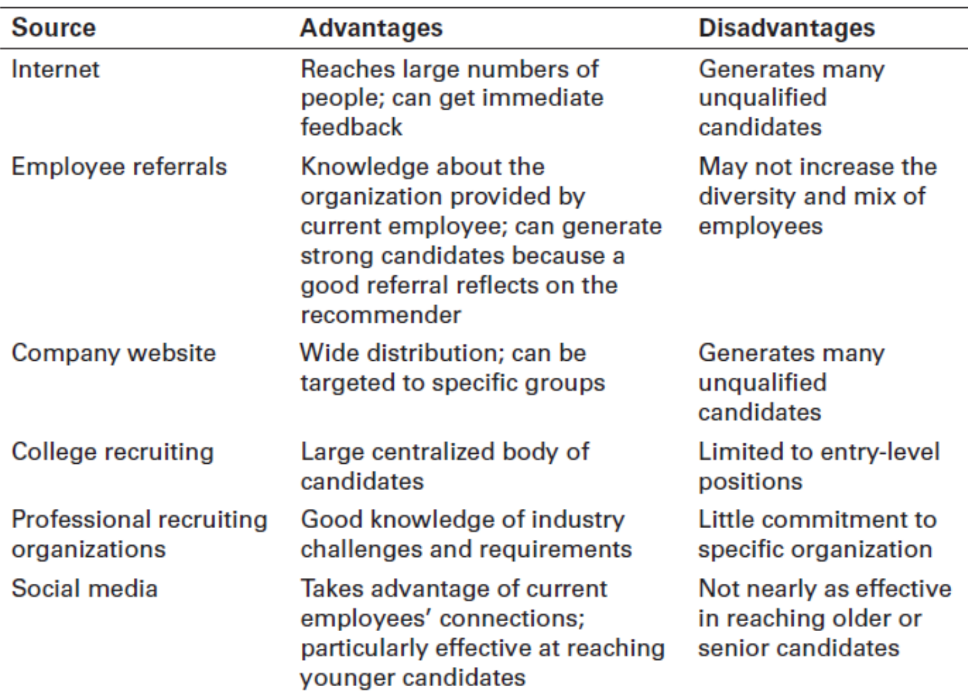
Recruitment: Attracting capable candidates to fill job vacancies.
Example: A company posts job openings on LinkedIn to find qualified applicants.
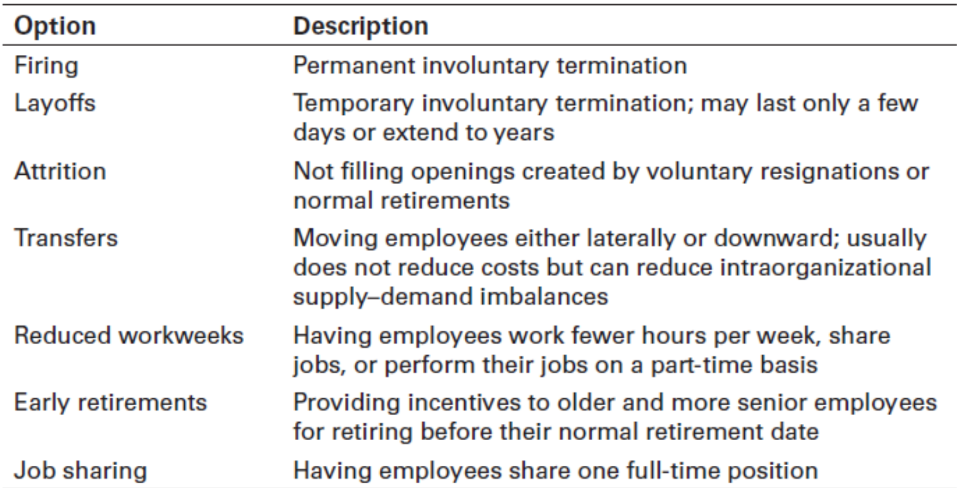
Decruitment: Reducing workforce size when necessary, often due to restructuring or cost-cutting.
Example: Offering voluntary retirement packages during an economic downturn.
Selection: Screening and hiring the best candidates for the job. Application form, written test, interview.
Example: Conducting interviews and skill assessments to select the most qualified applicant for a managerial role.
Employee Training: Providing learning opportunities to improve employee skills.
Example: Offering courses to help employees learn to use new accounting software.
Performance Evaluation: Assessing how well employees perform their roles.
Example: Using annual reviews to measure progress against set goals and provide constructive feedback.
Compensation and Benefits: Developing competitive salary packages and additional perks like health insurance.
Example: Offering bonuses to high-performing employees to retain top talent.
Job Description: Clearly define a role's responsibilities, work environment, and conditions.
Example: Writing a job description for a marketing manager that outlines tasks like campaign planning and team leadership.
Person Specification (Job Specification): Listing qualifications, skills, and traits required for the job.
Example: Stating that a marketing manager must have a degree in marketing and 5 years of experience.
Essay Question (EQ)
IV. Management Techniques & Strategic Planning
A. Management by Objectives (MBO):
Management by Objectives (MBO) in HRM
A system where managers and employees set specific goals together.
Mbo splits the overall objectives into the specific groups task eg: Increase profit is overall objective, so marketing must get more sales etc .
Progress is regularly reviewed, and rewards are given based on achievements.
Employees are evaluated based on how well they accomplish specific goals
Example: A sales manager and employee set a goal to increase sales by 10% in three months. Progress is checked monthly, and a bonus is given if the target is met.
Advantages of MBO
Clear goals: Employees know exactly what to achieve.
Example: A marketing team sets a clear goal to increase website traffic by 20%.Better communication: Managers and employees discuss and agree on goals together.
Example: A manager regularly meets with the team to track progress and address challenges.Increased motivation: Employees feel more motivated when they help set their own goals.
Example: A salesperson sets a target with their manager and feels ownership of the goal.Performance evaluation: Goals provide a clear basis for reviewing success.
Example: At the end of the quarter, the team is evaluated based on specific metrics.Aligned goals: Individual tasks are connected to company objectives.
Example: An HR team’s recruitment goal supports the company’s expansion plan.
Disadvantages of MBO
Time-consuming: Setting and monitoring goals takes time.
Example: A manager spends hours creating detailed individual goals for each employee.Lack of flexibility: Goals may become irrelevant if situations change.
Example: A company sets sales targets, but market conditions shift unexpectedly.Overfocus on results: Employees may prioritize hitting targets over quality.
Example: A production team meets their goal but sacrifices product quality to do so.Short-term focus: Long-term objectives may be neglected.
Example: An employee focuses on completing this month’s target instead of planning for the next year.Communication issues: Poor coordination can lead to unclear or unrealistic goals.
Example: A manager sets goals without fully explaining them to the team.
Comparison: MBO vs. Traditional Performance Appraisal
Aspect | Management by Objectives (MBO) | Traditional Performance Appraisal |
Focus | Future-oriented; focuses on achieving goals together. | Past-oriented; focuses on evaluating past performance. |
Process | Collaborative goal-setting between manager and employee. | Manager evaluates employee's performance individually. |
Criteria | Measures success by achieving specific objectives. | Evaluates based on general traits, behaviors, or tasks. |
Feedback | Ongoing feedback and regular discussions throughout the period. | Typically involves periodic or annual feedback sessions. |
Employee Involvement | Employees are actively involved in setting and planning objectives. | Limited employee involvement; decisions made mostly by the manager. |
Outcome | Promotes growth, motivation, and alignment with organizational goals. | Focuses on identifying areas of improvement or deficiencies. |
Explanation and Examples
MBO (Management by Objectives)
Explanation: Employees and managers set clear, measurable goals together. Progress is reviewed regularly, and success is judged by how well objectives are met.
Example: A salesperson and their manager set a goal to increase sales by 20% in six months. They meet monthly to discuss progress and adjust strategies.
Traditional Performance Appraisal
Explanation: Managers evaluate employees based on their past performance, often using ratings or rankings. Goals may not always be clear to the employee.
Example: At the end of the year, a salesperson’s performance is reviewed based on overall sales, punctuality, and teamwork, with little discussion about future goals.
B. Strategic Planning:
Strategic planning is about creating long-term goals and aligning resources to achieve them.
Levels of Strategy: CBF
Corporate Strategy
Corporate strategy is a long-term plan to achieve organizational goals.
Types of Corporate Strategies:
Growth Strategy: Expanding markets or products.
Examples:
Focus: Concentrating on one type of business (e.g., a company expanding its product line in a single industry).
Vertical Integration: Expanding into supply chain stages (e.g., a car manufacturer starting to produce its own parts).
Horizontal Integration: Merging with competitors to expand market share (e.g., one tech company acquiring another).
Diversification: Entering new industries (e.g., a food company branching into beverages).
Stability Strategy: Continuing operations without major changes.
Example: A company maintaining its current market share and product offerings without aggressive expansion.
Renewal Strategy: Improving performance by reducing costs or restructuring.
Examples:
Retrenchment - cutting costs and reducing operations to survive during tough times.
Example: A company shuts down unprofitable stores and lays off staff to save money.
Turnaround - making changes to fix problems and return to success.
Example: A company improves product quality and starts a marketing campaign to boost sales and recover.
Business-Level Strategy
This strategy focuses on how an organization competes in a specific market.
Examples of Business-Level Strategies (Porter’s generic strategies): (Focus, Different, Cost)
Focus: Targeting a specific market / smaller segment market (e.g., luxury car brands).
Differentiation: Offering unique products that stand out in the market (e.g., Apple’s premium smartphones).
Cost Leadership: Offering products at the lowest cost in the industry (e.g., Walmart).
Functional-Level Strategy
These strategies are specific to departments (e.g., marketing, HR, finance) and support the overall business strategy by optimizing resources in each area.
Examples of Functional-Level Strategies: MOH
Marketing Strategy: Deciding how to promote products (e.g., social media campaigns).
Operations Strategy: Improving production efficiency (e.g., adopting lean manufacturing).
HR Strategy: Attracting and retaining top talent (e.g., offering competitive salaries and career growth opportunities).
Strategic Management Process
Define the Mission:
Identify the organization's purpose.
Example: A hospital’s mission is "to provide affordable, high-quality healthcare."Analyze the Environment:
Study external factors (like competition) and internal strengths.
Example: Use a SWOT analysis to assess opportunities and threats.Set Objectives:
Create measurable and clear goals.
Example: "Increase customer base by 15% in the next year."Develop Strategies:
Decide how to achieve the goals.
Example: Launch new products for an underserved market.Implement Strategies:
Put the plan into action.
Example: Assign budget and resources to marketing efforts.Evaluate Performance:
Monitor results and make adjustments if needed.
Example: Review quarterly sales to ensure goals are being met.
Nature and Purpose of Planning
Planning helps organizations set a clear path to achieve goals, use resources efficiently, and prepare for future challenges.
Example: A tech startup creates a five-year plan to launch three new products, focusing on innovation and market growth.
By combining MBO (Management by Objectives) and strategic planning, organizations can set clear goals, track progress, and adjust to changes effectively.