Climate and Biomes
How is the Earth warmed?
*The balance of incoming and outgoing ultraviolet, visible, and infrared energy (“shortwave radiation”) from the sun drive Earth’s climate
Incoming solar radiation is reflected or absorbed
~1/3 of incoming solar radiation is reflected back (as light + UV) to outer space by gasses in our atmosphere or by Earth’s surface
solar radiation that’s not relected is absorbed by gases in our atmosphere or by Earth’s surface, becoming warmer and emitting infrared radiaiton (heat)
Earth re-radiates incoming infrared radiation
Most re-radiated solar radiation is re-absorbed (as heat) by Earth’s surface
some escapes the gasses in our atmosphere and goes into outer space
Greenhouse gases absorb infrared radiation
GHGs: molecules in Earth’s atmosphere that absorb and re-emit infrared radiation
~99% of gases in the atmosphere are nitrogen (78%) and oxygen (21%) → NOT GHGs
naturally-occuring greenhouse effect makes Earth livable → keeps the Earth warm enough to live
Natural sources of GHGs:
water vapor
carbon dioxide
methane
Human Activity sources of GHGs:
halocarbons
nitrous oxide
carbon dioxide
methane
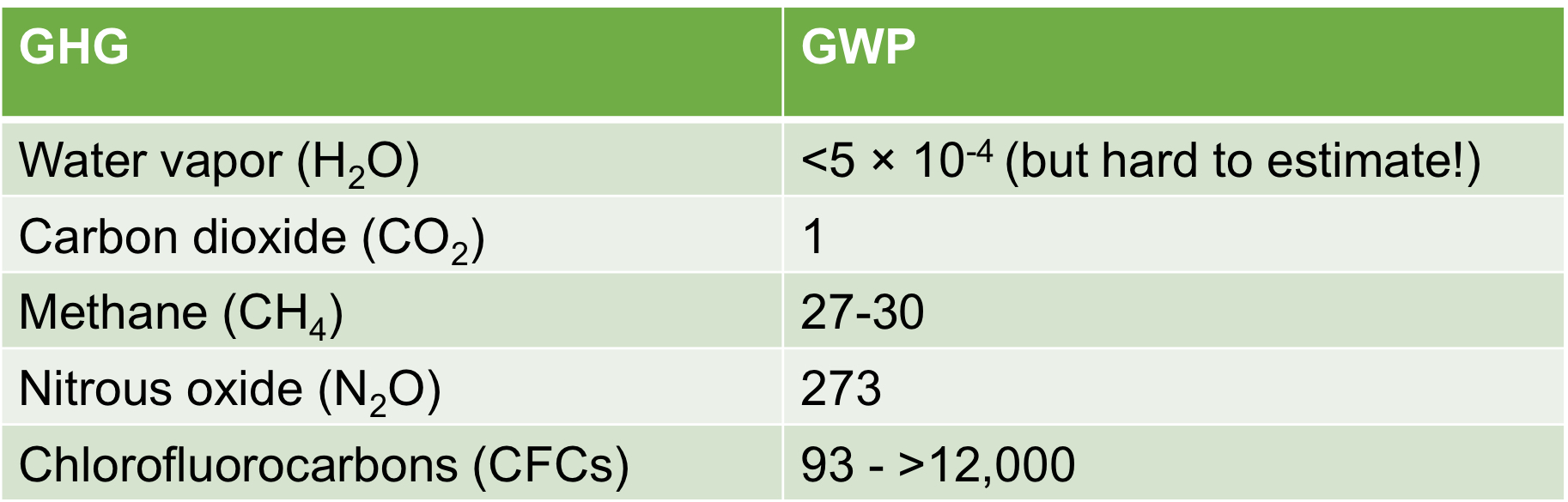
Global Warming Potential (GWP): relative measure of how much energy the emissions of 1 ton of a gas will absorb over a given period (100 years)
3 Factors Affect Solar Radiation Received at Different Latitudes:
Distance sunlight travels through the atmosphere
shorter distance at equator → less solar energy reflected/absorbed by atmosphere
Angle at which sunlight hits Earth
solar energy is spead over smaller area at equator (more concentrated)
Reflectivity of Earth’s surface
low albedo (brightness) of dark forests at equator absorb more solar energy than ice at poles
*Albedo: fraction of solar energy reflected by a surface (brightness)
Earth’s Tilt causes seasonal Temperatures
Solar Equator: latitude that receives the most direct Sun rays (shifts throughout the year)
The northern hemisphere receives more sunlight March → Sept
the southern hemisphere receives more sunlight Sept → March
Atmospheric Currents Result from Unequal Heating
Atmospheric Currents: circulation patterns of air between Earth’s surface and the atmosphere
Physics reminders:
warm air rises (thats why we get down when theres a fire)
warm air can hold more moisture than cold air (thats why its dry in the winter)
air moves from areas of high to low pressure
*Polar cells:
~60degrees N/S, air rises and drops moisture
cold, dry air sinks
*Ferrel cells (weak):
area between ~30-60degrees N/S, lacking distinct atmospheric currents
moves warm air towards the poles and cold air down towards the equator
Different rotation speeds lead to deflected surface air circulation → Coriolis Effect
Gyre: large-scale ocean circulation pattern
unequal heating: warm water expands, moves away from the equator
wind patterns, ocean basin topography and salinity - also affected by coriolis effect
Gyres redistribute energy through global oceans
Climate ≠ Weather
Climate: typical atmospheric conditions throughout the year; measured over many years (long term patterns)
Weather: variation in temperature and precipitation in a specific place over periods of hours or days (short term patterns)