Language-Change
Age of Languages:
How old is English?
Old English: Emerged around the 5th century AD with the Anglo-Saxon invasions of Britain.
Written Evidence: Old English texts, such as Beowulf (8th-11th century), provide early records.
Development: Evolved through Middle English (11th-15th century) to Modern English (16th century onward).
How old is Polish?
Old Polish: Began to form around the 10th century AD with the establishment of the Polish state.
Written Evidence: The earliest texts include:
Bulla gnieźnieńska (1136), Psałterz Floriański, Biblia Królowej Zofii, Kazania ŚwiętokrzyskieDevelopment: Evolved into Middle Polish (16th-18th century) and Modern Polish (19th century onward).
How old is any language?
Proto-Languages: Most languages trace back to earlier proto-languages (e.g., Proto-Indo-European for many European languages).
Continuous Evolution: Languages evolve gradually, making it difficult to pinpoint an exact "birth" date.
Criteria for Determining Age:
Written Evidence: Old manuscripts, inscriptions, and texts provide the earliest records (e.g., Beowulf for English, Bulla of Gniezno for Polish).
Indirect Evidence: References in foreign documents or records (e.g., Roman accounts of Germanic tribes).
Related Languages: Comparative linguistics helps trace language families and their divergence (e.g., English and German as Germanic languages).
Nationhood: The emergence of a distinct language often coincides with the formation of a national identity (e.g., Polish with the Polish state).
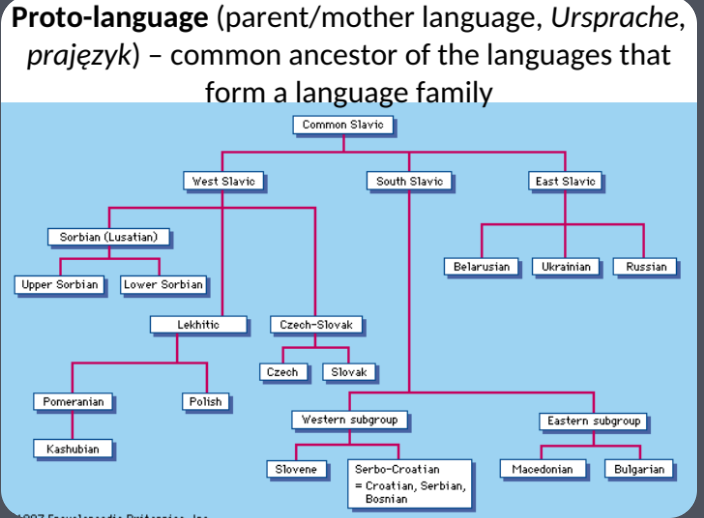
The only surviving manuscript of Beowulf is the Nowell Codex, housed in the British Library.
Major Periods in the History of English:
Old English (Anglo-Saxon) (449–1100):
c. 500 AD: Germanic tribes (Angles, Saxons, Jutes) invade Celtic Britain, replacing Celtic-Roman languages with Germanic.
Characteristics: Highly inflectional, pure Germanic language.
793 AD: Viking invasions introduce Old Norse loanwords.
Middle English (1100–1500):
1066: Norman Conquest brings French loanwords.
Characteristics: Loss of inflections; Great Vowel Shift begins.
Language Contact: Significant French influence on vocabulary and structure.
Early Modern English (1500–1700):
Key Events: Tudors come to power (1485), discovery of America (1492), printing press introduced by William Caxton (1476).
Characteristics: Emergence and codification of standard English; development of grammars and dictionaries.
Expansion: English spreads outside the British Isles.
Sound Changes in Language:
Qualitative Change:
Involves a shift in the quality of a sound.
Examples:
niesę > niosę (Polish)
green [gre:n ] > [gri:n ] (English vowel shift).
Quantitative Change:
Involves lengthening or shortening of sounds.
Example:
Old English lang [lang] > late OE [la:ng ] > early ME [lo:ng ] > late ME [long] > [loŋ].
Assimilation:
A sound becomes similar to a neighboring sound.
Examples:
I can buy it [ai km bai]
Pan Bóg [pambuk] (Polish)
impossible, illegal, irregular
z czym [szczym] (Polish)
Is this yours?, issue.
Dissimilation:
A sound becomes less similar to a neighboring sound.
Example:
Latin marmor > French marbre > English marble.
Metathesis (Transposition):
Sounds switch places within a word.
Examples:
gars > grass
brid > bird
arm vs. ramię (Polish)
mleko vs. milk.
Epenthesis (Addition):
A sound is added to a word.
Examples:
emti > empty
thunor > thunder.
Elision (Loss):
A sound is omitted.
Examples:
probably [probli]
cupboard, forehead
w og(ó)le (Polish).
Lenition (Weakening):
A sound becomes weaker or softer.
Examples:
American English letter [leDer]
pater vs. father.