% 4.3 - Infection and response
4.3.1 Communicable diseases
4.3.1.1 Communicable (infectious) diseases
Pathogens = microorganisms that enter the body and cause communicable (infectious) diseases:
Both animals and plants can be infected by pathogens
Pathogens can be bacteria or viruses or protists or fungi
Bacteria -
Are very small cells - around 1/100th the size of your body cells)
Can reproduce rapidly inside your body
Make you feel ill by producing toxins that damage your cells and tissues
Viruses -
Are not cells and are tiny - around 1/100th the size of a bacterium
Can reproduce rapidly inside your body
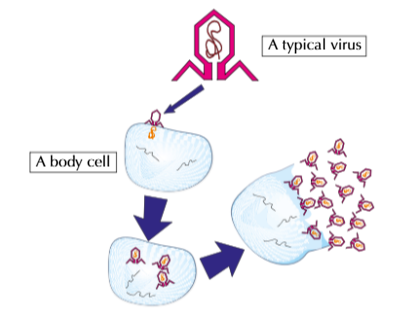
They live inside your cells and replicate themselves using the cells machinery to produce many copies of themselves
Cell lysis (bursts) will occur, releasing all the new copies of that virus
This cell damage is what makes you ill
Protists -
Are all eukaryotes and most of them are single-celled
Protists are often transferred to the organism by a vector which doesn’t get the disease itself
Vector = any organism that can spread disease
Fungi -
Are all eukaryotes
Some are single-celled
Others have a body which is made up of hyphae (thread-like structures)
Hyphae can grow and penetrate human skin and the surface of plants - causing disease
Hyphae can produce spores, which spreads to other plants and animals
Transmission of pathogens can occur in number of ways:
Water -
Bathing or drinking dirty water can transmit pathogens
Such as cholera bacterium
Air -
Pathogens can be carried in the air and can then be breathed in
Some are transmitted by droplets carried in the air produced when you cough or sneeze
Such as the influenza virus that causes flu this way
Direct contact -
Pathogens can be transmitted by touching contaminated surfaces including the skin
Such as athlete’s foot which is a fungus that is spread by touching the same things as an infected person
Unhygienic food preparation -
Pathogens can be transmitted via food that hasn’t been prepared in the right conditions
For example, bacterial diseases like Escherichia coli can be spread which is a cause of food poisoning
Vectors -
Any organism that can spread a disease is called a vector
For example malaria is spread by mosquitoes which act as a vector
4.3.1.2 Viral diseases
Measles:
Spread by droplets from an infected person’s sneeze or cough
Symptoms:
Fever
Red skin rash
Can be very serious if complications arise - for instance, measles can sometimes lead to pneumonia (lung infection)
For this reason most young children are vaccinated against measles
HIV:
Spread by sexual contact or exchange of body fluids such as blood - can happen when people share needles when taking drugs
Symptoms:
Flu-like symptoms
Successfully controlled with antiretroviral drugs - these stop the virus from replicating in the body
Late stage HIV (AIDS) occurs when the body’s immune system becomes so badly damaged it can no longer deal with other infections or cancers
TMV:
A virus that affects many species of plants (for example tomatoes)
Symptoms:
Causes a mosaic pattern of discolouration on the leaves
This discolouration affects the growth of the plant due to lack of photosynthesis
4.3.1.3 Bacterial diseases
Salmonella:
Is a type of bacteria that causes food poisoning
Spread by eating food contaminated with Salmonella bacteria, or eating food prepared in unhygienic conditions
In the UK, poultry are vaccinated against salmonella to control the spread
Symptoms:
Fever
Abdominal cramps
Vomiting
Diarrhoea
All of the above symptoms are caused by the toxins that the bacteria produce
Gonorrhea:
Is sexually transmitted disease (STD)
Symptoms:
Think yellow or green discharge from vagina or penos
Pain when urinating
Used to be able to treat with antibiotic penicillin until many resistant strains appeared
To reduce the spread of Gonorrhea now:
Treatment with antibiotics
Use of a barrier method contraception such as condom
4.3.1.4 Fungal diseases
Rose black spot:
A fungal disease
Symptoms:
Causes purple or black spots to develop on the leaves of the rose plants
Leaves can then turn yellow and drop off
Affects the growth of the plant as photosynthesis is reduced
Spreads through the environment in water or by the wind
To reduce and treat the spread of rose black spot:
Gardeners can treat the disease using fungicides and/or removing and destroying the affected leaves
These leaves then need to be destroyed so that the fungus can’t spread to other rose plants
4.3.1.5 Protist diseases
Malaria:
Part of the malarial protist’s life cycle takes place inside a mosquito
Mosquitos = the vectors as they pick up malarial protist when they feed on an infected animal
When the mosquito feeds on another animal, it infects if by inserting the protist into the animal’s blood vessels
Symptoms include:
Recurrent episodes of fever - can be fatal
To reduce and treat the spread of malaria:
Controlled by preventing the mosquitos from breeding
Controlled by using mosquito nets
Controlled by using insecticides
4.3.1.6 Human defence systems
The non-specific defence systems of the human body against pathogens:
Skin -
Acts as a barrier to pathogens and also secretes antimicrobial substances which kill pathogens
Nose -
Hair and mucus in your nose trap particles that could contain pathogens
Trachea and bronchi -
secrete mucus to trap pathogens
Lined with cilia (hair-like structures) which waft the mucus - that contains the trapped mucus - up to the throat where it can be swallowed to the stomach
Stomach - produces hydrochloric acid which kills the pathogens
Role of the immune system in the defence against pathogens:
If a pathogen enters the body the immune system tries to destroy the pathogen
White blood cells help to defend against the pathogens by:
Phagocytosis -
The process of phagocytes (type of white blood cell) engulfing and ingesting foreign cells/pathogens
Antibody production -
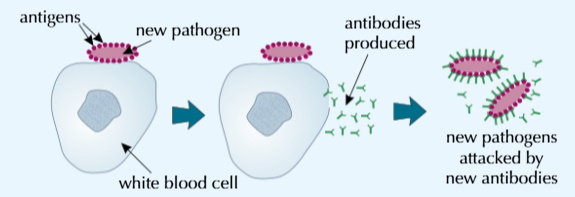
Every pathogen has unique molecules called antigens on its surface
Lymphocytes (another type of white blood cell) start to produce proteins called antibodies that attack/kill foreign cells that enter your body
Antibodies are produced rapidly
Antibodies also cause the pathogens to stick together and make it easier for phagocytes to engulf them
Antitoxin production -
Lymphocytes can produce antitoxins to counteract toxins produced by the invading bacteria
4.3.1.7 Vaccination
How a vaccine works:
Involves injecting small quantities of dead or inactive forms of a pathogen
They carry antigens which cause your body to produce antibodies to attack them even tho the pathogen is harmless
If the same pathogen re-enters the body the white blood cells respond quickly to produce the correct antibodies
Preventing infection
Pros of vaccination:
Helped control lots of communicable diseases that were once common in the UK
Epidemics can be prevented if a large percentage of the population is vaccinated
So even the people who aren’t vaccinated are unlikely to catch the disease as there’s fewer ppl able to pass it on
Spread of pathogens can be reduced by immunising a large proportion of the population
Cons of vaccination:
Vaccines don’t always work - sometimes they don’t give you immunity
Can have bad reactions (side effects) to a vaccine - but are very rare
4.3.1.8 Antibiotics and painkillers
Antibiotics = medicines that help cure bacterial disease by killing infective bacteria inside the body:
Antibiotics don’t destroy viruses
Difficult to develop drugs that kill viruses without also damaging the body’s cells
Important that specific bacteria should be treated by specific antibiotics
Bacteria can become resistant to antibiotics -
Bacteria can mutate and some mutations can cause them to be resistant to an antibiotic
Means that when you treat the infection only the non-resistant strains of bacteria will be killed
The individual resistant bacteria will survive and reproduce causing the population of that strain to increase
To slow down the rate of development of resistant strains it’s important to avoid over-prescribing antibiotics
Also important to finish the whole course of antibiotics
Painkillers (e.g aspirin) are drugs that help reduce symptoms and don’t actually tackle the cause of the disease or kill pathogens
4.3.1.9 Discovery and development of drugs
Traditionally drugs were extracted from plants and microorganisms:
Drugs extracted from plants:
The heart drug digitalis - originates from foxgloves
The painkiller Aspirin - originates from willow
Drugs extracted from microorganisms:
Alexander Fleming was clearing out some petri dishes containing bacteria
One of the dishes had mold growing on it and the area around the mould was free of bacteria
The mould (called Penicillium mould) contained the substance penicillin that killed the bacteria
Most new drugs are synthesized by chemists in the pharmaceutical industry but a starting point may still be the plant
New drugs have to be tested and trialled before being used:
Preclinical testing:
Drugs are tested on human cells, tissues and live animals in a laboratory
Used to test for efficiency - whether the drug works and produces the effect you’re looking for
Used to test for toxicity - how harmful it is
Used to find the rough estimate of the dosage - concentration that should be given and how often it should be given
Clinical trials:
Uses healthy volunteers and patients
Very low doses of the drug are given at the start of the trial
And is gradually increased
If the drug is found to be safe oh healthy volunteers, drug can then be tested on people suffering from illness
Optimum dose is then found - this is the dosage that is the most effective and has few side effects
To test how well the drug works:
Patients are randomly put into 2 groups
1 is given a new drug, the other is given a placebo - ( a fake or inactive treatment that looks like the real drug but contains no active substance)
Allows for the doctor to see the actual difference the drugs make
Allows for the placebo effect - when the patient expects the treatment to work and so feels better, even though there is no treatment
Clinicals trials are often double blind trials - neither the patient or the doctor knows until all the results have been gathered
Results of drug testing and drug trials aren’t published until they’ve been through a peer review - helps prevent fake claims
4.3.2 Monoclonal antibodies
4.3.2.1 Producing monoclonal antibodies
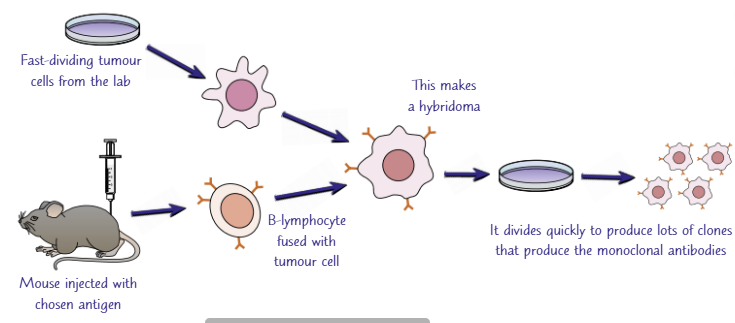
Monoclonal antibodies are produced from lots of clones of a single white blood cell - means all of the antibodies are identical and will only target one specific antigen:
Produced by stimulating mouse lymphocytes to make a particular antibody
Lymphocytes are combined with a tumor cell to make a cell called the hybridoma cell
Hybridoma cells can be cloned to get lots of identical cells
All produce the same antibodies (monoclonal antibodies)
The antibodies can then be collected and purified
4.3.2.2 Uses of monoclonal antibodies
Some uses examples include:
For diagnosis such as in pregnancy tests (figure out if you need to now how a pregnancy test works)
Used in labs to measure the level of hormones and other chemicals in blood, or to detect pathogens
Used in research to locate or identify specific molecules in a cell or tissue by binding to them with a fluorescent dye
Used to treat some diseases -
Cancer cells have antigens that aren’t found on normal body cells
They are called tumour markers
You can make monoclonal antibodies that will specifically bind to these tumour markers
A radioactive substance a toxic drug or a chemical can be bound to the monoclonal antibody
The monoclonal antibody targets specific cells (the cancer cells) because they only bind to the tumour markers
The drug kills the cancer cells but doesn’t kill any normal body cells
However, monoclonal antibodies have some problems:
Monoclonal antibodies create more side effects then expected
E.g. - can cause fever, vomiting and low blood pressure
MEans that they are not widely used as treatments as scientists had originally thought they might be
There is one clear advantage tho:
For cancer treatment, the side effects of an antibody-based drug is less that standard radiotherapy or chemotherapy as they tend to kill body cells
4.3.3 Plant disease
4.3.3.1 Detection and identification of plant diseases
Common signs of plant disease are:
Stunted growth
Spots on leaves
Areas of decay
Abnormal growths (e.g lumps)
Malformed leaves or stems
Discolouration
Infestation of pests
Identification of plant disease can be made by:
Looking up signs in a gardening manual or on a gardening website
Taking infected plants to a laboratory to identify the pathogen
Using testing kits that identify the pathogen using monoclonal antibodies
Plants can be damaged by a range of ion deficiency conditions:
Nitrates from the soil are needed to make proteins and therefore for growth
Stunted growth is caused by nitrate deficiency
Magnesium ions are needed for making chlorophyll which is needed for photosynthesis
Chlorosis (yellow leaves) is caused by magnesium deficiency
Plants can be infected by:
Viral pathogens
Bacterial pathogens
Fungal pathogens
And insects such as aphids can cause huge damage to plants
If horticulturists (people who grow plants professionally) recognise these deficiency symptoms they can:
Add the correct fertiliser (add missing nutrients to the soil)
Adjust soil quality (to improve nutrient availability)
To ensure plants grow in optimum conditions
4.3.3.2 Plant defence responses
Physical defence responses:
Tough waxy cuticle on leaves -
Provides a barrier to stop pathogens entering
Cellulose cell walls -
Form a physical barrier against pathogens that make it past the waxy cuticle
Layers of dead cells around stems (e.g. bark on trees) -
Provide another barrier against pathogens
Chemical defence responses:
The production of antibacterial chemicals -
Kill bacteria
The production of poisons -
To deter herbivores
Mechanical defence adaptations:
Thorns and hairs -
Deter herbivores from touching and eating them
Have leaves which droop or curl when touched -
Can knock of insects
Can move away from things
Mimicry to trick animals