Respiration
There are two types of respiration:
Aerobic Respiration - Uses oxygen. Creates significantly more ATP than anaerobic respiration, and does not produce lactic acid
It occurs in the mitochondria
Anaerobic Respiration - Does not use oxygen. Create significantly less ATP than aerobic respiration and produces lactic acid with is toxic to the body.
It occurs in the cytoplasm
Lactic acid can be removed through exhalation.
Equations
Aerobic Respiration:
602 + C6H12O6 → 6CO2 + 6H20 + ATP
Oxygen + Glucose → Carbon Dioxide + Water + Energy
Anaerobic Respiration in animals
C6H12O6 → Lactic acid + ATP
Glucose → Lactic Acid + ATP
Anaerobic Respiration in plants and fungi (fermentation):
Glucose → Ethanol + Carbon Dioxide + ATP
Carbon Dioxide Test
Wood lice
Put hydrogen carbonate indicator in a test tube
Put a wire gauze with wood lice in the test tube
If there is a colour change of red to yellow, carbon dioxide is present.
It should turn from red to yellow as the woodlice are respiring
Seeds
Place germinating seeds and boiled seeds in two separate thermal flasks
Place a thermometer in the test tube
Respiration releases heat.
Germinated seeds should emit heat because they are respiring, and boiled seeds shouldn’t as they are dead and not respiring
Muscles
When exercising at high intensity, your muscles will require more oxygen to aerobically respire
The lungs won’t be able to supply enough oxygen to aerobically respire
Less aerobic respiration will mean less energy will be produced.
Anaerobic respiration will begin, and lactic acid will be produced and less energy will be produced.
This could cause cramps. Remove lactic acid through exhalation.
Lungs
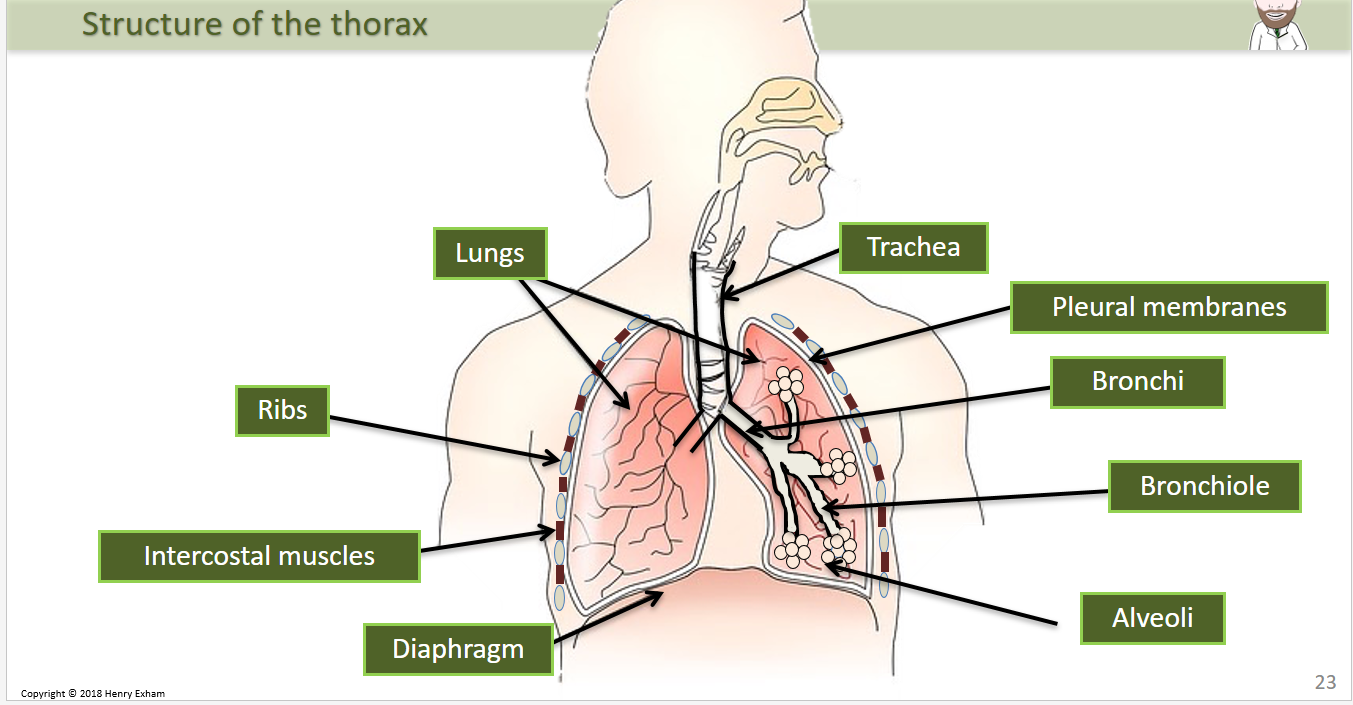 Thorax - Chest
Gas exchange
Ventilation - Breathing. Moving air in and out of the lungs
This required a difference in air pressure and relies on the thorax being an airtight cavity ( no air) .
Movements of the intercostal muscles and the diaphragm cause the change in volume inside the cavity and therefore the air pressure.
Inhalation
Intercostal muscles contract
Ribs move up and out
Diaphragm contracts and flattens
Volume of air in the thorax increases which reduces the pressure
Air rushes into the lungs
Exhalation
Intercostal muscles relax
Ribs move down and in
Diaphragm relaxes and returns to dome shape.
Volume of thorax decreases and therefore the pressure increases
Air is forced out of the lungs
Alveoli
The lungs contain 700,000,000 tiny air sacs called alveoli.
They are surrounded by a network of blood capillaries
Gasses diffuse into and out of the blood based on concentration gradients.
Oxygenated blood travels back to the heart to be pumped around the body
Adaptations for gas exchange
They have a large surface area for diffusion
They are moist to help dissolve gases to increase the rate of diffusion
Rich blood supply for a steep diffusion gradient
Walls are permeable
One cell thick cell walls
Breathing rate experiment
Measure resting breathing rate
Run on the spot for 5 minutes
Measure breathing rate immediately after exercise
Wait 5 minutes then measure breathing rate again
Repeat thrice
Ensure that the people doing the experiment are the same gender, age, and fitness level. Ensure the room’s temperature is the same, food and drink before is the same and time spent exercising is the same.
Smoking
Smoking contributes to the following lung conditions:
Lung Cancer
Tobacco contains carcinogens (stuff that mutates stuff into cancerous tumors).
Chronic Bronchitis
In healthy lungs, the cells lining the bronchi and bronchioles have cilia, cells that waft mucus that traps bacteria and dust up the lungs.
Goblet cells secrete (produce and discharge) mucus
The cilia waft the mucus up to the throat where it can be swallowed and destroyed in the stomach acid.
Tar in cigarettes damages and paralyses the cilia.
Bacteria builds up in the lungs and causes chest infections.
The tar irritates the lining encouraging more mucus to be produced
The smoker develops a heave cough called smoker’s cough and chronic bronchitis
Emphysema
Smoke damages the alveoli walls to burst and fuse
This greatly decreases surface area for gas exchange
The victim is unable to carry out basic tasks like walking due to lack of oxygen.
There is no cure.
Coronary Heart Disease
Coronary heart disease is when you get fatty deposits in the wall of the coronary arteries which normally supply your heart with oxygen.
Eventually these can get blocked entirely with a clot and some oxygen will not get to the heart.
This is called a heart attack.
Carbon monoxide in smoke binds to haemoglobin in the blood instead of oxygen.
Therefore the heart has to work harder, beat faster and with a higher pressure
This damages the artery wall making clots more likely to happen.
Nicotine makes blood cells more sticky and narrows blood cells (vasoconstriction)
These things increase the effects of CHD and makes a heart attack more likely.