Achievement Motivation
Without motivation, exercise (and its benefits) won’t happen.
Direction and intensity of effort (Sage, 1977)
Direction of effort: Where a person wants to put their effort/ reason someone wants to put in effort
Intensity of effort: amount of effort someone wants to exert.
· The reason for starting, continuing, and determination of path (Slavin, 2003)
· The motivation answers the question of “why?”
Types of motivation
Intrinsic- motivation from person’s inner desires. Excitement, fun, self-improvement.
Extrinsic- Motivation from outside sources (tangible rewards “trophy” or intangible “social status”.
Need Achievement Theory
Motivation is a balance between wanting to succeed and wanting not to fail (McClelland and Atkinson)
Achievement motivation: desire to succeed- fear of failure
Fear of failure is too large — no motivation to achieve.
High achievers go for difficult tasks, display a high level of effort
Low achievers avoid difficult tasks, lower effort, are more likely to give up, and focus on the shame of failure.
Nach characteristic (need to achieve):
Approach behaviours
Seek challenges and competition
Enjoys evaluation
Values feedback
Not afraid to fail
Naf characteristics (need to avoid failure):
Avoidance behaviours
Avoids challenges and competitions
Avoid risk
Preoccupied with failure
Lacks persistence
Components that contribute to NAT:
personality
situations
resultant tendencies emotions
emotions (pride/shame)
achievement behaviours
Level of achievement motivation shown depends on the interaction between
personality (innate- trait approach or developed)
situation
-Probability of success: task difficulty
High NACH like tasks with 50% chance of success.
Low NACH like task with a relatively certain outcome
-Incentive value of success
Perceived importance of situation to the individual
NACH= not afraid to fail - rather play than not
NAF= preoccupied with failure - avoid all challenges
Analyse the graph and discuss what it shows
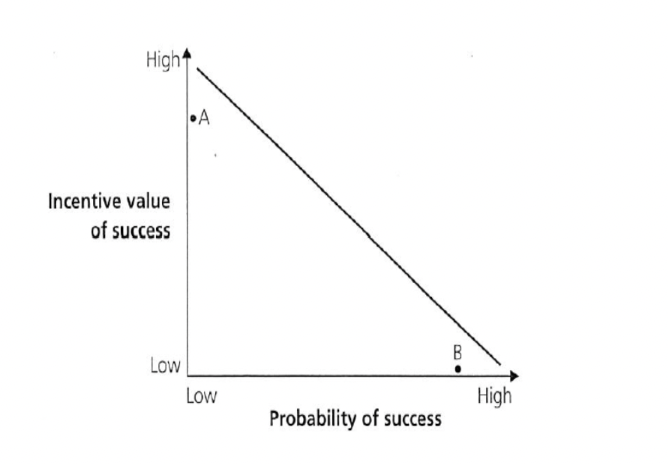
Probability of success vs Incentive value of success
Easy task= likely to succeed = little incentive+pride attached - favoured by NAF
Hard task= less likely to succeed = bring great pride+satisfaction- favoured by NACH
Need Achievement theory, as a coach
Allow success- set achievable process and performance goals, not just outcome goals
Raise confidence- positive reinforcement
Highlight successful role models- people with similar characteristics
Credit internal reasons- ability
Avoidant behaviour happens because of
lack of self-confidence
high anxiety
learned helplessness
attributing failure internally
NACH DOES NOT=EXTROVERT SOME CAN BE INTROVERTS TOO
Improve need and motive to achieve (Nach) | Reduce the tendency and motive to avoid failure (Naf) | |
1 | Increase positive reinforcement improves pride and satisfaction | Reduce punishment |
2 | Reduce punishment | Focus negative feedback on effort, not ability (reduces risk of learned helplessness) |
3 | Ensure achievable goals | Avoid situations where defeat/ failure is inevitable |
4 | Ensure some situations guarantee success - gradually increase task difficulty | If not possible, alter criteria for success (score more than last game) |
5 | Develop confidence and self-efficacy | |
6 | Ensure challenging tasks | |
7 | Ensure the incentive value of success is high | |
8 | Attribute success to internal factors |
Goal-Oriented Theory
Task-oriented people- doing task correctly and improving
Ego-oriented- being better than others
Achievement behaviour (how hard you try, persist, tasks chosen and how well you perform) is influenced by two things..
Achievement goals
Task-oriented- success- getting better- improving learning
Ego-oriented- success- being better than others
Perceived ability (self-belief)
more for age-oriented athletes (if they think they are good= try harder and seek challenging tasks vice versa)
Attitude towards success (beating others vs improving yourself) combined with how capable you belive you are, determines:
effort
persistence
tasks chosen
performance
Question: The Coach introduces new coaching methods. Describe how Atkinson’s model of achievement motivation may influence the soccer team’s response to coaching (3)
individuals are motivated by the desire to succeed (NACH) and the fear of failure (NAF)
New coaching methods are introduced; players with high NACH may see this as an opportunity to improve.
Players with higher NAF might resist/ feel anxious about new methods.