Ecosystems + Energy Flow
Definitions
Biotic Factor - Living factors within an ecosystem
Abiotic Factor - Non-living factors within an ecosystem
Producer - Organisms that can photosynthesise to manufacture their own food (plants)
Consumer - Organisms that feed off other organisms to obtain food
Photosynthesis - A process through which glucose (energy) is manufactured
Parasite - An organism that lives in or on another organism, causing it harm
Pollinator - An organism that transfers pollen from the male to the female part of a plant
Predator - An organism that kills and feeds on prey
Prey - An organism dies by a predator
Adaptation - A feature that enables an organism to survive in its environment
Zone of Tolerance - The range of an abiotic factor that an organism can survive in
Atmospheric Nitrogen - Nitrogen that is found in the atmosphere
Mutualism - A relationship in which both organisms benefit
Biodiversity - The variety of species in an ecosystem
Eutrophication - The process in which nutrient levels increase in a waterway, resulting in increased algal growth and decreased oxygen levels
Keystone Species - A species that plays a crucial role in its ecosystem
Germinate - To grow and put out shoots
Intensity - How much heat is released from a fire front
Ecosystems
An ecosystem is formed by organisms interacting with each other and their non-living environment in a balanced way
Source of energy for ecosystems
Ecosystems require energy from an external source
The ultimate source of energy for all ecosystems is the sun
Photosynthesis
carbon dioxide + water = glucose + oxygen
Competitors compete for resources
Competition often happens when organisms share the same limited resources in the same ecosystem
E.g. members of the same species may compete for a mate
Predators and prey keep each other in balance
Predators must adapt to efficient hunting if they are to catch food to survive
Prey must adapt to escape predators for their species to continue to survive
Interactions between predator and prey are crucial for stabilising ecosystems
E.g. fox and rabbit
Pollinators and Plants
Flowering plants have male and female sex organs
In order for fertilisation to occur, they need a pollinator
This relationship is called mutualism
Abiotic factors affect what can live in an ecosystem
Abiotic factors are chemical and physical factors within an ecosystem
Organisms have adaptations to abiotic factors
Structural - A feature on the body that helps the organism to survive
Behavioural - The way an organism responds to the environment
Physiological - A process inside an organism’s body that helps it survive
Coral bleaching is caused by abiotic factors
If water temperature or pollution increases, then the coral will expel the algae and become bleached, and eventually the coral will die
Nitrogen
Cycles through ecosystems
Nitrogen is found in amino acids
Nitrogen makes up 78% of the air on Earth
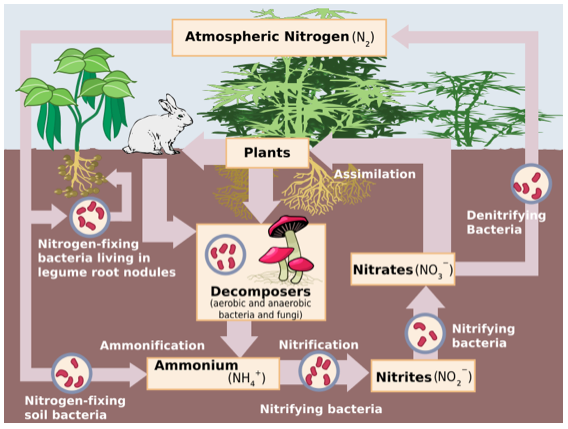
Nitrogen cycles from the atmosphere
Plants cannot use atmospheric nitrogen; they need to obtain nitrogen from the soil in the form of nitrate
Types of Bacteria
Decomposers - Convert nitrogen chemicals from organic matter into ammonia
Nitrogen-Fixing - Bacteria convert nitrogen from the air into other compounds in the soil
Nitrifying - Bacteria convert ammonia into nitrates and nitrites
Denitrifying - Bacteria convert nitrate into nitrogen gas
Other elements also cycle through ecosystems
Carbon, oxygen, hydrogen, and phosphorus are other important elements that cycle through ecosystems
Eutrophication
As oxygen levels drop, aquatic species are affected