Electrical Signals
produced when there are changes in ion movement in the membrane
can only happen in turn when permeability of the membrane changes
triggering event is what will cause permeability of membrane to change (either opening or closing of gated channels)
Gated Ion Channels: channels that open or close in response to different triggering events/stimuli around the cell. 4 main types,
Chemically gated: respond to a chemical (neurotransmitter hormone)
Mechanically gated: respond to change in cell shape/deformation of cell membrane
Thermally gated: respond to heat or cold/change in temperature
Voltage gated: respond to change in cell membrane potential
Graded Potentials
Graded Potential: change in membrane potential that varies in strength and duration
magnitude of a graded potential is related to the magnitude of the triggering event
larger stimulus —> more gated channels open —> more ion movement —> more graded potential in the cell
duration of stimulus is proportionate to duration of graded potential as well
ion channels open longer —> more time for ion movement —> longer graded potential —>
Na+ gated channel is typically opened, therefore usually depolarizing potentials because it causes the cell to become more positive
happens in small, localized area around where the triggering event or stimulus happened (known as active area)
spread in both directions and are decremental (weaken off as time goes on), therefore graded potentials are better suited to short distance signaling
a strong enough graded potential can trigger an action potential
Action Potentials
Action Potential: essentially a longer signal to travel further distances
brief, rapid, and large change within the membrane potential (always! while graded potentials can vary)
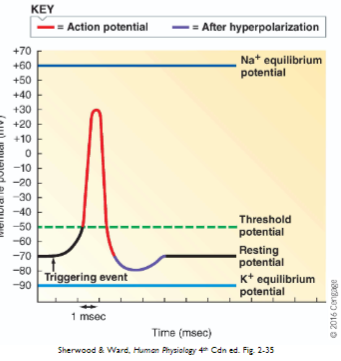
as soon as triggering event reaches threshold potential, rapid depolarization occurs where membrane potential goes from negative to positive mV
Threshold: -50 to -55 mV
reversal of membrane potential to +30 mV (called overshoot or spike)
Voltage-Gated Na+ and K+ channels:
action potentials trigger the opening and closing of voltage gated (VG) channels
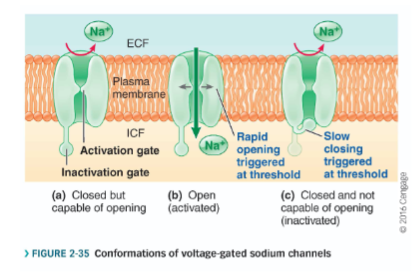
at resting membrane potential, voltage gated channels are closed but capable of opening
stimulus —> gated ion channels open —> depolarization
VG Na+ channels
activation gate: opens rapidly at threshold
inactivation gate: closes slowly at threshold
has 3 different states
closed but capable of opening
open (activated)
closed and not capable of opening (inactivated)
VG K+ channels
open slowly at threshold
close slowly during repolarization
Changes in Membrane Permeability and Ion Movement
resting membrane potential is -70 mV
Na/K pump: membrane is more permeable to K+ due to leak channels
Voltage gated channels are CLOSED during resting potential
triggering event
activation gate of some VG Na channels are opened
Na+ influx and slow depolarization
further depolarization will open more VG Na channels
threshold - increased Na+ permeability
rapid influx of Na+ leads to large depolarization (rising phase)
peak of action potential = +30 mV
repolarization (falling phase)
VG Na+ channels close (inactivation gate closes), less Na+ gets into the cell
VG K+ opens, more K+ out of the cell
hyperpolarization
VG K+ channels are slow to close
return to resting membrane potential
Na/K pump
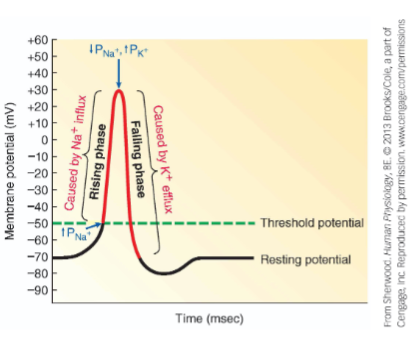
Influx of Na+ causes depolarization (become more positive)
Efflux of K+ causes repolarization (become more negative)