Intelligence Testing
Definition (#f7aeae)
Important (#edcae9)
Extra (#fffe9d)
Introduction:
Intelligence is the ability to:
Understand complex ideas
Adapt effectively to the environment
Learn from experience
Engage in various forms of reasoning
Overcome obstacles through thoughtful action.
Core debate:
Does intelligence constitute a single, unitary function or is it a composite of several independent abilities?
Unitary function:
Intelligence is a single general ability ('g').
All cognitive tasks show positive correlations.
Spearmans ‘g’ factor theory.
Composite abilities:
Multiple independent intelligence factors.
Difference cognitive abilities exits independently.
Gardner’s Multiple Intelligences.
Factor-Analytic Theories:
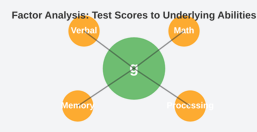
Factor-Analytic approach: Provides a statistical framework for understanding the structure of intelligence by examining relationships between test scores to uncover underlying abilities.
Statistical framework: Uses factor analysis to identify underlying dimensions of intelligence from patterns of correlations between test items.
Hierarchial struture: Reveals how specific abilities group into broader factors, providing a systematic understanding of cognitive abilities.
Spearman’s ‘g’ factor:
Spearman introduced the two-factor theory of intelligence, proposing that intelligence comprises:
'g' factor: General intellectual ability.
's' factors: Specific ability factors.
'g' is a single, general mental energy.
Underpins all cognitive tasks.
High positive correlations indicate high 'g' saturation.
General findings:
Inductive reasoning tasks strongly correlate with 'g'.
Spearman later acknowledged "group factors".
Correlations suggest a hierarchical structure.
Cattell-Horn’s Gf-Gc Model:
Cattell proposed 2 primary types of general intelligence, later expanded by Horn:
General Fluid Intelligence (GF):
Identifies novel patterns.
Solves unfamiliar problems.
Nonverbal, culture free.
Independent of instruction.
General Crystallized Intelligence (GC):
Repository of acquired knowledge.
Accumulates throughout adulthood.
Dependent on cultural exposure.
Based on education and experience.
Horn’s additional factors:
Gv: Visual processing.
Gs: Speed of processing.
Ga: Auditory processing.
Gq: Quantitative processing.
Grw: Reading/writing processing.
Gsm: Short-term memory.
Glr: Long-term storage and retrieval.
Carroll’s 3-Stratum theory:
Carroll's (1993) Three-Stratum Theory describes intelligence at 3 hierarchical levels:
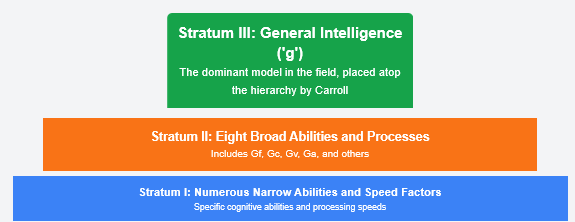
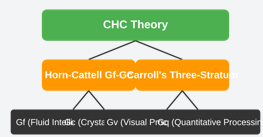
The CHC Model (Cattell-Horn-Carroll) integrates 2 major models.
Integration:
Combines Horn-Cattell's Gf-Gc model with Carroll's Three-Stratum theory.
Structure:
Hierarchical organization (pervasive → broad → narrow abilities).
Modern application: Foundation of tests like Stanford-Binet 5
Gardner’s Mutiple intelligences:
Proposes that human intelligence comprises several relatively independent intelligences.
Key aspects:
Intelligences are relatively independent.
Each has its own processing mechanisms.
Intelligences have evolutionary significance.
Intelligences are expressed in specific domains.
9 Intelligences:
Linguistic:
Involves sensitivity to spoken & written language, the ability to learn languages, and the capacity to use language to accomplish goals.
Ex: Writers, poets.
Logical-Mathematical:
Consists of the capacity to analyze problems logically, carry out mathematical operations, and investigate issues scientifically.
Ex: Mathematics, scientists.
Musical:
Involves skill in the performance, composition and appreciation of musical patterns.
Encompasses the capacity to recognize and compose musical pitches, tones and rhythms.
Ex: Composers, musicians.
Bodily-Kinesthetic:
Entails the potential of using one's whole body or parts of the body to solve problems or fashion products.
Ex: Athelets, craftsmens, surgeons.
Spatial:
The potential to recognize and use the patterns of wide space and more confined areas.
Ex: Navigators, pilots.
Interpersonal:
The capacity to understand the intentions, motivations, and desires of other people.
Ex: Teachers, counselors.
Intrapersonal:
The capacity to understand oneself, to appreciate one's feelings, fears and motivations.
Naturalistic:
Recognize patterns in nature and classify objects.
Ex: Botanist, hunters.
Existential:
The capacity to tackle deep questions about human existence.
Ex: Philosophers, religious leaders.
Critiques:
Whether these distinct domains truly represent "intelligences" or are "abilities."
Lacks strong empirical support from psychometric research, which often finds high correlations between different cognitive abilities.
Successfully rekindled the debate about whether human intelligence is unitary or multifaceted.
Information-Processing Approach:
Shifts focus from identifying intelligence structure to understanding underlying mental mechanisms.
Perspective: Intelligence is a set of cognitive processes involved in:
Acquiring → Storing → Retrieving → Manipulating
Cognitive processes:
The mental mechanisms that transform sensory input into meaningful information.
Information flow:
Sequential processes that describe how information moves through the cognitive system.
Luria’s Processing styles:
2 basic types of information-processing styles:
Simultaneous (Parallel) processing:
Information is integrated and synthesized all at once, perceiving multiple pieces of information as a whole.
Ex: Appreciating a painting
Successful (Sequential) processing:
Each piece of information is processed individually in a specific sequence, characterized by logical and analytic thought.
Ex: Memorizing a phone number.
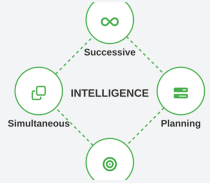
The PASS model:
Planning, Attention, Simultaneous, Successive
Proposes that intelligence involves 4 interconnected cognitive processes essential for effective problem-solving.
Planning: Determining how to solve a problem, selecting strategies.
Attention: Selectively focusing on stimuli and resisting distractions.
Simultaneous: Integrating separate stimuli into a single whole.
Successive: Processing information in a specific serial order.
Application: Interventions based on PASS theory improve reading and mathematics skills for children with learning disabilities.
Measuring Intelligence:
Stanford-Binet Scales:
Incorporates both verbal and non-verbal scales for individuals aged 2 - 85+.
5 key factors:
Fluid reasoning.
Knowledge.
Quantitative reasoning.
Visual-spatial processing.
Working memory.
Adaptive testing approach: Items adjust based on performance, with "floor" and "ceiling" levels to optimize efficiency.
Reliability: 0.97 - .98
Validity: Criterion related from experts and other tests.
Wechsler Scales:
Key indices:
Verbal Comprehension Index (VCI): Similarities, vocabulary.
Working Memory Index (WMI): Digit span, arithmetic.
Full Scale IQ (FSIQ): Overall cognitive ability score.
Perceptual Reasoning Index (PRI): Block design, Matrix reasoning.
Processing Speed Index (PSI): Symbol search, coding.
General Ability Index (GAI): Alternative overall score.
Weschler IQ classification:
≥ 130: Very Superior.
120-129: Superior.
110-119: Above avergae.
90-109: Average.
80-89: Below average.
70-79: Borderline
≤ 69: Mentally retarded.
Culture-Fair Testing:
Aims to minimize cultural bias by:
Reducing factual knowledge: Minimizing reliance on culture-specific factual information.
Limited language: Using minimal language instructions.
Visual tasks: Focusing on performance-based tasks and visual reasoning.
Ex: Raven’s Progressive Matrices to measure fluid intelligence through visual pattern recognition.
Limitation:
Culture-fair tests may still lack predictive validity.
Group differences in scores can persist, suggesting thought processes may not be equally encouraged across cultures.
Ethical and Social Issues:
Sensitive social issues: Intelligence assessment intersects with sensitive social issues, particularly regarding group differences in IQ scores and their interpretation.
Historical misuse: The book "The Bell Curve" by Hernstein and Murray linked IQ differences to racial groups, leading to significant backlash due to its implications and policy recommendations.
Group differences: Claims about group differences have historically been used as political and social tools to oppress religious, ethnic, racial, or other minority group members.
Ethical responsibility: Crucial to recognize that claims about group differences can be used as tools to oppress minority groups.
Limitations and Misuse:
Short Forms: Short forms reduce reliability and validity. Wechsler cautioned against using them to save time.
Historical Misuse: Group tests were misused by untrained individuals, leading to public disillusionment.
Group Tests: Group tests are for screening only. They're insufficient for placement decisions.
Legal Requirements: Legal mandates often prohibit group test data alone for class assignment.
Key takeaway: Full tests are recommended when intervention or placement is needed.
Ethical practice:
Ethical practice demands a multifaceted approach that prioritizes well-being and fair treatment.
Psychometric Soundness: Tests must be free of systematic bias, supported by rigorous reliability and validity studies.
Behavioral Observation: Examiners should observe "extra-test behavior" such as coping with frustration and reactions to items.
Professional Training: Professionals bear a "great responsibility" requiring thorough preparation and ongoing training.
Focus on Intervention: Research should concentrate on environmental interventions to effectively boost measured intelligence.
Future direction:
Culturally sensitive measures: Development of assessments that minimize cultural bias and measure intelligence across diverse populations.
Neuroscience integration: Combining psychometric approaches with neural data to create more theoretically grounded assessment models.
Emotional & social intelligence: Expanding assessment beyond traditional cognitive abilities to include emotional and social competencies.