math
<<equation of lines<<
- the slope-intercept form: of a a linear equation is %%y=mx+b%% where m is the slope of the tine and b is the y-intercept.
- the point-slope for: of a linear equation is %%y-y1=m(x-x1)%%, where %%(x1,y1)%% is any point on the line and m is the slope of the line.
]]equation of lines]]
- the equation of a horizontal line is %%y=b%%, where %%b%% is the y-intercept of line (ex: y=2)
- the equation of a vertical line is a %%x=a%%, where %%a%% is the x-intercept of the line.
- formulas: y=mx+b and y-y1=m (x-x1)
}}classifying triangle}}
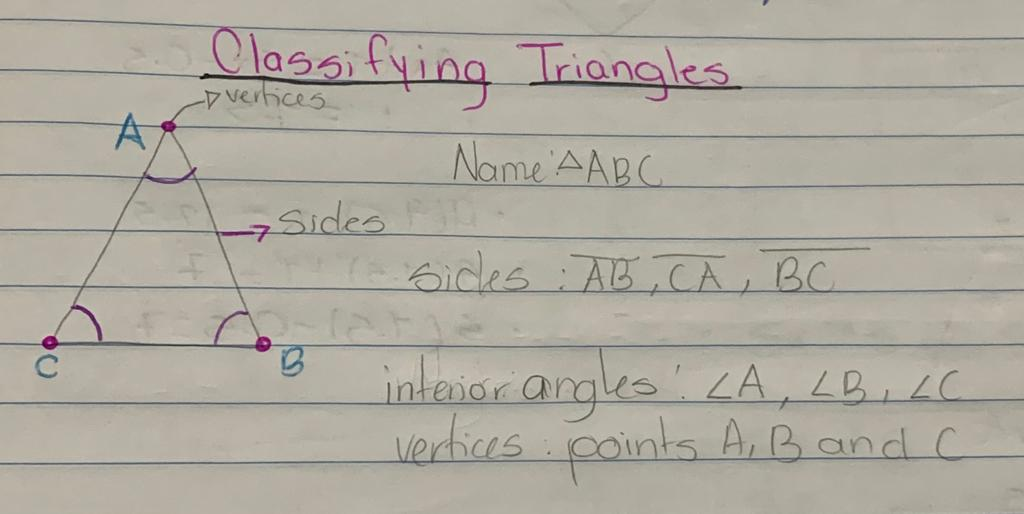
- we can classify angles in two ways:
- by their sides:
- by their angles:
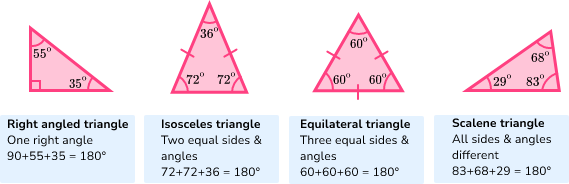
- right triangle: a triangle in which one of the interior angles is 90°
- obtuse triangle : more than 90°less then 180°
- acute triangle: less than 90°
- equilateral triangle: a triangle that has all its sides equal in length.
## 
{{angles of triangles{{
- theorem/ triangles angle-sum theorem: the sum of the measures of the angles of a triangle is 180°
- each exterior angle of a triangle has two remote interior angle that are not adjacent to the exterior angle.
- exterior angle theorem: the measure of an exterior angle of a triangle is equal to the sum of the measures of the two remote interior angles. example (m<4=m<2 +m m<3)
- corollary: is theorem with a proof that follows as a direct result of another theorem.
- colloraries:
- the acute angles of a right triangle are complementary
- there can be at most on right or obtuse angle in a triangle.