Y10 SEM1: HUM EXAM CHEAT SHEET
💰 ECONOMICS (25 min)
🎯 Economy targets (memorise numbers)
GDP growth: 2-4%
Inflation: 2-3%
Unemployment: 4-5%
👉 Think: 3⃣ 2⃣ 4⃣
📈 Business cycle
Economy constantly moves between:
Expansion (growth) → Peak → Contraction (slowdown) → Recovery
🌏 Macroeconomics
Study of the economy as a whole.
Purpose:
make predictions
reduce uncertainty
improve decisions
📊 3 indicators of economic performance
Economic growth
Is the economy producing more goods/services?
Unemployment
How many people can't find work?
Inflation
Are prices rising too quickly?
💵 GDP
GDP = total value of goods & services produced in Australia in one year.
Purpose:
measure economic performance
track growth
compare living standards
GDP per capita
GDP ÷ population
Shows average output per person.
⚠ GDP limitations
GDP doesn't measure:
wellbeing
unpaid work
environmental damage
📈 Sustainable growth
Economic growth should:
create jobs
increase incomes
improve living standards
not harm future generations
Target = 2-4%
👷 Unemployment types
Frictional
between jobs
Structural
skills no longer needed
Cyclical
economy slows down
Seasonal
only needed certain times of year
🏷 Inflation
Inflation = increase in prices of goods/services.
Healthy economy = small inflation (2-3%)
Measured by:
ABS
CPI
Causes
Demand-pull
too much demand
Cost-push
higher business costs
Effects
lower purchasing power
higher interest rates
more inequality
🏢 Business responses
During downturn
reduce output
cut costs
increase promotions
innovate
During boom
increase output
hire workers
increase promotions
innovate
✊ HISTORY (25 min)
🌍 United Nations
Created:
1945
after WWII
Purpose:
prevent future wars
promote peace
encourage cooperation
📜 UDHR (1948)
Universal Declaration of Human Rights.
Key ideas:
everyone is free and equal
everyone has the right to be safe
no discrimination
🇺🇸 US CIVIL RIGHTS MOVEMENT
👦 Emmett Till (1955)
14 years old
murdered in Mississippi
Significance:
open casket exposed racism
shocked America
helped spark movement
🚌 Rosa Parks (1955)
refused to give up bus seat
started Montgomery Bus Boycott
🚍 Montgomery Bus Boycott (1956)
lasted 381 days
peaceful protest
major success
🗣 Martin Luther King Jr
non-violent protest
"I Have a Dream" (1963)
🏫 Little Rock Nine (1957)
9 African American students
integrated a white school
Significance:
violent opposition
Eisenhower sent troops
🇦🇺 INDIGENOUS RIGHTS MOVEMENT
🖤 Before 1960s
Indigenous Australians:
not counted in census
limited voting rights
segregation existed
📅 KEY DATES (VERY HIGH YIELD)
1938 → Day of Mourning
Equal rights protest.
Leaders:
William Cooper
William Ferguson
Jack Patten
1962 → Right to vote
Federal voting rights granted.
1963 → Bark Petition
Yolngu protested mining
first Aboriginal document recognised by Parliament
1965 → Freedom Rides
led by Charles Perkins
exposed racism in NSW
1966 → Gurindji Strike
Wave Hill station
land rights protest
1967 → Referendum
Over 90% voted YES.
Allowed:
Indigenous Australians counted in census
Federal government could make laws
1992 → Mabo Decision
rejected terra nullius
recognised Indigenous land rights
1997 → Bring Them Home Report
Investigated Stolen Generations.
2008 → National Apology
Kevin Rudd apologised.
🤝 Reconciliation
Building respectful relationships between Indigenous and non-Indigenous Australians.
Goal:
address past injustices
create a fairer future
🌏 GEOGRAPHY (25 min)
🌍 Core ideas
Climate change
Long-term weather changes caused mainly by greenhouse gases.
Greenhouse effect
Gases trap heat in Earth's atmosphere.
Global warming
Increase in Earth's temperature.
Mitigation
Reduce causes of climate change.
Adaptation
Adjust to climate impacts.
Sustainability
Meet current needs without harming future generations.
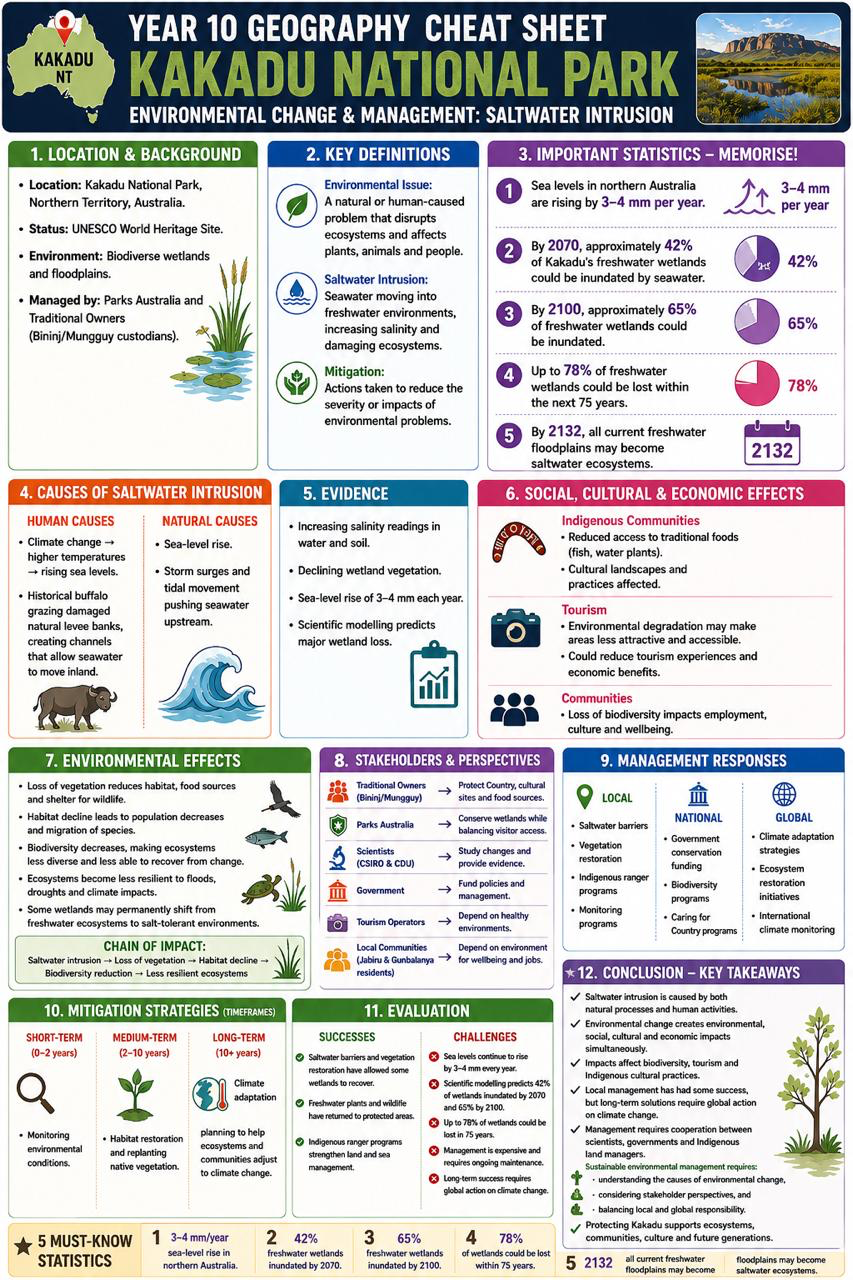
🌊 KAKADU CASE STUDY
🏛 POLITICS & LAW (25 min)
🇦🇺 Foundations
Democracy
A system of govt where citizens vote & have a say.
Constitution
A set of rules/laws that explains how Aus’s govt operates.
Rule of law
Nobody is above the law, including the government.
Federalism
Power shared between federal + state governments.
Electoral system
The process Australians use to vote members into Parliament.
⚖ 3 branches
Legislative
Makes laws.
Executive
Applies laws.
Judiciary
Interprets laws.
🏛 Bicameral parliament
House of Representatives
forms government
introduces laws
Senate
reviews laws
represents states
⚖ Separation of powers
Government powers divided between branches.
Purpose:
prevent abuse of power
increase accountability
📍 Division of powers
Exclusive
Federal only.
Examples:
defence
immigration
currency
Concurrent
Shared.
Examples:
education
healthcare
⚠ Threats to democracy
populism
terrorism
misinformation/disinformation
distrust & indifference
foreign interference
vested interests
🛡 Safeguards
Universal suffrage
Everyone can vote.
Shared democratic values
Freedom, equality, respect, fairness.
Right to dissent
Peacefully disagree with government.
High Court
Protects Constitution and prevents abuse of power.