Spring Force and Hooke’s Law
Extension and compression
extension happens when an object increases in length
compression happens when an object decreases in length
As force increases extension also increases
The extension of an elastic object, such as a spring, is described by Hooke's law:
force = spring constant × extension
F = Ke
This is when:
force (F) is measured in newtons (N)
spring constant (k) is measured in newtons per meter (N/m)
extension (e), or increase in length, is measured in meters (m)
Limit of proportionality
Spring constant- is a measure of the stiffness of a spring up to its limit of proportionality.
The limit of proportionality(elastic limit) refers to the point beyond which Hooke's law is no longer true when stretching a material so:
the elastic material no longer returns to its original deformation making it now have a inelastic deformation
this means the elastic limit of a material is the furthest point it can be stretched or deformed while being able to return to its previous shape but if this limit is pasted
its deformation is said to be inelastic
Force-extension graphs
The realtionship between deforming Force(F) and extension of the spring(e)
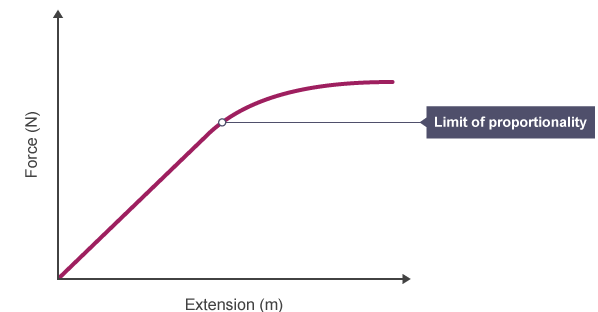
In this instance, the relationship between force and extension changes from being linear(or directly proportional) to being non-linear.
elastic deformation and liner extension is seen under the limit of proportionality
while non-liner extension and inelastic deformation is seen beyond that
The gradient of a force-extension graph before the limit of proportionality is equal to the spring constant.
Inelastic Materials like clay or putty usually show non-linear extension.
Energy stored in a spring
work is done when a spring is compressed or extended
The Elastic potential energy is the energy stored in the spring. Provided inelastic deformation has not happened, the work done is equal to the elastic potential energy stored.
The elastic potential energy stored can be calculated using the equation:
elastic potential energy = 0.5 × spring constant × (extension)2
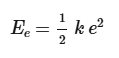
This is when:
elastic potential energy (Ee) is measured in joules (J)
spring constant (k) is measured in newtons per meter (N/m)
extension (e), referring to the increase in length, is measured in meters (m)
Key fact:
This equation also works for the reduction in length when a spring is compressed.