French grammer
Passe Compose
uses auxiliary/helping verb and past participle
auxiliary verbs: avoir or etre - use etre for verbs in Dr.Mrs.Vandertrampp
past participle: remove ending of verb and add special ending
er - e ir - i re - u
when using etre, the past participle has to agree with subject pronoun
if subject pronoun is feminine, past participle ends with extra -e
if subject pronoun is plural, past participle ends with -s
if subject pronoun is plural & feminine - past participle ends with -es
Reflexive Verbs: when using reflexive verbs, the reflexive pronoun (me, te, se, nous, vous) is attached to conjugated form of etre
subject pronoun + reflexive pronoun + etre(conjugated) + past participle + agreement (if needed)
Negative (avoir): subject pronoun + n’ + avoir(conjugated) + pas + past participle
Negative (etre) - subject pronoun + n’/e + etre (conjugated) + pas + past participle + agreement (if needed)
Negative (reflexive verb) - subject pronoun + n’ + reflexive pronoun + etre (conjugated) + pas + past participle + agreement (if needed)
when using reflexive verb, the reflexive pronoun is attached to etre, so the negative goes around it
Irregular Verbs for passe compose
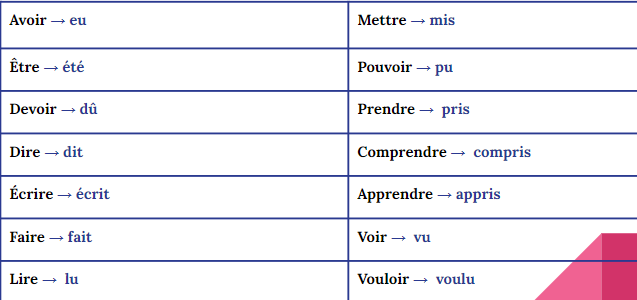
Imparfait
is used to describe actions in the past
to express habitual or repeated actions in the past that have no indication of a beginning or end
attest to the existence of a fact or generalization about a moment in the past
to express the difference between ‘then’ and ‘now’
in a hypothetical context to suggest or propose
take the ‘nous form’ of the verb
remove the ending and add special endings depending on the subject pronoun
Je - ais Tu - ais Il/Elle/On - ait
Nous - ions Vous - iez Ils/Elles - aient
Special case: for etre, do not use sommes, but use ‘ét’
DrMrs. Vandertrampp
Devenir - devenu - to become
Revenir - revenu- to come back
Monter - monté - to climb
Rester - resté - to stay
Sortir - sorti - to exit/to go out with (go out with friends)
Venir - venu - to come
Aller - allé - to go
Naitre - né - to be born
Descendre - descendu - to go down
Entrer - entré - to enter
Rentrer - rentré - to go home
Tomber - tombé - to fall
Retourner - retourné - to return/ to turn over
Arriver - arrivé - to arrive
Mourir - mort - to die
Passer - passé - to pass/ to come
Partir - parti - to leave
Difference between Passe Compose and Imparfait
Passe Compose
answers question “What happened'“
expresses a completed action that happened in the past
expresses a shift/temporality in feeling
started in the past but still continues today
interrupts an action
actions that happened one after the other
has, have, or be
Imparfait
answers question “What was something like”
expresses a habitual/repeated action that occurred in the past
expresses an action that has no beginning or end, and the action happened an undetermined number of times
indicates a consistent state of being or feeling
indicates an action that was entirely in the past
expresses simultaneously done actions (while)
was, were, or used to
Age, Description, Location, Time, Weather (All Deer Like The Woods)