Applied Ruminant Nutrition (NTR 550)
Week 1 Aug 18-24
Set 2: Classification Role of Ruminants
classification
how living things make a living staying alive
autotrophs: don’t eat other living things to survive
heterotrophs: eat other living things to survive
phylogeny of ruminants
kingdom: animalia
phyla: Chordata (skeleton type)
class: Mammalia (milk producing)
order: Arteriodactyla (hooves)
suborder: Ruminantia (number of chambers in the stomach)
family: Bovidae, Giraffidae, Cervidae
subfamily: caprinae - sheep and goats
subfamily: bovinae: cattle, antelope, bison, and buffalo
subfamily: antilopinae: antelopes and gazelles
genus species: bos taurus, bos indicus, ovis aries, capra hircus, bison bison, odocoileus virginianus
what makes a ruminant a ruminant?
key characteristics:
4 chambered stomach
2 toed-foot
may have dew claws
0 upper incisors
some species do have “reduced” upper incisors
chew cud
herbivores
mammals
over 150 species
pseudo-ruminants
3-chambered stomach
camels, llamas, alpacas
classification of ruminants
grazing preferences and adaptions are unique
3 distinct feeding types:
concentrate selectors (deer)
intermediates (goats)
grass/roughage eaters (sheep)
role of ruminants
why were ruminants domesticated?
they have been domesticated for over 10,500 years
multi-purpose and benefits to humans
food souce: milk, meat, blood, fat
clothing and tools: hides, hair/wool, hooves, horns, and bones
fuel: dung as heat source
labor: pull heavy carts and plow (cattle, oxen, yak)
all of theses functions are still vital to society today
what do they contribute to society today
food source:
high quality protein (AA balance)
lamb has the highest out of all the ruminants
high bioavailable Ca, P, Zn, Fe
animals only source of B12
good source of healthy fats (medium chain saturates vs. CLA)
clothing:
wool and leather are now considered high end textiles
there is rich history and prestige to these products
heat:
biodigestion of manure (not common in developed countries)
labor:
thousands if not millions still used as labor resources
cultural role:
religious symbol in India
symbol of wealth in Africa
Icon of history in America
American cowboy
nostalgic connection to the land
entertainment:
rodeos
farming as a hobby
zoos and wildlife parks
utilization of natural resources
convert sun’s energy into products capable of supporting life
low value land (grasslands) into high value products
aid in carbon sequestration
natural nutrient recycling
fertilizer
species conservation
Set 3: Rumen Anatomy Physiology
structure of digestive system
concentrate feeders have the smallest rumen size to body weight ration
forage/roughage feeders have the largest rumen to body weight
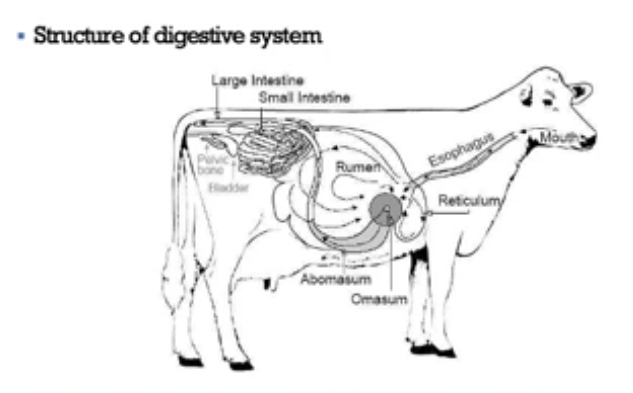
ruminant digestive anatomy and physiology
mouth
collect feed into mouth
grazing animals 25,000-40,000 prehensile bites per day
do not chew food during initial eating
rule of thirds
mouth structure of ruminants
have split lips
larger incisors that match on both sides
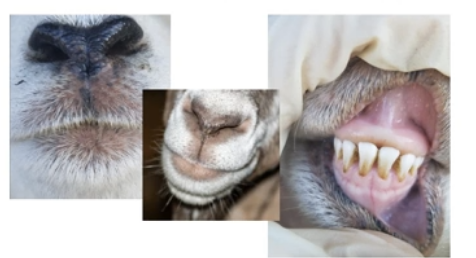
cows have a uni-lip
shorter and wider incisors and a longer tongue
the grazing bovine
grazing time and rumination time are opposite
tend to graze in the morning and afternoon
rumination overnight generates heat
important in the winter months
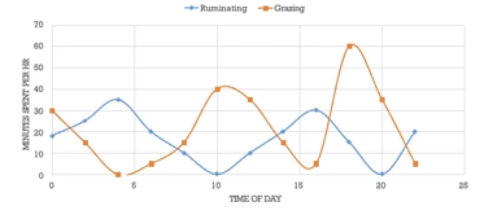
ruminant digestive anatomy and physiology
saliva
up to 50 quarts
contains enzymes
salivary lipase (fats)
salivary amylase (starch)
important for buffering rumen
sodium, potassium, phosphate, bicarbonate, urea, chlorine, magnesium, calcium
rumination
chewing the cud
esophagus is a 2-way route
very important process for microbial attachment and fermentation
stomach
4 chambered
75% of body cavity
left side of the body
average 48hr passage rate
rumen
~75% of total stomach volume
40-gallon capacity in mature cow 4 regions divided by muscular pillars to open the rumen wall and muscular contractions for mixing (important for fermentations)
dorsal, ventral, caudodorsal, caudoventral
anaerobic (limited O)
pH range 6.5-6.8
pH extremes: 3.5 - 8
home to microorganisms
bacteria, protozoa, fungi
fermentation of starch and fiber
NPN and RDP utilization
mostly urea
vitamin K and B’s synthesized
site of fermentation
volatile FA: acetate, propionate, and butyrate
gas: methane, carbon dioxide, hydrogen sulfide
50-65% starch and soluble sugar consumed is digested
papillae lining
reticulum
~9% of total stomach volume (3rd in size)
5 gallon capacity
honeycomb
sorts particle size
small to omasum
larger return to rumen
hardware disease
traps large/dense metal objects
omasum
~ 12% if total stomach volume
many plies, butcher’s bible
lots of surface area traps large particles
water and some VFA absorption
abomasum
~ 4% of total stomach volume
true stomach
hydrochloric acid, pepsin, pancreatic lipase
protein, starch, fat digestion
pH: 3.5 - 4.0
mucous lining
true stomach
microbial protein
small intestine
150 ft long tube in mature cow
20-gallon capacity
3 sections: duodenum, jejunum, ileum
pH raises from 2.5 to 8
pancreatic, liver, gall bladder secretions
villi
nutrient absorption
peptides, AA, carbs, fats, some vitamins and minerals
cecum
minor functionality and development
microbial fermentation
microbial protein and VFA
large intestine
3 ft long in mature cow
2 gallon capacity
water absorption
minerals and some VFA from cecum
rumen development
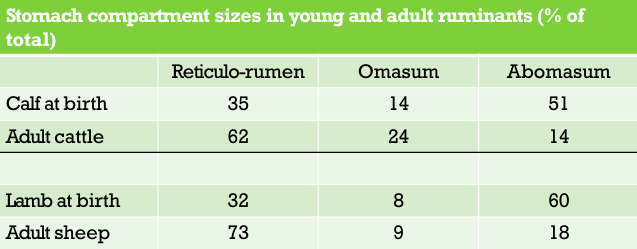
from birth to 2-3 months young ruminants have non-ruminant like digestive system function (abomasum is the largest compartment at birth)
reticular groove (esophageal groove)
muscular folds in the reticulum
shunts milk directly to omasum (bypass rumen and reticulum)
rumen needs microbial inoculation
occurs through contact with mature ruminants in environment
cannot utilize NPN
rumen development
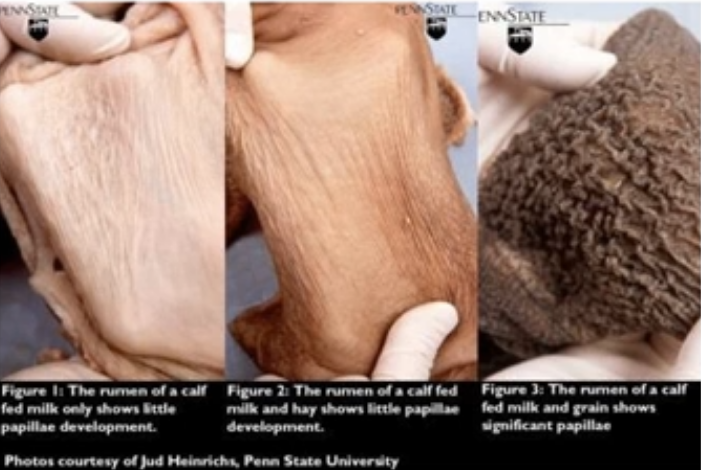
papillae growth (lengthen)
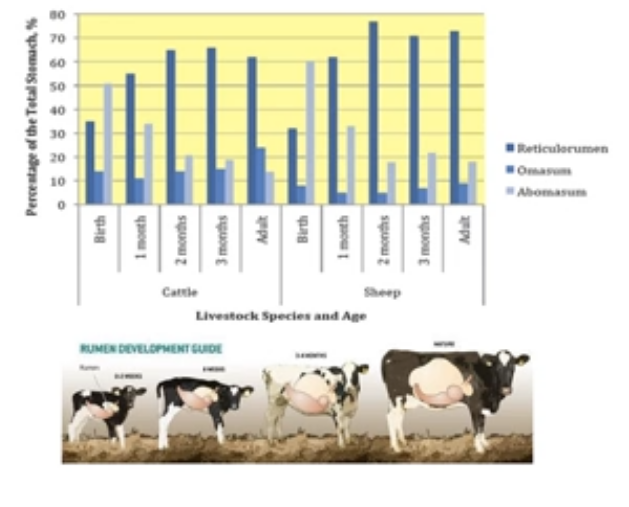
milk and grain (concentrate) showed the most papillae development
development occurs at three weeks
propionic and butyric acid contribute to the development of rumen papillae on a grain diet
acetic acid is made more on a forage diet
butyric acid is actually used for papillary growth (energy)
Set 4: Domestic Ruminant Management
beef cattle management
divided into production segments
cow-calf
cow nutrition
calf nutrition
replacement heifer nutrition
stocker
growing cattle
finishing
feedlot cattle
pasture finished cattle
beef cow nutrition
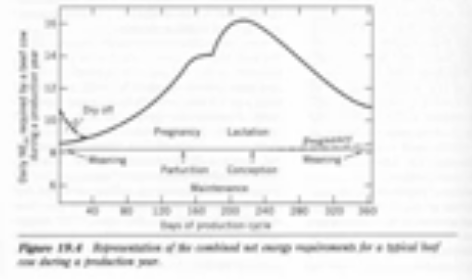
there are 4 distinct phases during the yearly cycle of a beef cow
calving to breeding (80-85 days)
peak nutritional demands
breeding to weaning (120-125 days)
moderate nutritional demands
weaning to late gestation (110 days)
lowest nutritional demands
late gestation to calving (50-60 days)
moderate nutritional demands
stay in production until 8-10 years
primarily forage based
pasture
harvested forages - hay, silage, haylage
supplemental protein and energy
concentrates - corn, soybeans
by-product - distillers, hulls, meals
other supplements
vitamins and minerals
beef calf nutrition
milk nutrition (directly from dam)
60-70% of nutrients before weaning from milk
other calf nutritional sources
pasture
supplemented forage
creep feed
calf weaned ~7 months of age
heifer development and stockers
high forage diets
supplement with protein, energy, and minerals
by products (lower starch supplements)
lots of protein
goal of 1.5 - 2.0 lbs./day ADG (average daily gain)
heifer goals
65% mature weight at puberty around 9-12 months of age
75% mature weight at 1st breeding by 14.5 months of age
85% mature weight at 1st calving at 23-24 months of age
feedlot nutrition (< 1/3 of their lifetime)
approximately 3 phases of diets
receiving (70% roughage; 30 days)
growing (50% roughage; varies)
finishing (20% roughage; 90 days)
diet composition (TMR) (everything they need will mixed in one ration)
forage
silage, hay, by-product roughages
concentrates
corn (whole, cracked, steam flaked, dry rolled, high moisture)
protein sources (soybean meal distillers grain, urea (NPN))
fats
tallow, vegetable oils, AV blends
additives
ionophores, MGA (heifers only), buffer, vitamins, minerals
dairy cattle management
stages of production
calves typically hand fed
replacement heifers
dry cows
~ 2 months when cow is not lactating
lactating cows
~10 months after calf is born
dairy cattle nutrition
pre-weaned claves
milk based diet for 6-8 weeks (separated from dam)
colostrum
“non-saleable milk”
milk replacer
concentrate starter feeds
growing replacement heifers
forage based diet supplemented with concentrates
goals
breed at 12-15 months 60% of mature body weight
calve at 22-24 months at 85% of mature body weight
mature dairy cattle
lactating cows
~ 50:50 forage: concentrate TMR
need effective fiber
high energy rations
buffers
lactation lasts ~10 months
dry cow
preparation for next lactation
critical time in dairy nutrition
higher roughage diets
sheep and goat management
divided into production segments
maternal production
ewe/doe nutrition
meat/wool vs. milk
lamb/kid nutrition
growing/finishing
feedlot lambs/kids
pasture finish lambs/kids
ewe/doe nutrition
phases of production cycle
flushing (2 weeks)
pre-breeding supplementation
breeding (< 6 weeks)
gestation (5 months)
lactation (2 months or 10 months)
highest nutritional demands
maintenance (5 months)
lowest nutritional demands
pasture based
supplemental protein, energy, vitamins and minerals
meat production
feedlot
growing phase (3-5 months)
finishing phase (2 months)
roughage and concentrates
vitamins and minerals
pasture finished
7-9 months
high quality forage
minerals and vitamins
exotic ruminants under human management
not exactly the same as domestic ruminants
feed resources vary greatly from global region of origin
selection by animal in wild is difficult to mimic
feed resource nutrient profiles
necessity of animals to be visible to audience
people love to watch animal eat
lifespan much longer than in wild
overview
to apply nutritional management, one must first understand the basics of nutrition and the general management of the species
Set 5: General Nutrition
classifying nutrition
6 classes of nutrients
protein, lipids, carbs, vitamins, minerals, and water
note energy is not a nutrient (quality of nutrients)
categorizing nutrients
essential vs. non-essential
macro vs. micro
water-soluble vs. fat-soluble
available vs. bypass (proteins)
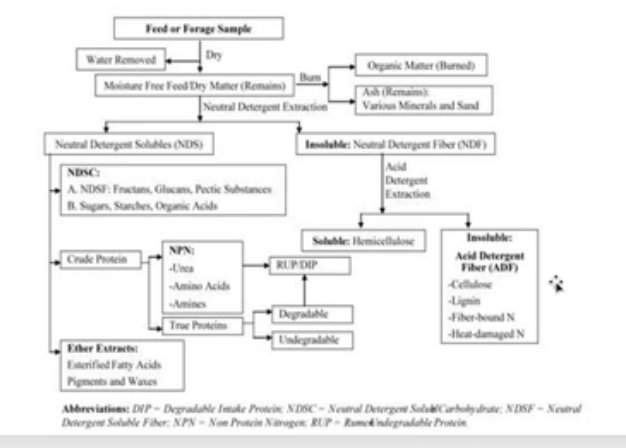
proximate analysis
summary of nutrient digestion
nutrients are broken down during digestion
metabolized by the animal or microorganisms
often utilized enzymes to break down structure into basic units
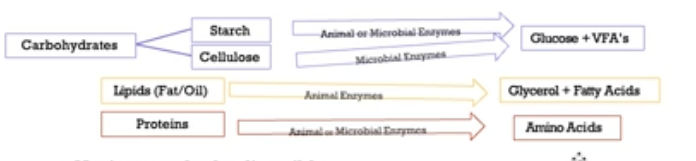
nutrients need to be digestible
diets must have the right proportion of nutrients to meet requirements
lipids are mostly broken down by animal enzymes
proteins can be digested by microbial and animal enzymes
nutrient requirements and the life cycle
animal nutrition involves eating feed to get nutrients
growth, reproduction, and production
a balanced ration:
contains the nutrients at the required concentrations for that particular animal
hierarchy of nutrient use
maintenance
development
growth
brain and CNS
bone
muscle
fat
lactation
reproduction
fattening
nutrient hierarchy
maintenance of the animal
breathing heartbeat
walking
chewing
cell structures
development
cell regeneration
learning
production purposes
growth, lactation, reproduction, fattening
meat, milk, pregnancy
nutrients throughout life cycle
start with conception
work through stages of pre/post-natal growth and development
maintenance requirements of animal post growth
reproduction
lactation
fattening
note: not all animals will go through each stage of the hierarchy of nutrient use altering requirements
prenatal nutrient requirements
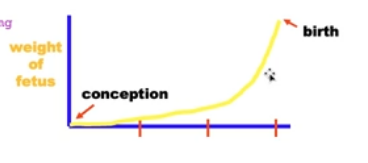
in utero growth during gestation
all nutrient are provided by dam
most development occurs in the 1st trimester
most growth occurs in the 3rd trimester
nutrient supply can alter metabolism and health of animal for entire lifetime
fetal programming: effect of nutrition of the dam to the fetus
mammalian neonatal nutrient requirements
colostrum
1st milk provided by dam
rich in nutrients: fat, protein, vitamins
supply of antibodies
provides passive immunity
immunity of newborn until its immune system matures and can make antibodies
timing of consumption is critical
antibodies and initial nutrients are large
gaps in intestinal lining begin to close within 12 hours after birth
critical for long term health of newborn
milk
transition to milk from colostrum at ~ day 2
excellent source of all (most) nutrients for that species
milk or milk replacer is species specific
veal calves are raised on milk alone
pale color of meat
main milk protein = casein
primary milk sugar = lactose
d
juvenile nutrient requirements
growth of the young animal:
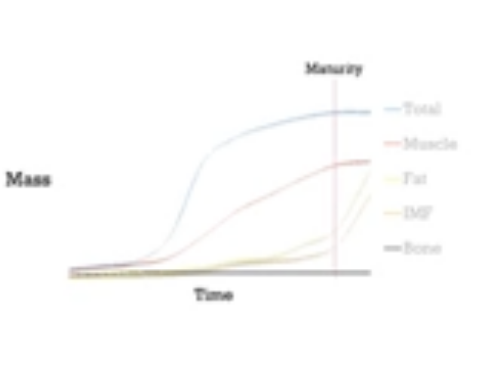
muscle growth requires protein for the building blocks
bone slowly and steadily increases as animal grows
market animals typically are harvested before excessive fat deposition occurs
hierarchy of at deposition
nutrients and life cycle
tissue growth of the animal affects the nutrient requirements of the animal
young (juvenile) animals
high protein
high energy
mature animals (maintenance)
low protein
high energy
fattening animals
low protein
high energy
reproduction effects on nutrient requirements
age of animal during reproduction will impact nutrient requirements
reproduction increases protein and energy requirements in all animals
young, pregnant females
very high nutrient requirements
she is still undergoing growth, development, and maintenance
adding in reproduction and preparation for lactation
insufficiencies = reduced genetic potential, dystocia, decreased productivity
affects fetal development
fetal programming
number of offspring
fewer fetuses = bigger fetuses
more fetuses = more nutrient requirements
less space for rumen capacity
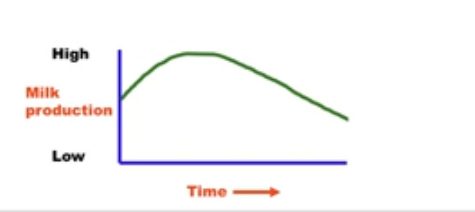
lactation peaks
goats: 55 days
sheep: 3 days
cows: 60-80 days (also the time for rebreeding)
life cycle and nutrient requirements
amount an animal can eat will affect nutrient density of diet required
animals need amount of nutrients, not percentages
total amount increases during growth while percentage declines until maturity
example of growing calf:
500 lbs. eats 4% of BW = 20 lbs.
18% CP = 3.6 lbs. CP
750 lbs. eats 3% of BW = 22.5 lbs.
17% CP = 3.8 lbs. CP
1000 lbs. eats 2.5% BW = 25 lbs.
16% CP = 4.0 lbs. CP
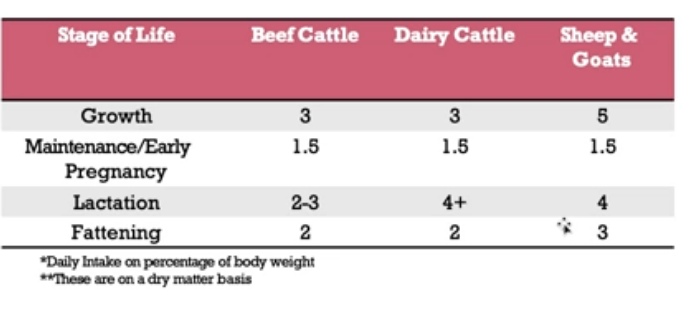
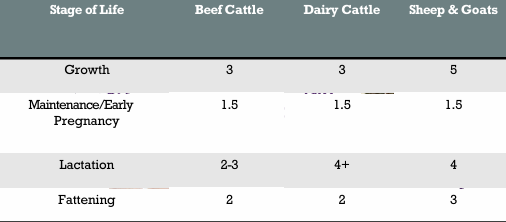
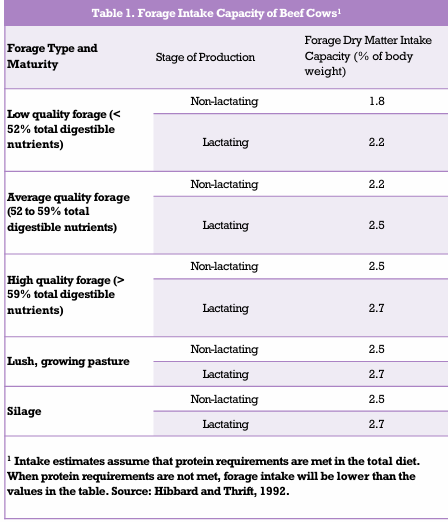
estimate of % DMI based on stage of production cycle
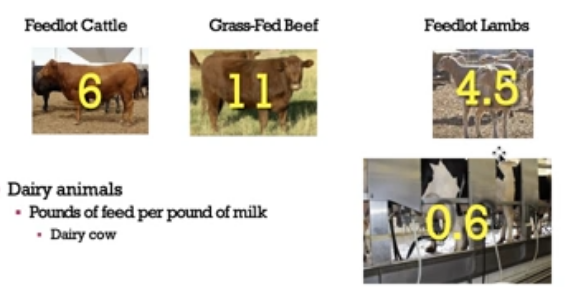
feed efficiency
meat animals
pounds of feed required per pound of body weight gain
dairy animals
pounds of feed per pound of milk
dairy cow
Week 2 Aug 25-31
Set 6: Feedstuffs
feed classification
source or part of the plant and what they contribute to a balances diet
forage/roughage
concentrate
energy
protein
supplements
vitamins
minerals
feed additives
feeds into diets and rations
there are 100’s of feedstuffs available to incorporate into ruminant diets
ingredients
availability, cost, handling, palatability
requirements
nutritional demands
putting it all together in rations
roughages
high fiber plant products and by-products
vary in protein and energy
plant species, harvet/storage
critical in all ruminant diets
may be a stand-alone diet for ruminants
main roughage categories used in ruminant diets:
forages:
pastures
hays
silage/haylage
straws
by-products
types
alfalfa: hay, cubes, pellets
beet pulp
bermudagrass: pasture, hay
citrus pulp, dried
corn silage
cottonseed hulls
fescue: pasture, hay, haylage
haylage
oat or rye: hay, haylage
orchardgrass: pasture, hay
peanut hulls
red clover
textile byproduct (cotton)
timothy: pasture, hay
wheat straw
white clover
pasture as forage resource
pastures are grazing systems in which the animal directly consumes the forage resource
wide variety of options for pasture management with impact nutritional value
plant species (fescue, bermudagrass, orchardgrass, clover)
grazing management practices
hay as forage resource
hay is a conserved forage: plant material was cut when plant was alive, dried and compressed for storage
wide variety of options for hay management which impact nutritional value
plant species (fescue, bermudagrass, orchardgrass, clover, alfalfa)
harvest conditions
storage conditions
feeding management
silages/haylage as forage resource
silage are preserved forage: plant material harvested, compressed to create anaerobic environment, and them fermented for storage
2 main types of fermented forages
corn silage
haylage
straw as roughages
straw is conserved roughages of dead plant material after the primary grain crop has been harvested
typically much lower nutritional vailue than pasture, hay, or silages
supply bulk for rumination, rumen fill
main types of straw
wheat corn (corn stover)
soybean
peanut
by-products as roughages
cottonseed hull
outside coating of the cottonseed
contains fiber (shell and lint)
highly palatable to ruminants
can be incorporated up to 30% of diet dry matter
peanut hulls
shell removed from peanuts
low every value
less than 10% of diet
concentrates
nutrition dense feedstuffs that typically contribute energy and/or protein to ruminant diets for higher production scenarios
these cannot be fed to ruminants alone, total diet must also contain roughages
broken into 2 categories
energy concentrates
protein concentrates
high energy concentrates (energy less than CP less that 20%)
4 main feedstuffs in this category
grains (starch)
potatoes/tubers (starch)
sugars/candies
fats/oils
contain fat/oil or readily available carbohydrate (sugar/starch)
concentrates: energy
barely
citrus pulp dried
cookie meal
corn: whole, cracked, steam rolled, ground
cottonseed: whole
molasses
oats
peanut processing waste
rye
sorghum (milo): whole, dry rolled
soy hulls (soybean hulls)
sweet potato
wheat midds (middlings): loose, pelleted
wheat: whole or rolled
lipids
energy concentrates - grains
seeds from plants (separated from plant)
contain protective outer covering
starch is inside the grain
in nature, provides energy for the new plant’s growth
energy concentrates - grains-corn (maize)
main grain used on all animal feed
75% of all grain utilized
very digestible
very palatable
does not cause nutritional problems when fed properly
may contain a mycotoxin (poison from mold)
energy concentrated - grain-sorghum (milo)
drought tolerant
heat resistant
more pest resistant than corn
lower yielding than corn
good for animal fee if processed
flaking or grinding
not digestible whole
energy concentrated - grains-oats
has fibrous coating on outside of seed
higher fiber than other grains
less energy per pound of feed because fiber is less digestible than starch
more expensive
energy concentrates - grain-barley
similar to oats
starch not quite as digestible
needs to process barley to increase starch digestibility
palatable
ruminants
very few problems with it as a feedstuff
cost and availability
energy concentrates - grain-wheat
higher energy compared to oats/barley because no fibrous seed coat
mostly used for human consumption
very expensive to add to livestock diets
can be fed to animals in limited amounts
starch forms a pasty mass in GI tract if feed too much
lodged wheat plants can be fed to ruminants
if not moldy
sprouted grain is okay
energy concentrates - byproducts-whole cottonseed
whole cottonseed
protein, energy, and fiber
mature ruminants only
contains gossypol
incorporate at up to 15% if diet dry matter
<0.5% of BW for mature cows
<.33% BW for growing calves
energy concentrates - byproducts-soybean hulls
great source of energy
highly digestible fiber, low in starch
will not cause bloat
will not form a rumen mat
moderate protein
concentrates - energy-potatoes
NC is #1 sweet potato state in US
limited use in cattle diets
comes in a slurry with potato chunks
low pH
concentrates - energy-sugars
molasses
quick energy source
good source of minerals
Ca, Na, K, Mg, S, Cu, Zn, Fe, Mn
reduces dustiness of feed
increases feed palatability
feed in a restricted format
concentrates - energy-fats/oils
excellent source of calories
improves palatability of feed
reduce dustiness
limited amount can be fed to ruminants
5% of diet or less
can cause problems with fermentation and the microbes
forms of lipids
rumen protected formants
vegetable oil (restaurant grease)
animal fat (rendering by-product)
concentrates - protein
protein concentrates must contain at least 20% CP, and are lower in fiber
blood meal
cottonseed meal
fed to adult ruminants only
contains gossypol
toxic to non-ruminants (death)
toxicity can occur in calves, lambs, or kids because of pre-ruminant
not deactivated with heat
no hulls so lower fiber content
distillers’ grains
increased in popularity with expansion of ethanol market
products can vary by
distilling process (ethanol for fuel vs. drinking alcohol)
other processing - fat removal
water content (wet and dry forms available)
can be great source of protein and energy
caution of incorporation rate due to high sulfur
fish meal (fine/coarse)
poultry litter (broiler/turkey)
fed to ruminants on a regular basis
still legal to feed (only temporarily banned)
concern spilled poultry fees is found in poultry litter
poultry feed may contain meat/bone meal of ruminant origin
soybean meal
does not have trypsin inhibitor
soybean screenings
urea (regular/prilled)
urea is a non-protein nitrogen (NPN) protein supplement for ruminants
does not contain AA
for the microbes
can make high amounts of microbial protein
provides nitrogen to microorganisms to synthesize protein
soybeans
can be consumed by all species
no toxin or problems
standard protein supplement
whole soybean
toasted or with the oil removed
supplements
minerals
copper sulfate
primarily added to diet as a source of copper
defluorinated rock phosphate
dicalcium phosphate
added to diets to supply calcium and phosphorus
typically, 18% P and 21% Ca
limestone
magnesium oxide
monocalcium phosphate
salt (sodium chloride)
sodium bicarbonate
trace-mineral salt
high iron
high copper (no good for sheep)
vitamins
vitamin premix
additives
aureomycin crumbles
rumensin
combinations are endless
Set 7: Forage Plant Classification
forage plants
there are lots of different plant varieties available for utilization in supplying nutrition to ruminants
complex system
livestock managers vs. forage producers
use of reliable information
consideration of timelines
use of adapted species and varieties
matching crop needs
maximizing grazing season
soil testing and fertility
climatic conditions
forage conservation resources (hay, silage, stockpiling)
animal nutritional needs
classification
plants can be classified by:
season
cool vs warm
lifespan
annual vs perennial
ability to fix nitrogen
yes (legume) vs. no (grass, forb…)
palatability as a forage for livestock consumption
yes vs. no
anti-nutritional properties
toxins
thorns
bitter
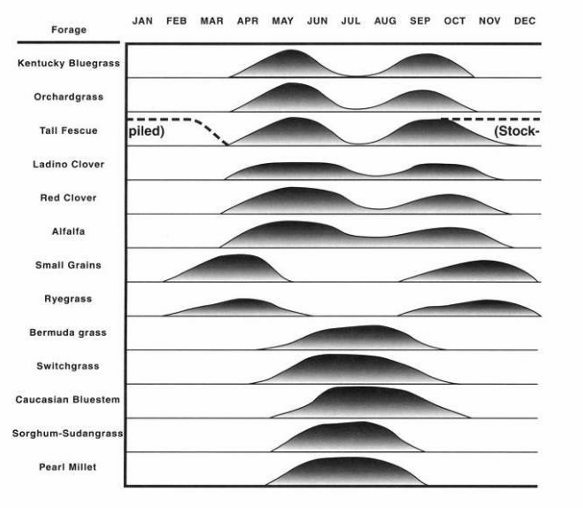
season: photosynthesis pathways
C-3 = cool season
1-3C compounds are formed which combine into glucose
fructose and sucrose
reserve energy stored as starch (more than warm season)
reactively high digestibility
higher total protein
rumen degradable protein
C-4 = warm season
4C organic acids formed (malate or aspartate)
relatively lower digestibility
lower total protein
more rumen by-pass protein
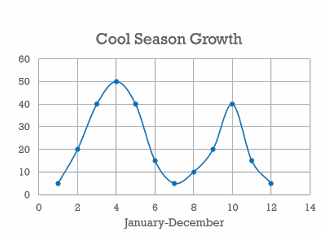
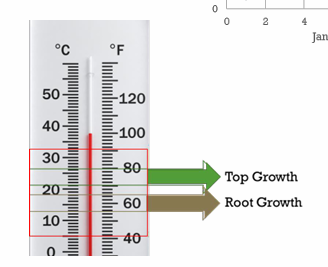
growth pattern of cool season plants
fescue
orchardgrass
bluegrass
ryegrass (A and P)
small grains (A)
prairie grassclovers (A and P)
alfalfa
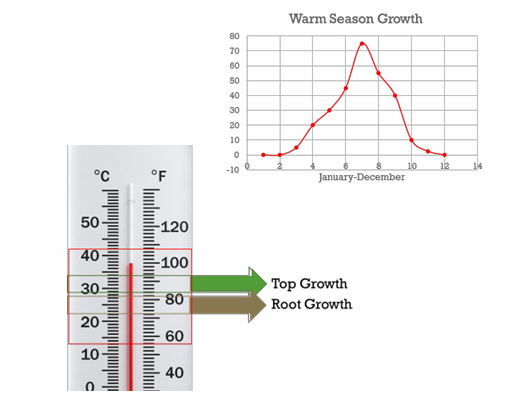
growth pattern of warm season plants
Bermuda grass
Sudan
crab grass
millet
switchgrass
gamagrass
bluestem
dallisgrass
johnsongrass
soybean
corn
annual vs. perennial
annual
corn
crabgrass*
pearl millet
sorghum-sudan hybrids
oats
barley
wheat
cowpea
soybean
arrowleaf clover
hairy vetch
crimson clover
perennial
bermudagrass
johnsongrass
dallisgrass
orchardgrass
tall fescue
timothy
kudzu
sericea lespedeza
alfalfa (last only 2-3years)
red clover (last only 2-3 years)
white clover
annual forages
annuals are great flexible option forages for ruminants
require replanting
short term flexibility
grasses and legumes, warn and cold season
work well in variety of settings
pasture, hay, haylages
cover crops
pasture transitions
perennial forages
perennials make up the backbone of forages for ruminants
grow back every year without replanting
long term sustainability
grasses and legumes, warm and cool season
work well in a variety of settings
pasture, hay, haylages
land that is not easily navigable with equipment
what are legumes
legumes have a rhizobia bacterium in the root system
found nodules on roots
rhizobia bacteria convent atmospheric nitrogen into a form the plant can use
fixing the nitrogen
higher in CP
nitrogen
what do plants do with nitrogen
make plant protein
legumes are desirable in pastures to provide nitrogen to grasses and animals
nutritional value of forages
legumes typical advantages over grasses at ideal harvest maturity:
higher leaf: stem ratio
more protein
more calcium
legumes disadvantages from grasses
can cause bloat
leaf shatter risk in hay knocking the leaves off)
alfalfa and clover
putting season and type together
cool season grasses
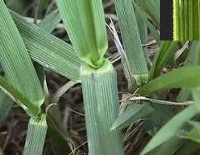
fescue
very common cool-season grass
comes in several varieties
Kentucky 31 endophyte infected
persistence, heat/drought/grazing/insect tolerant
causes toxicity in grazing animals
endophyte free
poor persistence
novel endophytes
almost as persistent as K-31
no toxicity concerns
works well as pasture or hay
orchardgrass
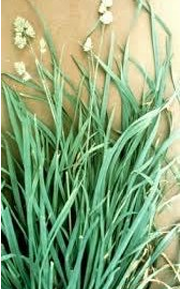
popular cool-season grass
limited adaptability across NC
mostly in the northern part of the US
good grass for grazing and hay
palatable
timothy
bluegrass
cool season legumes
clover
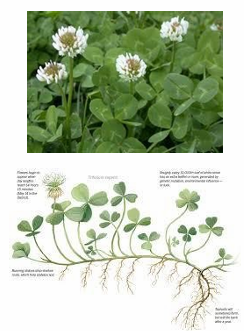
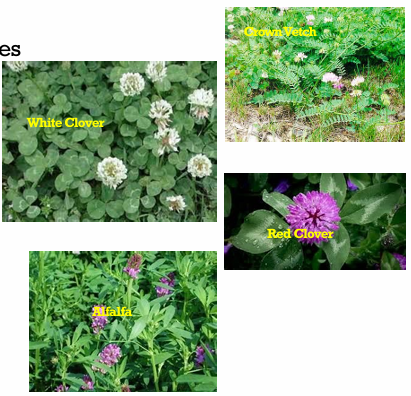
white
popular legume to add to pastures
utilization in mixed pastures with grasses so reduced bloat risk
grazing tolerant
good source of protein
lower yield due to small size of plant
red
upright growing legume
bi-annual
good source of protein
limited grazing utilization
bloat
persistence
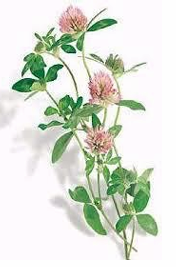
crimson
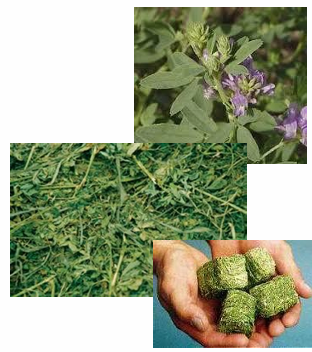
alfalfa
queen of legumes
excellent source of protein
great for hay and cubes
expensive
limited grazing utilization
bloat
persistence
vetch
hairy, crown
birdsfoot trefoil
warm season grasses
bermudagrass
grows abundantly in summer
can be grazed or made into hay
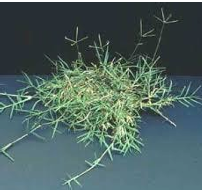
bahia grass
dallisgrass
crabgrass
warm season legumes
lespedeza
kudzu
not as popular for legumes
also, can be considered invasive
forbs and brassicas
tuberous (deep, large taproot) provide nutritional and soil health benefits (turnups_
increasing in popularity for cover-crop systems
putting the species together
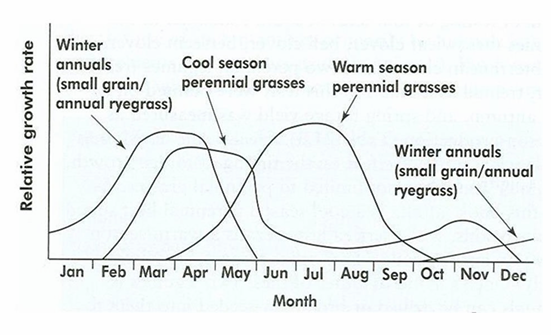
case study
goat farm has 35 acres and 75 Boer does
kid in early March
current pasture system is broken
into 3 sections
forage base is tall fescue
traces of red and white clover
currently feeding hay/grain ~6 months a year
does December to April and July to august
kids July to October
goal of marketing grass - finish kids at 80 lbs. by 7 months of age
what could the farm be doing wrong now that they are not achieving their goals? What more information do you need to know? Suggestions?
Set 8: Forage Plant Concerns
forage concerns
it takes more than knowledge of nutrition to properly feed animals
toxic plants
decreased production or death
nitrate poisoning
nitrate poisoning
excess nitrate (over .5% nitrate ion) is toxic to ruminants
excess fertilization can lead to high nitrates in some forages
NCDA tests forages for nitrate at no charge
some ruminants can be adapted to higher levels of nitrogen
if the animal has never been exposed to that forage/area/high nitrogen it can be fatal
prussic acid poisoning
prussic acid forms in some plants when they are stressed by drought or frost
this hydrocyanide acid is highly toxic to ruminants
prussic acid can be a problem with:
sorghum/suban grasses
wilted leaves from cherry trees
ergot alkaloids and fescue
tall fescue is widely distributed across the mid and eastern US
over 35 million acres of pasture and hay land
there are different types of fescues
also, with rye grass
Kentucky 31 fescue
“Kentucky 31” fescue is the most prevalent type in NC and elsewhere
it withstands drought, flooding, overgrazing, trampling
this resistance to harsh conditions comes for the symbiotic relationship with an “endophyte”
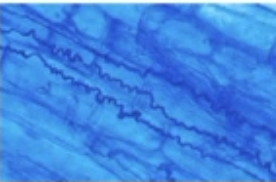
endophyte infected fescue
cattle
growing cattle
rough hair
heat stress, panting
low growth rate
increased respiratory rates
vasocontraction
brood cows
decreased pregnancy rate
decreased milk production
endophyte free fescue
fescue varieties selected without endophytes
no health problems for cattle
not suitable solution to problem
expense of “destroying” pasture and replanting
not drought, insect, or grazing tolerant
lacks persistence
novel endophyte fescues
now we have endophyte friendly fescue
example of novel endophyte fescue:
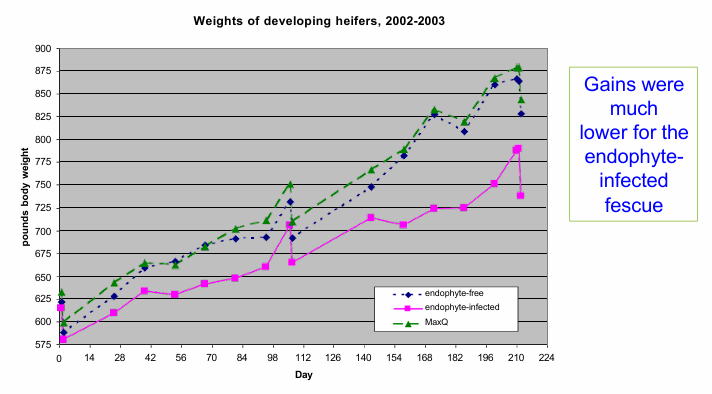
Max Q
has modified endophyte
hardy, but nontoxic to ruminants
it does a good job of keeping E-infected fescue out
still have expense of re-establishing pastures
takes 20-30 years
have to use cover crops
decreased land utilization
animal growth based on fescue type
Set 9: Feed additives
feed additives
what is an additive?
included in diet for reason other than nutrition
non-nutritive
if additive is classified as a “drug” it is regulated by the food and drug administration
withdrawal time
inclusion limitations
takes years to get approval
types of feed additives
antibiotics
anthelmentics
probiotic
ionophores
coccidostat
bloat guard
others…
safety concerns
approval
antibiotics
antibiotics kill or slow bacteria
do not impact viral diseases
concerns with use of antibiotics
withdrawal time
microorganism resistance
highly controversial issue
most regulated
misuse and overuse
not used in most natural or any organic programs
types
bacitracin methylene disalicylate
chlorotetracycline
monensin
tyloxin
carbodox
feed- grade antibiotics for disease outbreak
veterinary prescribed (VFD - veterinary feed directive)
short-term cure
narrow spectrum
disease prevention
rare cases (not widespread use)
broad spectrum
weaning/feedlot entry
ionophores
ionophores are rumen fermentation enhancers through altering rumen bacterial populations
improve rumen fermentation efficiency
less methane and carbon dioxide
more propionate and less acetate
less lactic acids
lower risk of acidosis
other benefits
less coccidiosis, flies, bloat
common added to stocker and feedlot cattle
examples
monensin (rumensin)
lasalocid (bovatec)
laidlomycin (cattlyst)
coccidiostats
coccidiosis can be a fatal disease
cattle
sheep
goats
decoquinate (Deccox) is often used as coccidiostat
anthelmintics
what are anthelmintics
control internal parasites
considerations for feeding
parasite spectrum
withdrawal time
seasonality
cost
deworming is hard
pre- and post- deworming
parasite burden and shedding
fly control
larvacides
deposited in manure and kills fly larvae upon hatching from eggs
Altosid
Rabon
ClariFly
probiotics
mixture of living bacteria/yeast to establish a desirable microflora in GI
good microbes
how do they work?
microbial competition
improve fermentation
healthy gut
common bacteria
lactobacillus
streptococcus
bifidobacterium
saccharomyces
bloat control
bloat = build up of gas in rumen
can be fatal
poloxalene (bloat guard) prevents legume (frothy) bloat in ruminants
can be fed as molasses blocks, lick tanks or granular forms
buffers
high starch diets
decrease rumen pH
buffers help increase pH
keep it closer to neutral
improve fermentation
prevent acidosis
examples
sodium bicarbonate (bi-carb) (baking soda)
potassium bicarbonate
calcium carbonate
acidifer
ammonium chloride
used to acidify urine of small ruminants
prevention and treatment of urinary calculi
beta agonists
promote lean growth
Ractopamine
“Optaflezz” for finishing cattle
Zilpaterol
“Zilmaz” for finishing cattle
temporarily off the market in 2013
beta agonists result in leaner and less fat
not approved for use in breeding animals
hormones
hormones are not routinely added to animal feed
only one hormone is approved as a feed additive:
MGA (melengesterol acetate)
mimics progesterone to alter estrous cycle in cattle
beef cattle only
stops their reproduction cycle
saves energy that can be used for growing
feed additives
remember:
feed additives are non-nutritive
therefor mineral supplements and vitamins are not in this category
Week 3 Sept 1-7
Set 10: Digestion Calculations (Estimating Digestibility)
determining digestibility
waste most of what is consumed
25 lbs. of dry matter intake per day
40% digestible
60% indigestible (15 lbs. of dry matter excretion) (30 lbs. on a wet matter biases which is more than it ate. this why some ruminant operations are targets more waste than initial output)
methodology for apparent digestibility
total fecal collection
measure everything going in and everything coming out
bag attached to animal or crate behind animal
marker methods
utilize an indigestible marker and put known concentration in and the collect representative fecal sample coming out and adjust calculations based on marker concentration
chromic oxide
ytterbium
determining apparent digestibility
(intake - fecal output x 100) / intake = % apparent digestibility
1. dry matter intake
how much was actually consumed
1-2 weeks for feed adaptability transition
2. fecal output
1. total fecal collection
5-7 days
2. digestive markers
3. length of collection
1. need adjustment period
determining apparent digestibility of whole diet
intake - fecal output x 100 = % apparent digestibility intake
example: lamb
1000 g/d as is consumed
diet is 87% dry matter
55% NDF
11% CP
500 g/d as is feces
feces is 60% dry matter
60% NDF
10% CP
determining apparent DM digestibility
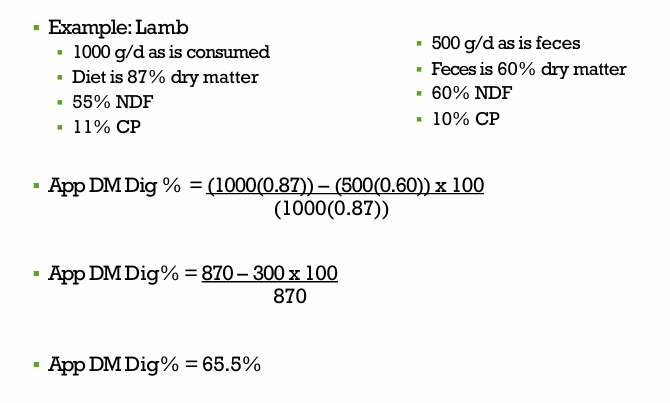
determining apparent CP digestibility
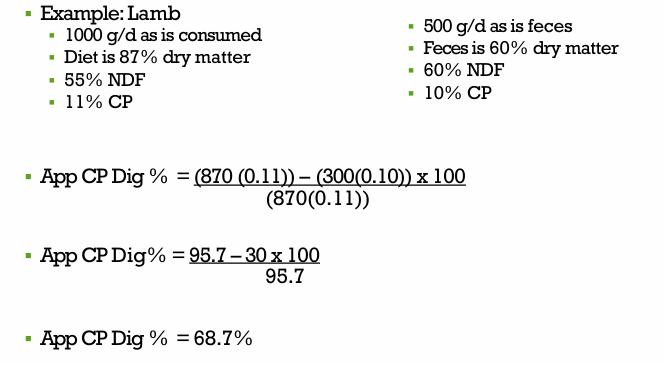
determining apparent NDF digestibility
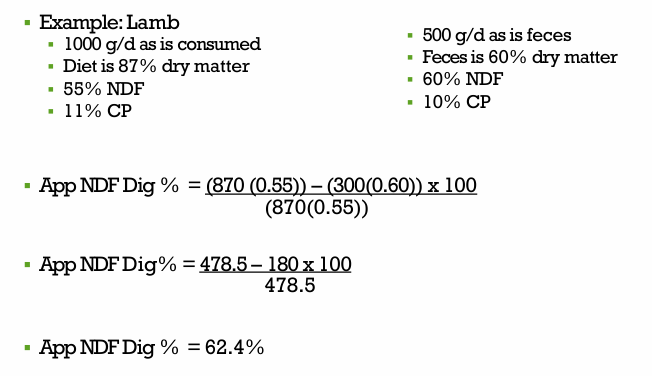
estimating digestibility of diet components
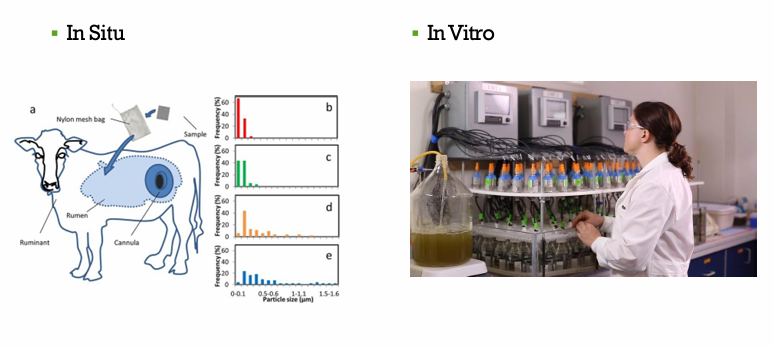
in situ = with the animal use mesh bags and then put it into the rumen and then take out 24-48 hours later
in vitro = can be used to show more measurements
uses rumen fluid
estimating digestibility
showing byproducts
adjusting for markers
alternatives
are the approving feed efficiency of the rumen
Set 11: Digestion
digestion
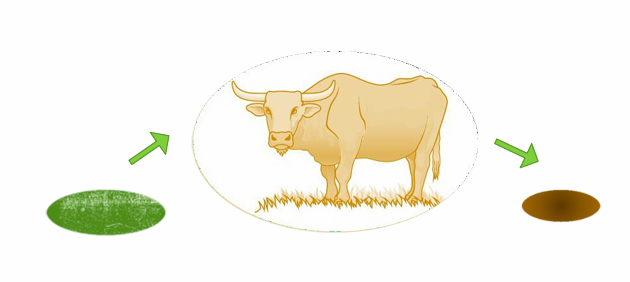
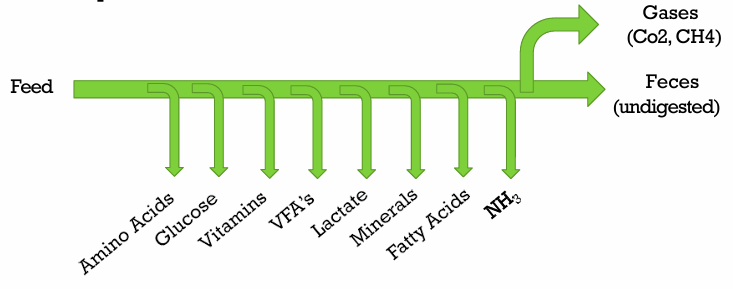
the process of events that occur in the GI tract that breaks down complex feeds into water soluble molecules available for absorption
how?
strategies vary species
overall goal is to survive long enough to reproduce
concentrate selectors (moose, mule deer, white tailed deer)
intermediate types (mountain goat, pronghorn, goat, elk, bison)
grass/roughages eaters (sheep, cattle, mouflon, aurox)
quality attributed to more cell contents and less cell wall
cattle have a larger omasum for stems that sheep which are more selective eaters
prehension
mouth
seeking out food
microbial fermentation
rumen and reticulum
acid and enzymatic hydrolysis
abomasum and small intestine
water capture
microbial fermentation
cecum and colon
factors affecting digestibility of feed
what determines how much of a feed will be digested
feed intake
papillae development
negative associative effects
feed processing
rumination
positive associative effects
fiber and lignin content
microbial population
passage rate
10-15% of energy is actually retained in the growing animal
stomach development of “pre-ruminant” to “ruminant”
esophageal groove
calcium salts in milk stimulate muscles to close
shunts milk to abomasum
avoid microbial breakdown of milk proteins
abomasum
rennin production to coagulate milk
slows down passage rate to increase digestibility
milk replacers have to have thickeners in them because they don’t really react to rennin
holds large volume of milk
small intestine
first 24 hours low trypsin activity and loose cell junctions
low amylase production at birth
never any sucrase production
no digestion of sugar but can be used for rumen fermentation
if digested in the hindgut scours will occur
no sweeteners added to milk replacers
lactase and lipase are adequate
large fat globule absorption and about 100 g of IgG absorption
rumen development
needs to be inoculated by mother
papillae
line rumen interior to increase surface area
very small when on milk diet
grows rapidly with feeding of solids
butyrate is desired VFA substrate
rumen capacity
rumen capacity increases at greater rate than rate of body weight growth
increasing intake of digestible forage per unit of energy needed for body weight gain
nutrient deficiencies
inhibition of microbes
decrease microbes
water
nitrogen
these are vital nutrients for the microbes
feed intake
increasing feed intake = increased rate of passage = decreased digestibility
important consideration for fine chopped forages and grains because they fit through the omasal orifice
need a dense fiber mat
passage rate
passage rate ←→ feed intake ←→ digestion
different layers will have different passage rates
liquids will flow faster
complex relationship on intake and disappearance
digestion, absorption, passage (urination and defecation)
liquid and solid fractions have differing passage rates
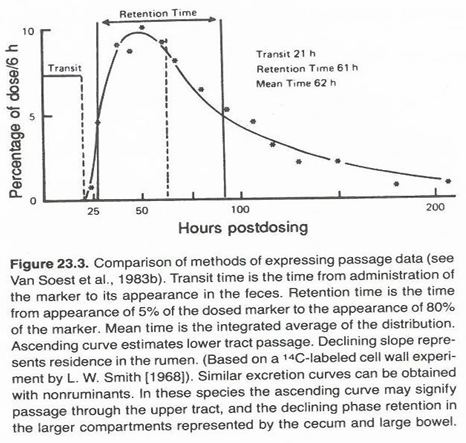
passage rate is about 48 hours for solids in the rumen
comminution (reduction of feed size to swallow)
chewing during eating only reduces size enough to soften and swallow
more size reduction by rumination after interior parts of plants have been removed and cell wall weakened through microbial degradation
sorting of layers of digested feed in rumen
trapping of CO2 inside plant stems (will float and form rumen mat)
feed processing
grinding of grains
increases digestibility
ex. 92% corn diet
cracking the feed increases the starch availability
be aware of acidosis and high blood sugar

example hay diet
smaller particles will be washed out of the rumen decreasing digestibility
retention rate is crucial for fermentation
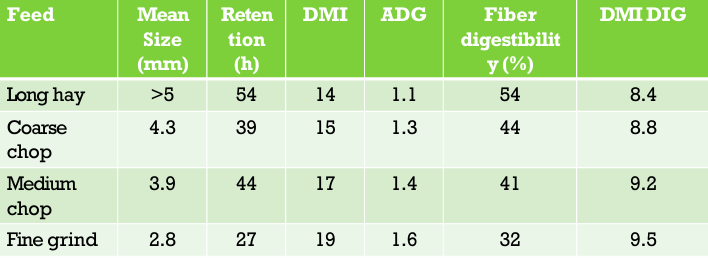
associative effects on digestion
characteristics of one feed affect the digestion of another
can be positive or negative
rumen adaptation time
starch vs. fiber fermenter bacteria
negative associative effects
forage + grain
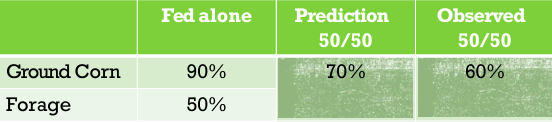
grain depressed forage digestibility
this happens because the grain decreases the rumen pH making forage harder to digest
positive associative effects
forage + forage
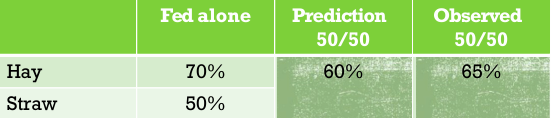
improve forage digestibility with providing forage with adequate energy
factors affecting digestibility of feed
site of fermentation (rumen vs. cecum and colon)
VFA provide energy to animal regardless of fermentation site of origin
can be in the rumen or colon
sheep have more post rumen fermentation the cattle
microbial protein and AA that are produced after the abomasum will probably not be absorbed and flushed out
microbial protein
microbial protein flowing to duodenum can be digested and AA absorbed
microbial protein produced in large intestine or cecum provide no AA to animal
papillae development
vary throughout life of ruminant
start small, enlarge, degenerate
“scratch” theory on papillae
minor effect on development
when forage in the diet is low the papillae degenerate
important in calves and when switching from forage to grain diets
specialized bacteria colonize rumen epithelium
ureolytic
urea = 2 ammonia = bacterial protein
5% CP from urea to 9% usably CP
volatile fatty acids
production per mol of glucose
2 acetate (CH3COO-) + 2 CO2
2 propionate (CH3CH2COO-)
1 butyrate (CH3CH2COO-) + CO2
ratio of protonated form (RCOOH) to dissociated/anionic form (RCOO-) dependent on pH and pKa
5-10 lbs. of sodium bicarbonate (NaHCO3) per 40-80 gal saliva/day

volatile fatty acids
VFA absorption and rumen pH
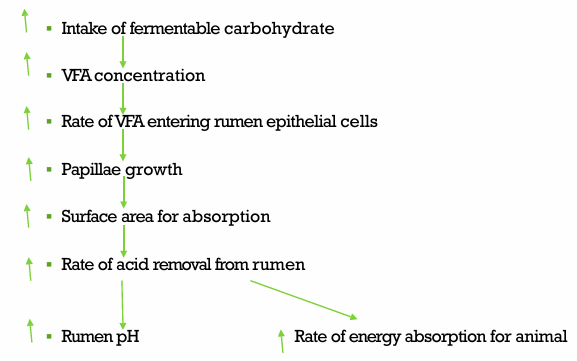
factors affecting digestibility of feed
motility of stomach
mixing of new feed with colonized feed particles
move and mix bacteria and fungi
the moving of feed also stimulates papillae growth
coordination of swallowing, eructation, regurgitation
rumination
scratch factor
health of the animal
reduced motility is used as clinical signs of health problems
hardware disease
intestinal compaction
displaced abomasum
flip or twist in the gut
acidosis (grain overload)
time spent ruminating is clinical observation as well
health of animal
rumen parakeratosis (rumen papillae become hard and keratinized after acidosis and crack)
result of continual exposure of rumen to pH below 6.0
pits in rumen epithelial barrier an allow “leakage” of bacteria into blood
abscessing of liver typically not seen until inspection of carcass
could reduce function and efficiency
10-20% of slaughter animals have abscesses on their livers
happens a lot in dairy cattle
antibiotics and/or ionophores can help efficiency
reminsion and bovatech
bloat
legume bloat
proteins in certain legumes stabilize foam in rumen
grain bloat
starch producing bacteria produce a slime that stabilizes bloat
digestion and absorption from small intestine
digestion and absorption in the small intestine is similar to that of non-ruminants
similar enzymes
considerable increase in surface area of epithelium in small intestine resulting from villi and microvilli
low pancreatic lipase and related enzymes
not that much fat digestion aka low lipase
adequate proteolytic enzymatic activity for very good protein digestion
digest microbial protein
digest free AA
absorption of AA by small intestine is via active transport
AA balance
ruminants have limiting AA(s) just like non-ruminants
beef and dairy NRC (national remodels
AA imbalance is a metabolic disturbance caused by feeding an excess of an AA
diets imbalanced and depress feed intake
problems increase when rumen protected AA’s
methionine (1st limiting AA in ruminants but too much is also bad)
adequate amylase for intestinal digestion
ruminal microbes possess amylase activity
for starch to glucose
pancreatic amylase activity
hindgut starch digestion
Set 12: Feed Intake Calculation (Feed Intake Impact and Estimation)
mechanisms of feed intake regulation
what determines how much a ruminant will eat
feed factors
physical
body weight
body temperature
pregnancy
lactation
endocrine
fat
palatability
environmental temperature
chemostatic/metabiotic
impact of feed intake
1. directly influences production
eat more, gain more, more milk (profitability)
example
600 lb. steers
corn silage based diet (65% moisture)
requires 7lbs. of DM for maintenance
A. eats 13 lbs. of feed DM/d and grains 1.6 lbs./d
feed conversion = 13/1.6 = 8.1
B. eats 17.6 lbs. of feed DM/d and gains 2.7 lbs./d
feed conversion = 17.6/2.7 = 6.5
2. total mixed rations (TMR)
most common type of diets in industry (beef feedlot/dairy)
concentration basis
examples
weaning and transportation stress of beef calves
will have to increase CP intake to 17-19% CP
early lactation Holstein dairy cow
17-18 CP at first and later in lactation 15% CP
hot summer
rumination increase heat production, so a nutrient dense diet decreases feed intake
3. changes associated with metabolic disorder
ketosis
late gestions or high milk production
acidosis
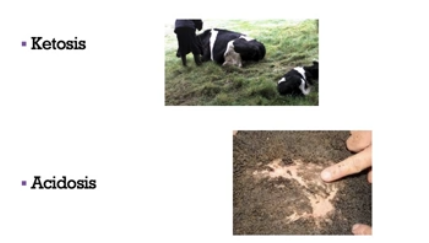
4. key factor in forage utilization and value
60-70% of value of forages is dependent on how much will be consumed
tools for calculating feed intake
on average: 2-4% BW on dry matter basis
NRC (National Research Council) feed intake equations
beef cattle (pregnant mature females)
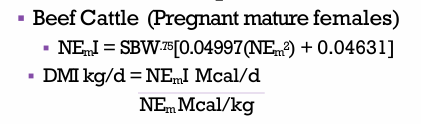
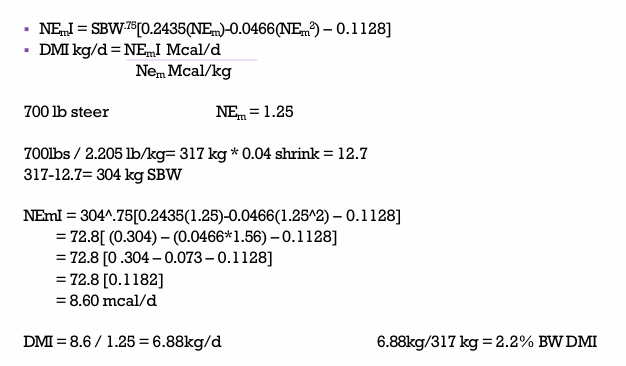
NEm = net energy maitanence
assume 4% shrink
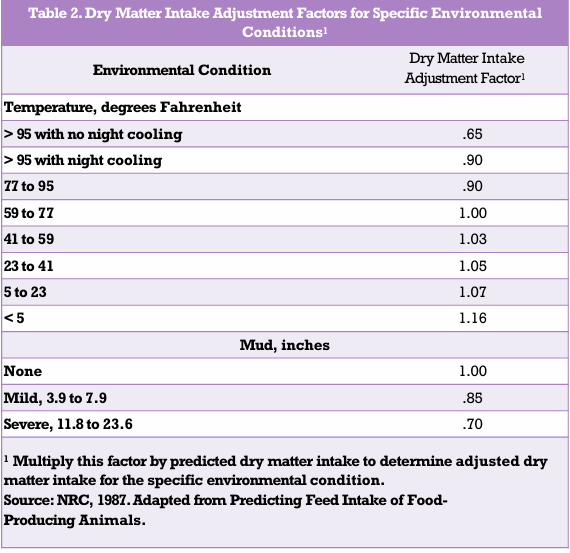
NRC has additional adjustments for: mud, temperature, milk production
example beef cow DMI calculation
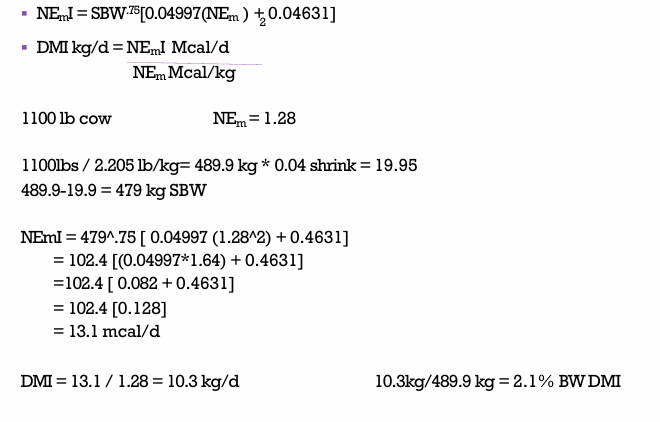
NRC feed intake equations
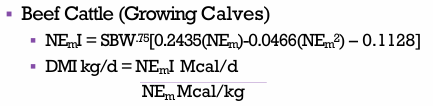
assume 4% shrink
NRC has additional adjustments for: breed, body fat, implants, temperature, mud
example beef finishing DMI calculation
tools for calculation feed intake
dairy cattle
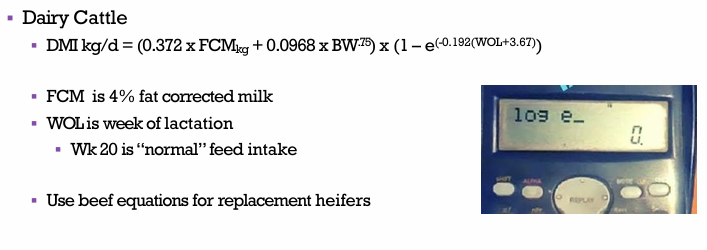
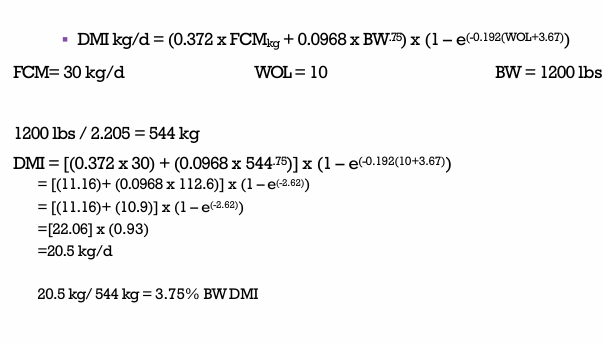
use beef equations for replacement heifers
example dairy cow DMI calculation
summary of dry matter intake
decrease relative energy requirements
drive gain
#1 factor for milk production
cost of intake
calculating NRC DMI expectations
Set 13: Feed Intake Regulation
importance of feed intake
approximately 2/3 input cost of a livestock operation is spent on feed
therefore, it is critical to combine
what an animal eats and how much an animal eats
with what the animal produces
mechanisms of feed intake regulation
what determines how much a ruminant will eat?
fat, environmental temperature, chemostatic/metabolic, pregnancy, physiology, body temp, body weight
1. palatability
acceptance of a feed to the animal
taste
smell
moisture
memory
texture
avoidance compounds
animal by-products
fats/oils
endophytes
tannins
molds/mildew
2. physical
gut fill
stretch receptors send neural feedback to regulate feed intake
limits to expansion ability = stretch receptors
rate of fermentation
ADF and NDF digestibility
quality of the forage
passage rate
physiological state of the animal
pregnancy, lactation
feed moisture
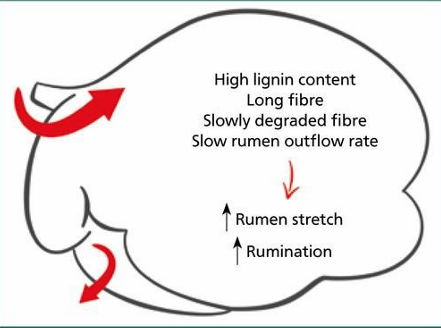
2. fiber intake regulation theory
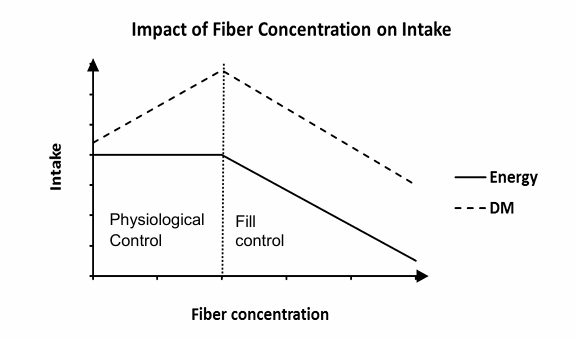
3. chemostatic or metabolic
animals eat to satisfy their energy needs
ruminants rely on volatile fatty acids regulation
mechanisms of regulation are complex pathways
acetate = rumen wall
propionate = liver
blood glucose much lower impact on ruminants
much lower concentration than non-ruminants
lower fluctuations associated with meals
will also rely on their innate hunger/fill the animal will eat more if their body tells them to because it is fulfilling a nutrient requirement
digestible energy intake regulation theory
Dr. H. Russell Conrad (The Ohio State University)
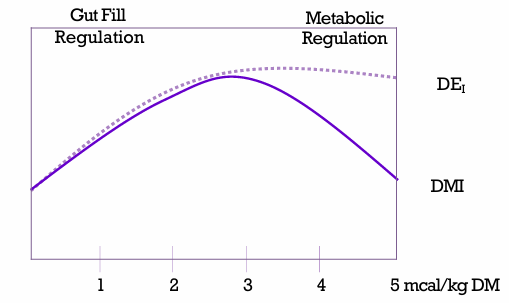
why can hormonal implants work in ruminants but not non-ruminants?
estrogenic impact on glucose
increase blood glucose decrease feed intake
why can ionophores work?
alter rumen microbial population to increase propionate and decrease acetate production
monensin can decrease feed intake because feed can be digested better

nutritional wisdom
toxic factors
endophyte (alkaloid)
selenium
cyanide (prussic acid)
nutrient deficiencies
nitrogen
minerals
can stimulate feed intake
feeding grain tend to decrease forage intake
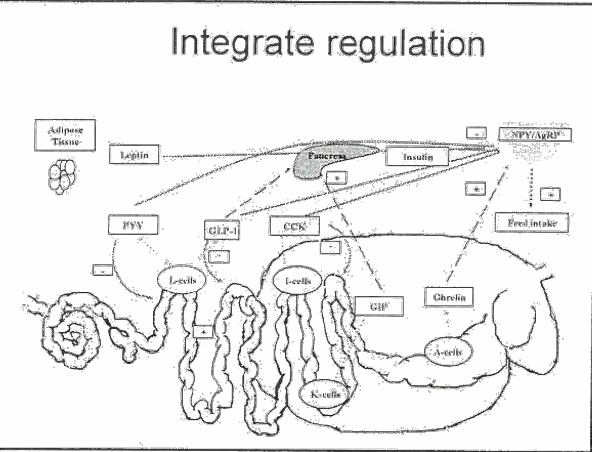
4. endocrine
hormones regulate feed intake
increase feed intake
neural peptide Y (NPY)
works with the hypothalamus
inhibited by insulin production
opposite impact of leptin
melanin concentrating hormone (MCH)
increases feed intake
ghrelin
hunger hormone
also causes stomach growling
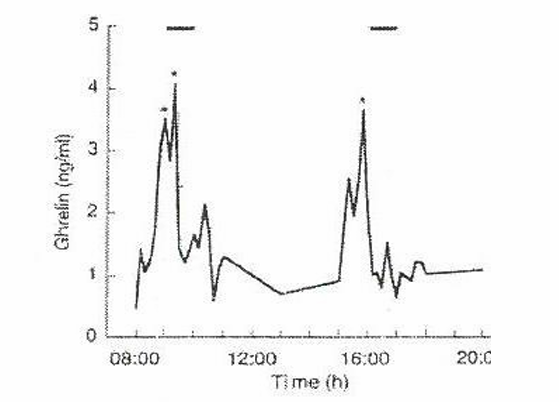
hormones
regulated feed intake
decrease feed intake
leptin
produced in fat cells (more produced in beef cows)
inhibits NPY
insulin
inhibits NPY
stimulated with high glucose levels
insulin growth factor 1 in the liver
GLP-1
the presence of fat in the small intestine causes the release of GLP-1
increases insulin production
CCK
cholecystokinase
decrease gut motility
inhibits NPY
GIP
5. environmental temperature
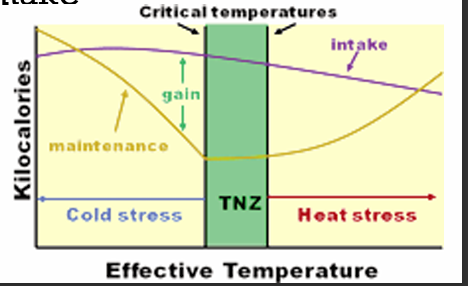
thermal neutral zone
cattle = 50-70 F
heat stress = decreased feed intake
cold stress = increased feed intake
6. body temperature
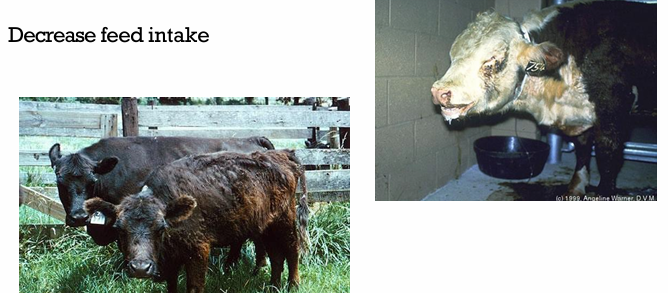
conditions that raise body temperature
illness, fescue toxicosis
decrease feed intake
7. pregnancy
last 2 months of gestation
increased fetal size
decreased rumen space
gut fill regulation takes precedent
decrease feed intake
8. lactation
increased feed intake
increased energy requirements
increased gut capacity
increased gut motility
less stress on the rumen wall from pregnancy
the release of oxytocin and prolactin increase gut motility
9. body weight
increasing body weight results in increased feed intake
not in a linear relationship
metabolic body weight
BW^.75
10. fat
body fat
adipose tissue is not just a storage vessel for extra energy
endocrine organ
start decrease DMI at BCS 6
BCS 1-9 in cows
dietary fat
intake will affect total DMI
>5% dietary fat will decrease DMI
11. feed factors
moisture
mold
forage quality
physical form
fat
N or S deficiency
NH3 (NPN) (urea)
sulfur toxicity
distilling of corn
0.35% will start decreasing food intake
Week 4 Sept 8-14
Set 14: Effective Fiber
ruminants need fiber - acid neutralization
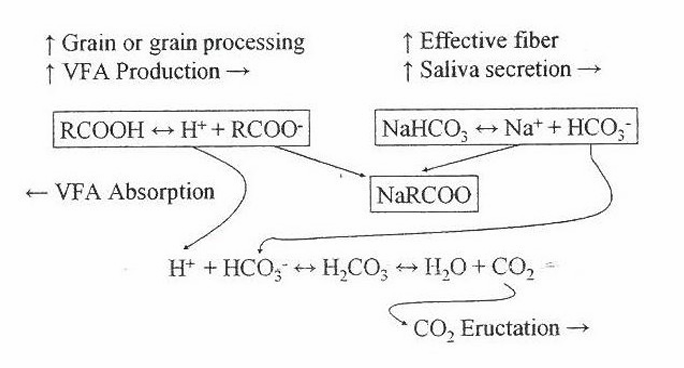
saliva is about 10-20% sodium bicarbonate
Carboxyl groups/VFA have to be protonated to be absorbed across the rumen wall
effectiveness of fiber
concept is NDF% x % effectiveness = %eNDF
forage NDF> non-forage NDF for eNDF
effectiveness is based on the ability to stimulate rumination and chewing
eNDF not in the NRC because of the incomplete data
many ration balancing programs have terms:
eNDF: the effectiveness to maintain milkfat %
peNDF: the physical effectiveness to maintain chewing relative to a forage standard
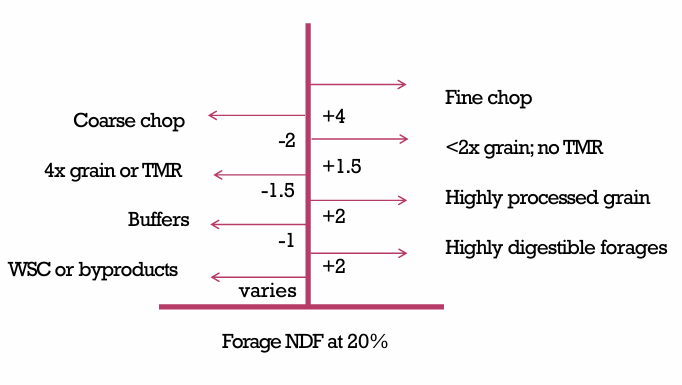
example of effectiveness calculation
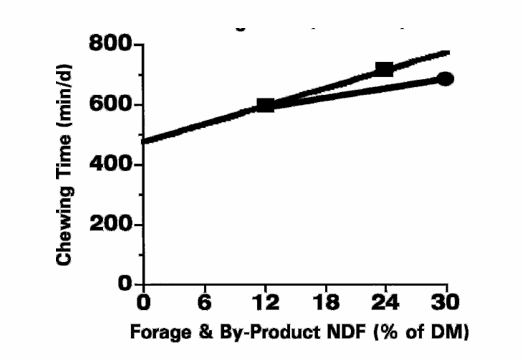
anything under 12 is not considered effective and might decrease chewing and rumination time
milk fat and rumen pH
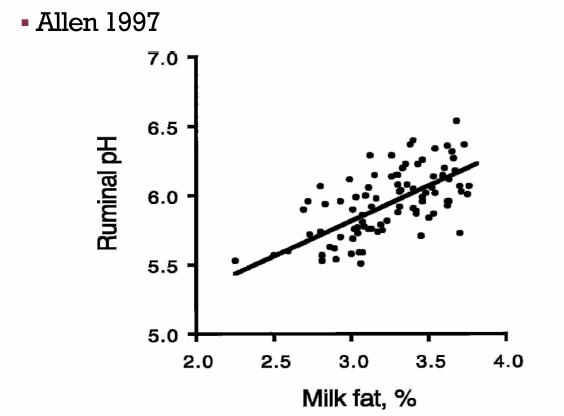
the lower the rumen pH the lower the amount of milk fat
good indicator of eNDF and that effects more than just chewing
effectiveness of feedstuffs
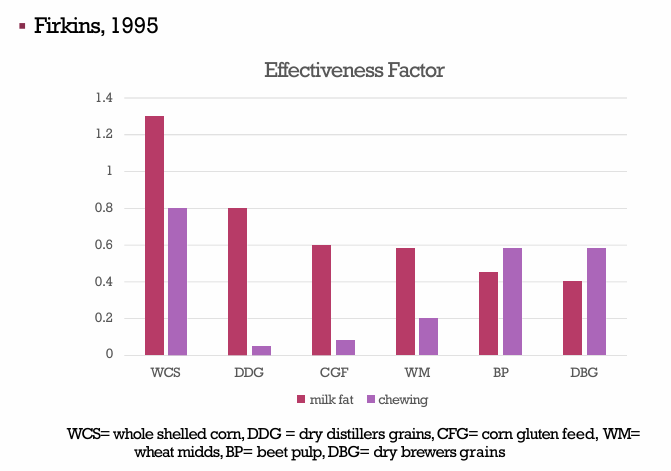
remember by-products are very variable so one batch might not as effective as the next
usable measures of effectiveness
effectiveness values or forage NDF are guidelines, with considerable variation among farms
chewing hard to measure on farms
milking parlor
milk fat
at least 40% of the cows should be chewing cud anything else you have to look at management
are the cows sorting the feed
are the feed particles too small
heat stress
cow comfort
stall size
some nutritionists spend a lot of time studying feces
chewing is hard to measure ruminants spend 6-9 hours chewing
so looking about milk fats a good reference of how the rumen is doing
manure screening and scoring
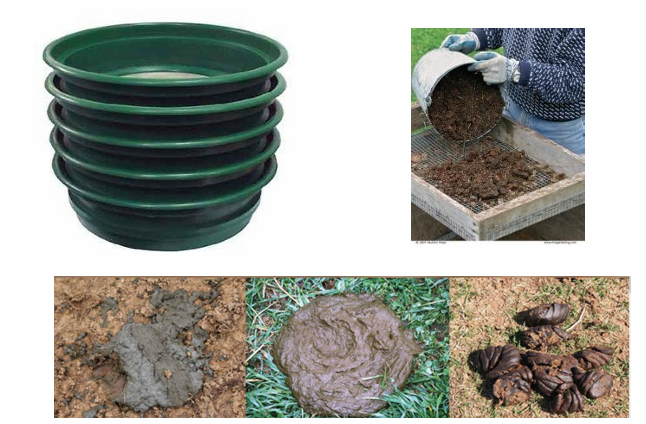
long loose feces might mean not enough long forages to stimulate fermentation rumen
functional specific gravity
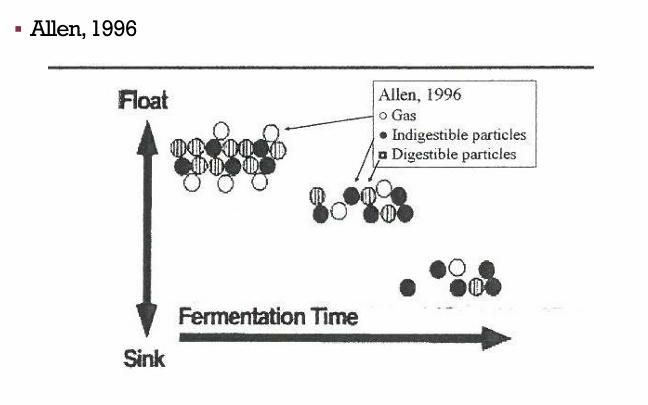
they type of feed and size determines where it will be n the rumen
the rumen mat is formed by fibrous particles that lock together and typically have greater digestibility and produce more gas as it is being fermented
spend longer time in the rumen
small particles sink and cannot trap gases like larger particles
things that inhibit CO2 production can inhibit digestibility and speed up passage rates requiring the animal to eat more feed
Penn state separator
horizontal shaking separates by length
check diet before feeding
can help estimate the NDF
can help see if animals are separating feed
good for pre and post screening
NDF for dairy cattle
maximal
dietary NDF
35-40% of total diet
forage NDF
>25% FNDF can decrease DMI
minimal
forage NDF
<20% FNDF can decrease digestive efficiency
<15% FNDF can decrease DMI
minimum forage NDF to neutralize NFC
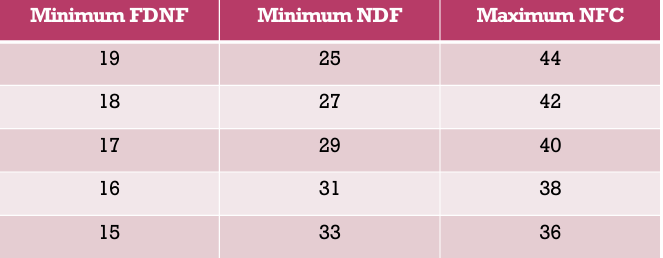
NFC = non forage carbohydrates
might have to give buffers to decrease the risk of acidosis
adjustment to forage NDF
conclusions
getting better at defining role of fiber and fiber requirements
balance or adjust for rumen-degradable starch
prevent excessive particle size reduction in mixer
prevent sorting
as variability increases or feeding management decreases the need more effective fiber
Set 15: Microbes (rumen microbiology)
rumen microbiology
ruminant animal
lack of enzymes to digest fiber
cellulose (beta 1-4 linked complex carbohydrate)
hemicellulose and pectin are alpha 1-4 linkages
like uronic acids
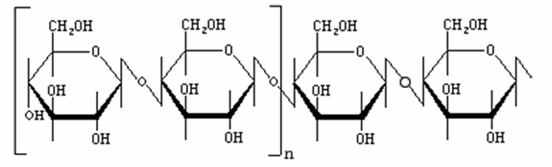
symbiosis with microorganisms
fermentation
hydrolysis of carbs makes VFA (short chain carbs), methane, and carbon dioxide
rumen conditions (constantly changing)
general ruminal conditions
temp: 39-41 C
pH: 5-7
gases: CO2, CH4, N, H, O2
the type of diet depends on the saliva contents
buffers
urea can go in and out of the rumen wall and into saliva
volatile FA: acetate>propionate>butyrate
differential removal of solids
complex an intermittent
substrates available
passage rates
sodium bicarb = changes rates of passage by changing what and the amount digesta is in each layer of the rumen
microbial diversity
always changing and adapting
complex nature of feed
highly specialized or widely adapted
ability to accomplish maximal growth
altering nutrients/substrates alters fermentation
biochemical interactions affect cell growth and conditions for each reaction vary
rumen microbiology
3 main classes of microorganisms
bacteria
~ 10^10/ml or /g
~ 50% of microbial biomass
different species
protozoa
~ 10^6/ml
~40% of the microbial biomass
fauna of rumen
holotrichs (ciliates) vs. entodiniomorphs (flagellates)
fungi
10³/ml
5-10% of microbial biomass
bacterial species
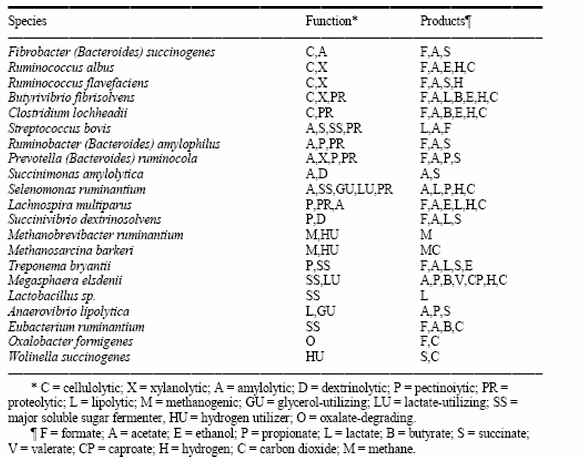
2 main classifications
what are their substrates
what are they producing
lytic = lyses molecular bonds for energy
examples = cellulolytic, xylanolytic, amylolytic …
microbes produce reduced environment produces reduce carbons such as methane
host produces oxidized carbons such as CO2
bacteria
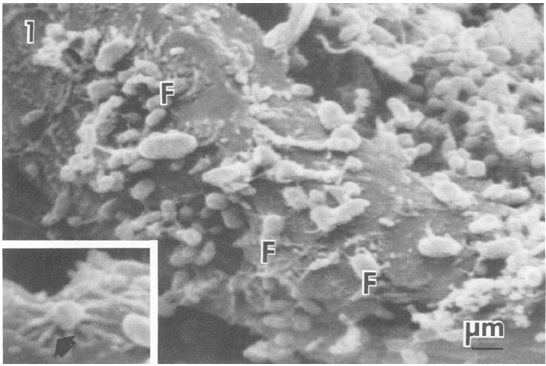
1st step is attachment most bacteria are not good at moving so they rely on being bumped into feed particles
primary colonizers
degrade cell wall to expose rest of plant cell
1. cellulolytics
prefer pH>6
degrade crystalline and cellulose structure
2. hemicellulolytics
digest mostly hemicellulose
some can digest some cellulose
generals but cannot compete with cellulolytics for cellulose
3.pectinolytics
rapid digestion w/o lowering pH
not much lactic acid production
digest pectin
polysaccharides and sugars for microbial energy
colonize on inside of cell wall due to wax of cell wall
competitive for substrate
exponential growth rates
fiber breakdown is slow because of branching structure (increases with maturity)
secondary colonizers (grow rapidly)
not capable of breaking down cellulose cell walls
produce AA, ammonia, and growth factors that the primary colonizers use
1. amylolytics
dependent on starch in diet - rapid reproduction
can be proteolytic and break down protein matrix around starch
2. sugar fermenters
also amylolytic
ex. Streptococcus bovis
produce lactic acid which is high energy wastage
tolerant low pH - rapid reproduction
3. lactic acid users
hold back 1 and 2 users unless diet change too fast
slow growth, not acid tolerant
convert lactic acid to propionate and butyrate
degrade cytoplasmic contents of cells
starches, sugars, proteins
not capable of digest cell walls and most cellulose
synergistic ecology
can grow without restriction
acidosis risk
interact with primary colonizers
use substrates from primary colonizers
protozoa
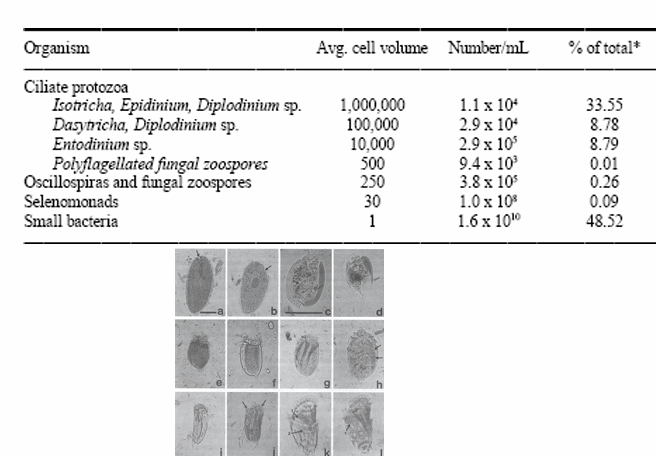
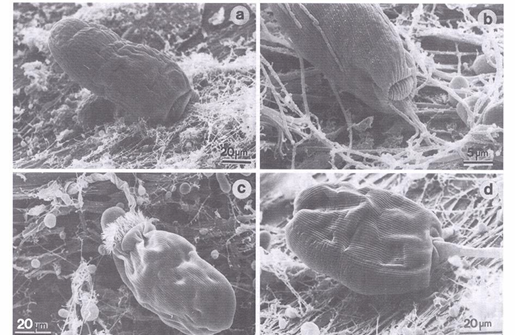
trich means air
huge
classification based on morphology and not products
also keep fungi in check
free swimmers
populate anywhere in the lquid phase
can decrease oxygen in the rumen which helps the bacteria
contribute to fiber degradation
contribute to starch digestion
chemotatic toward free sugars
ingulfs the whole sugar molecule which slows down starch digestion
proteolytic of protozoa
will die if pH goes below 6
40-50% of the biomass
only about 20% when reaching the small intestine
the products it makes are proteins (when other microbes feed on kind of a wasteful system, the animal could be using that protein, but it turns into microbial protein in the small intestine)
protozoic protein has no use to the host
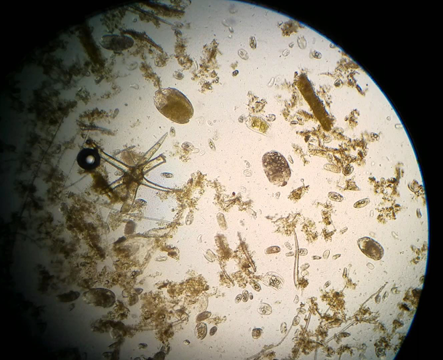
fungi
not well understood
discovered in the 1980’s and 1990’s
5-10% of biomass
attach to cell wall
zoospores attach and burrow into cell wells
less important than bacteria and protozoa
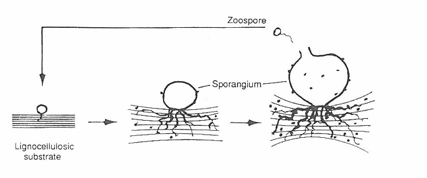
microbial compartmentalization
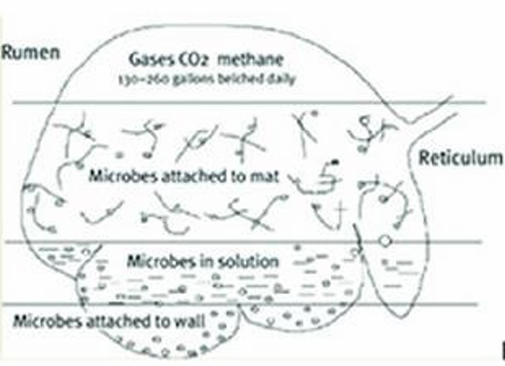
3 zones
liquid phase = soluble CHO
solid phase = insoluble CHO
those who digest fiber and starch
rumen wall = “epimural” ureolytic, facultative organisms
aid in ureolosis and oxygen transfer
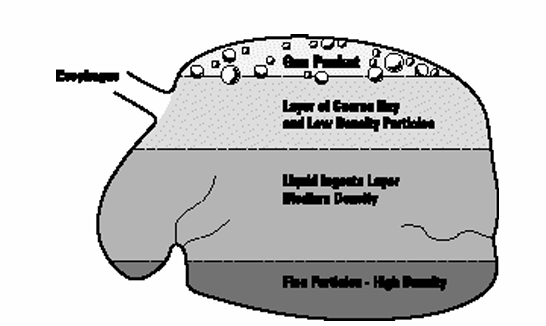
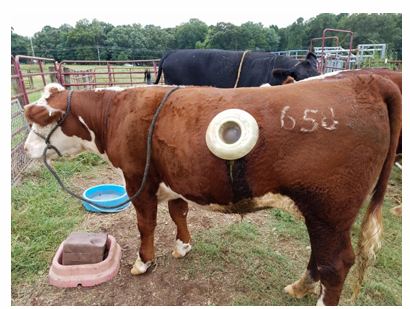
Set 16: Rumen Fermentation
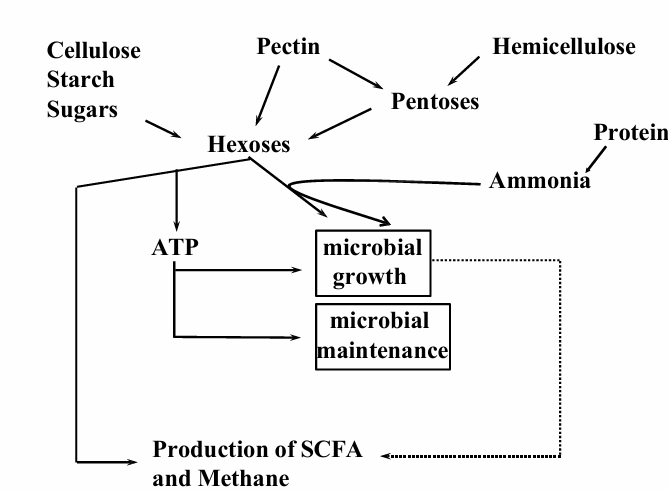
rumen degradation and carbon flow
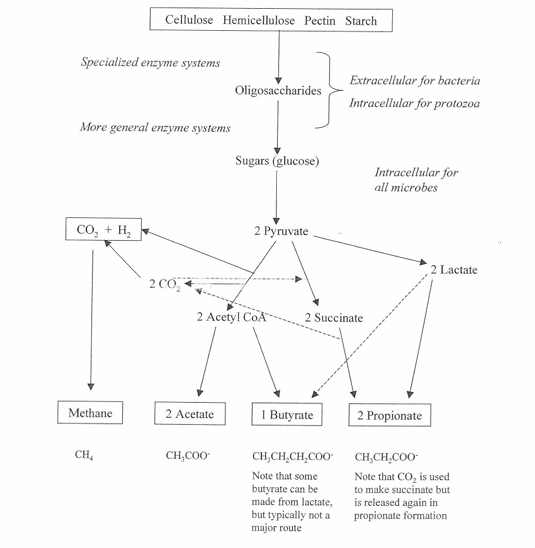
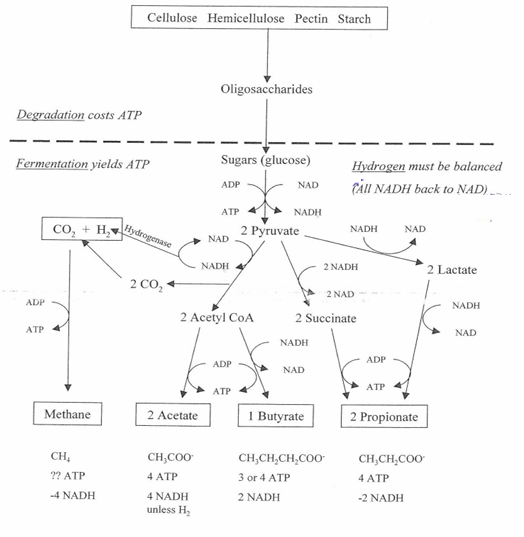
fermentation
free sugars and carbon skeletons are oxidized in metabolic pathways
yield 2-4 ATP per glucose
energy retention
VFA
some microbes have ant ETC to make ATP
the animal oxidizes the result of fermentation
about 80% of the energy is retained
hydrogen must be balanced
methane in the H “sink” - energy lost from the system
to increase quality of ruminant feed we are often looking how to improve energetics
energetics of fermentation
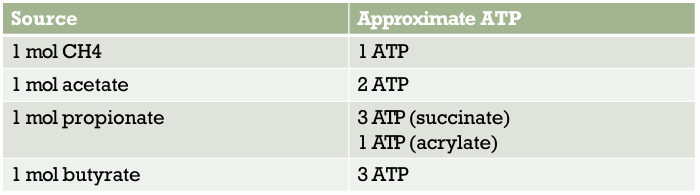
this processed is affected by ammonia, bacterial lyses, relative amounts of protein and carbs being fermented, and sulfur
fermentation balance
specific pathways of VFA production
high forage vs. concentration diets
efficiency of fermentation
yields of VFA energy
total VFA yields and profile
ATP yield
methane yield
carbohydrate fermentation (digestion) in ruminants
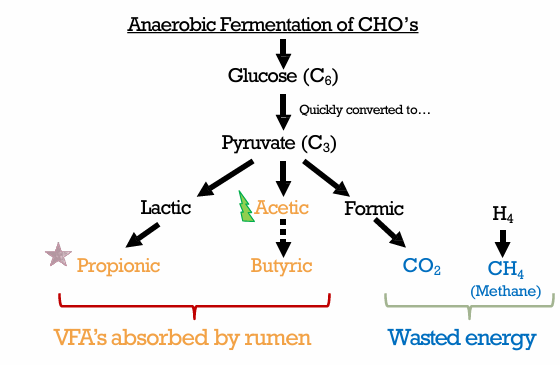
specific uses of VFA’s
absorption by the papillae
propionic acid (propionate)
forms glucose, milk sugar (lactose), AA
anti-ketogenic
promotes intramuscular fat (marbling)
low heat increment
acetic acid (acetate)
oxidized for energy
FA synthesis
promotes milk fat and back fat
ketogenic
heat production
can be converted into glucose
butyric acid (butyrate)
energy source for papillae
ketogenic
low heat increment
lower amount of the VFA
cannot be converted into glucose
altering actetate:propionate
increase passage rate
increase feed intake
grinding or pelleting forages
increase starch digestibility
unsaturated fats
ionophores
no known antobiotiv resistance
valuable for feedlots (intramuscular fat)
higher pelleted lower NDF will shift the ratio away from acetate
decreases chewing and rumination time and increases passage rates
cause a drop in pH
increase acetate: decrease propionate
increased feeding frequency
feeding TMR
higher milk fat
microbial protein
AA profile
similar to the profile of meat and milk
duodenal protein
about 60% of the protein in the duodenum is microbial protein
yield
OM intake - (OM flow to duodenum -microbial OM flow) = true OM digested
good for estimating digestibility
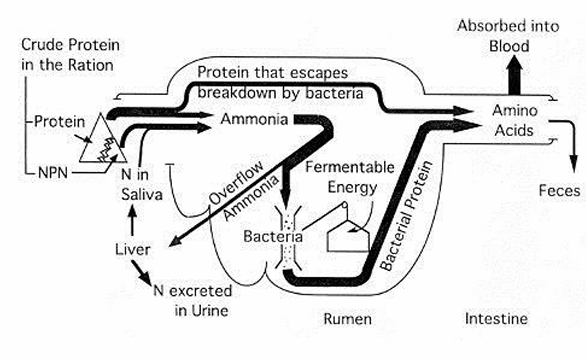
predicting microbial protein
modeling
Ohio Dairy model
microbial N flow, g/d = (22.9 x DMI) - (.365 x DMI²) - (1.74 x NDF)
NRC empirical model
TDN intake x .130 = microbial flow to duodenum
Cornell model
use multiple equations
rumen microbiology
always changing and adapting
bacteria, protozoa, fungi
complex nature of feed
highly specialized or widely adapted
ability to accomplish maximal growth
altering nutrients alters fermentation
Week 5: Sept 15-21
Set 17: Metabolism and Metabolic weights
metabolism
metabolism is the process in which the body uses nutrients once they have been absorbed
affects estimate of digestion
digestibility and gut function
N levels
microbial growth
diet
N recycling (urea)
nitrogen investigation
initial studies done in pigs
16% CP required = fed 10, 12, 14% CP to measure response
why not ruminants
limiting the N in ruminants impacts the microbes decreasing energy intake
biological value
utilization of N in rapidly growing or lactating animals
these animals are studied because typically during maintenance most of the nitrogen is lost
measure response to N
determine true absorption
N digested
endogenous
urinary N loss
the energy scheme
gross energy (GE): intake energy - potential energy available
feces
digestible energy (DE): GE - fecal energy
urine and gases
metabolizable energy (ME): DE - (urinary energy + rumen gas losses)
heat
net energy (NE): ME - heat loss (energy available to animal)
net energy maintenance (NEm)
net energy growth (NEg)
net energy lactation (NEl)
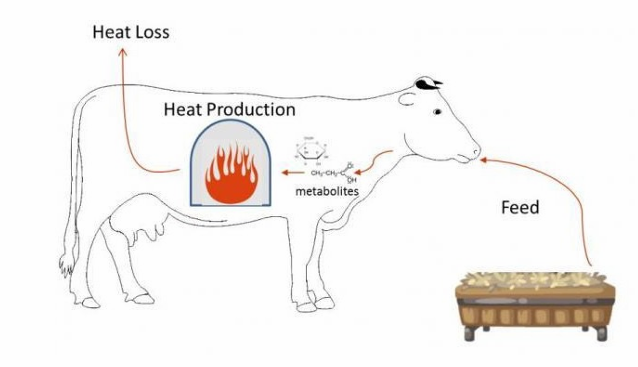
metabolizable of feedstuff
factors involved in determine metabolizablity of a feedstuff for energy
1. digestibility
feed processing and intake
2. species
methane loss
concentrate vs. grazers
3. feed additives
ionophores for methane and N
4. protein content
basal metabolism
in order to understand how production factors affect nutrient requirements, need to know basal metabolism
net energy required for maintenance
derivation of metabolic weights
ration balancing
feed intake prediction
percentage of ration energy used for maintenance
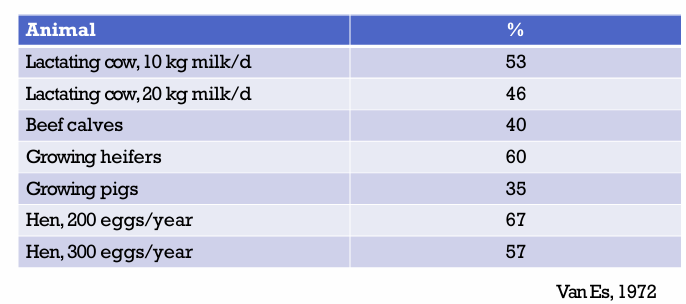
metabolic weight
motive
devise a consistent way to measure/calculate the heat loss/heat production/oxygen consumption
Lavosier’s experiment
1700’s
guinea pig melting ice (homeotherms)
heat production due to oxidative metabolism
surface law
surface law
Richet (1889) and Rubner (1883)
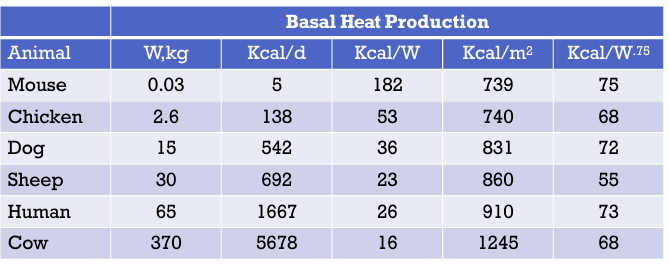
heat loss constant when expressed on per unit of surface area
rabbits and dogs
Rubner claimed 1000 kcal/d/m² of surface
Voit’s table (Kleiber, 1961)
summary of heat loss data
Voit’s Table
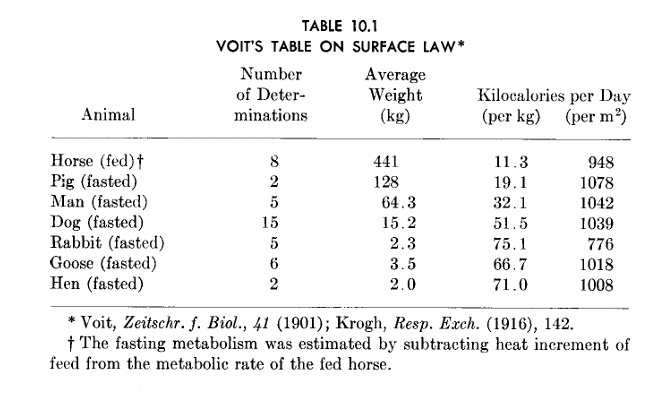
surface law
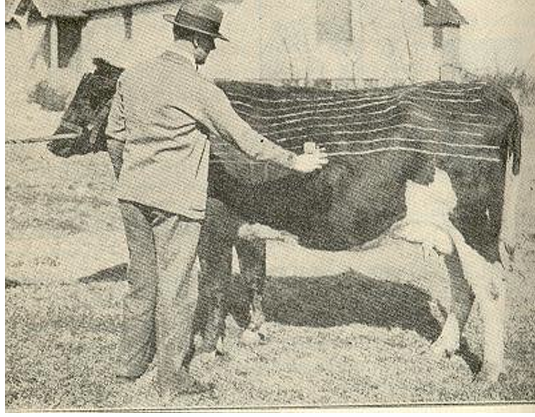
problem
difficult to get accurate, consistent estimates of surface area
human example combined height and weight
S(cm²) = 1.84 W(kg)^.475 x L(cm)^.725
why not just use a function of body function
W0, W1, W0.5, W0.66, W0.73
exponential weights
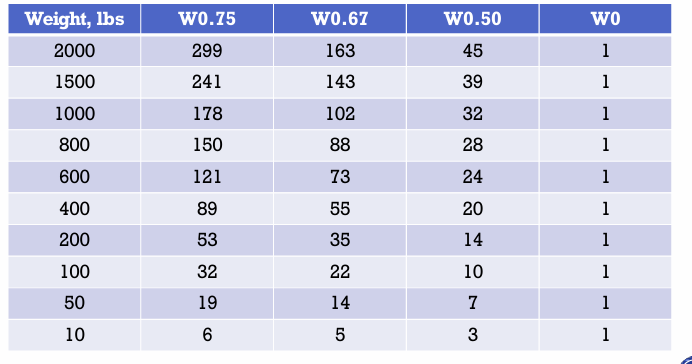
surface area is proportional to body weight
basal heat production relative to weight (W, Kg) and surface are in various species
Brody, 1945
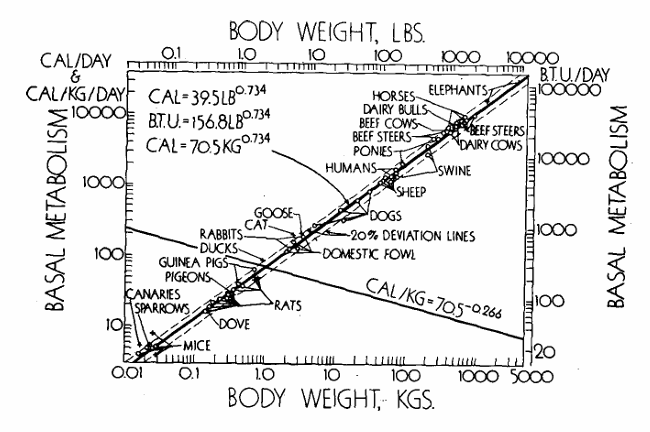
basal metabolic rate
basal/minimal/standard/fasting
70 kcal/ BW^0.75
standards
adult
resting
post absorptive metabolic state
thermodynamics
functional BMR
other factors
thermodynamics
internal work
pressure/volume (lungs, heart)
synthesis/breakdown of complex molecules
anabolic and catabolic pathways
gradients
maintain electrochemical gradients
basal metabolic rate
functional explanation of BMR
service functions
heartbeat
respiration
conscious neural activity
renal activity (clearing toxins from the body)
cellular maintenance functions
ion transport (Na+, K+, -ATPase)
protein, lipid, nucleic acid turnover
basal metabolic weight
other factors affecting BMR
time of day, time of year
age/health
sex
nutritional status
body composition
body fatness
adipose tissue
active body mass
visceral organs as a proportion of total body mass
organs such as the liver require unproportionate energy requirements
a thin cow with a large gut organ ratio will require more energy than a fat muscular animal at the same age
environmental conditions
defining maintenance energy
what about energy required for maintenance
define maintenance: energy (metabolizable) to maintain 0 energy balance
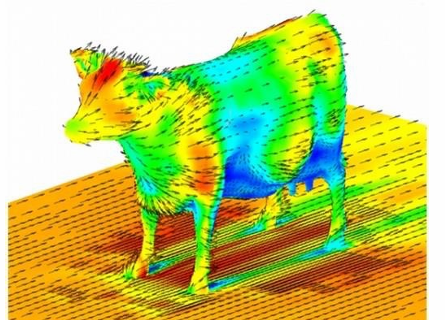
bovine air flow dynamics
Set 18: Fat Metabolism
biohydrogenation
chemical assessment of fat
ether extract
crude fat
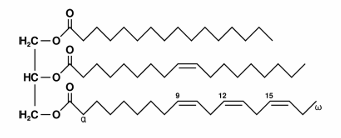
waxes and other indigestible or unusable energy sources
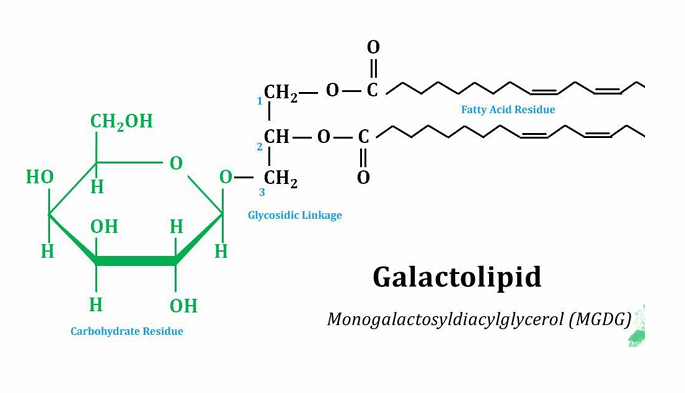
phospholipids of soybeans and the galactolipids of forages only have 2 fatty acid side chains
fatty acids
triglycerides
phospholipids
galactolipids
chemical assessment of fat
iodine value (i.v.)
measure of saturation of the fat (double bonds = darker reaction)
iodine attaches to the double bond
more double bonds more color
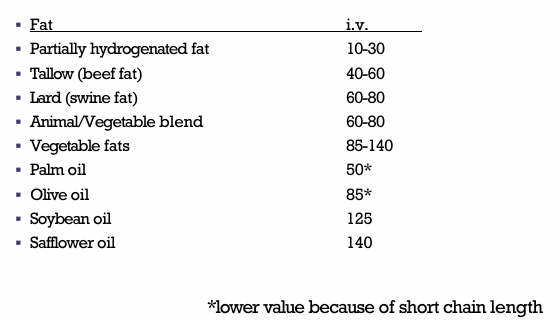
fatty acid composition of some feeds
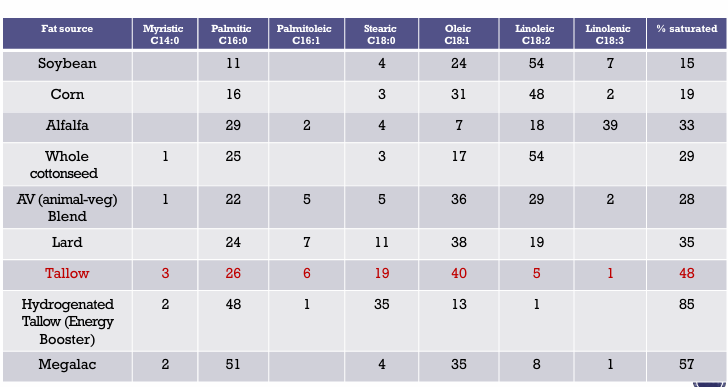
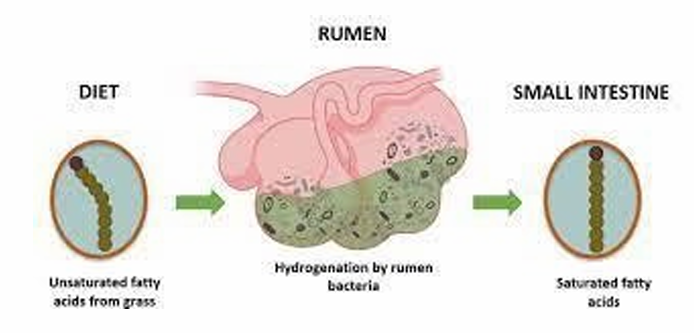
biohydrogenation
bonds made by plants are cis
double bonds typically occur at 3,6, and 9 carbons from the omega side
animals desaturate FA from 9th C toward COOH
animal enzymes place double bonds with 3 carbons in between them
rumen bacteria can change the cis bonds to trans and also move the double bond over by one carbon (makes the double bonds conjugated)
biohydrogenation with bacteria
incomplete biohydrogenation alters ruminant tissues
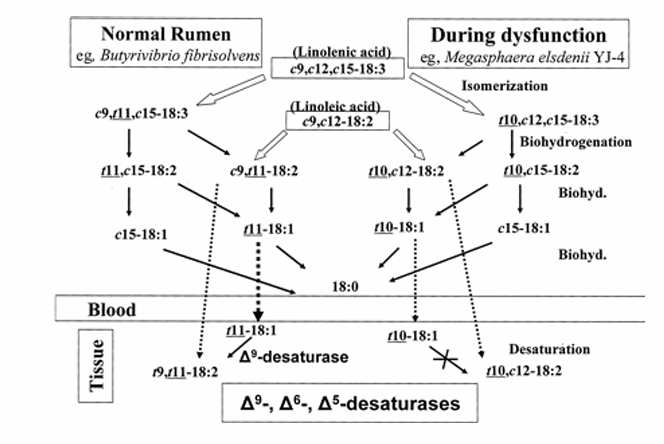
megasphaera can cause milk depression
also is pH tolerant will be there in acidosis
ionophores might be able to prevent this
2 major processes of biohydrogenation
1. conversion of 18:2 or 18:3 cis to trans intermediates
2. complete hydrogenation to 18:0
these bacteria are sensitive to low pH
trans intermediates have profound impact on metabolism
incomplete biohydrogenation products in ruminant products
diet and management impact biohydrogenation in the rumen
roughages promote higher pH which supports Butyrivibrio fibrosolvens
more c9, t11 18:2 conjugated linoleic acid
shown to reduce heart disease in humans
6 oz serving: grain finished: 0.14g grass finished: .36g
CLA needed to alter human health: 2.4-6 g/day
17 servings grain finished, or 7 servings of grass finished beef
inhibition of fibrolytic and methanogenic bacteria by FA
unsaturated FA with free carboxylic acid
interfere with the rumen bacteria
gram-negative are more susceptible because of their cell wall structure
can with stand low concentrations of unsaturated FA
slugs of unsaturated fat are more toxic
decrease of the H2 and CH4 producers = decreased A:P ratio
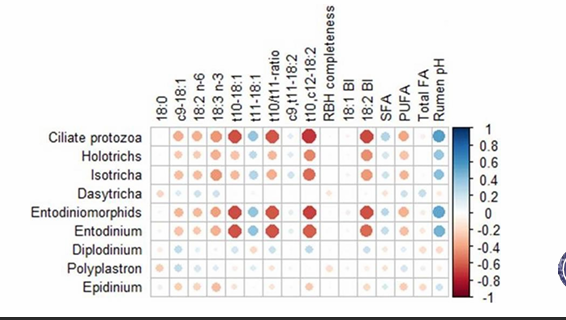
inhibition of protozoa by unsaturated FA
25-50% reduction in protozoa
inert fats depress protozoa too
megalac and tallow
fat substitution for grains
increase energy without increasing grain which decreases risk of acidosis
but also decreases feed intake and efficiency of the microbes also decreases microbial protein in the duodenum
FA soaps
soaps (megalac) are inert
R1COO- Ca++ -OOCR2
bypass
high digestibility
less soluble and less toxic
in lower pH the soaps break apart
digestibility of fat
small intestine
low pancreatic lipase activity
low solubility of very saturated triglycerides probably decreases interaction with lipase
phospholipase and bile
normal levels are able to handle the inclusion of fats unless the soaps/fats are highly saturated and cannot be solutalized
above ~5% supplemental fat in diet the digestibility becomes more variable/decreases
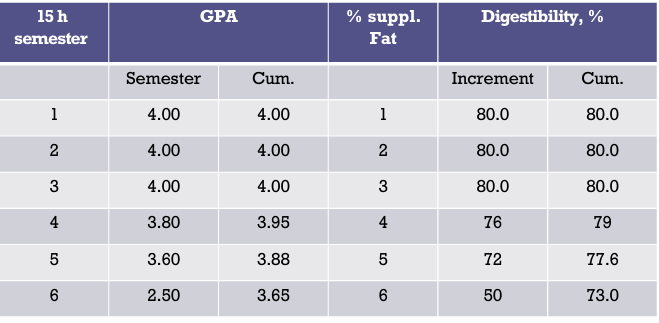
ketosis
symptoms
low blood sugar
drops below 40 mc/ml
happens when too much fat is being metabolized too quickly
ketones in breath, milk, urine
beta-hydroxybutyric acid (BHBA)
decreases urine pH
acetoacetic acid
acetone
made fromacetoacetic acid
urine analysis
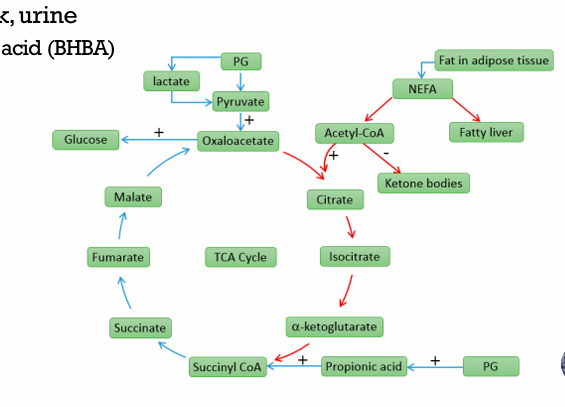
Kreb’s cycle
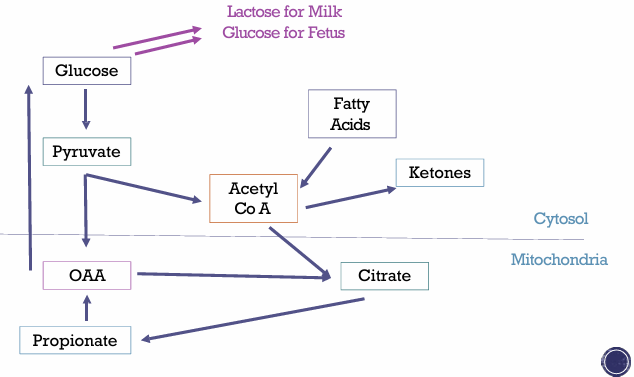
ketosis
treatment
IV with glucose
oral propylene glycol
calcium propionate
long term is to increase propionate
60-70% of glucose is from propionate
prevention of occurrences
promote feed intake with appropriate forage:concentrate diets
maintain proper BCS
avoid sporadic feeding
happens with multiple fetuses
and with high milk production in dairy cows
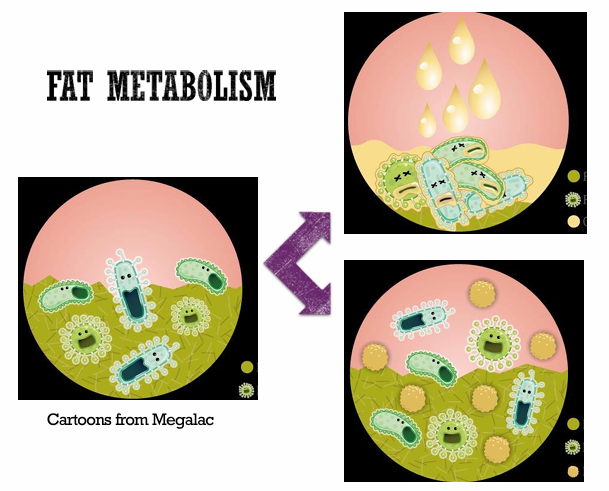
fat metabolism
Week 6: Sept 22-28
Topic 19: Vitamins
vitamins
fat soluble vitamins
vitamin A, D, E, K
supplement ADE
K microbial synthesis
tissue synthesis vitamin D
water soluble vitamins
B complex, vitamin C
microbial synthesis B complex
tissue synthesis vitamin C
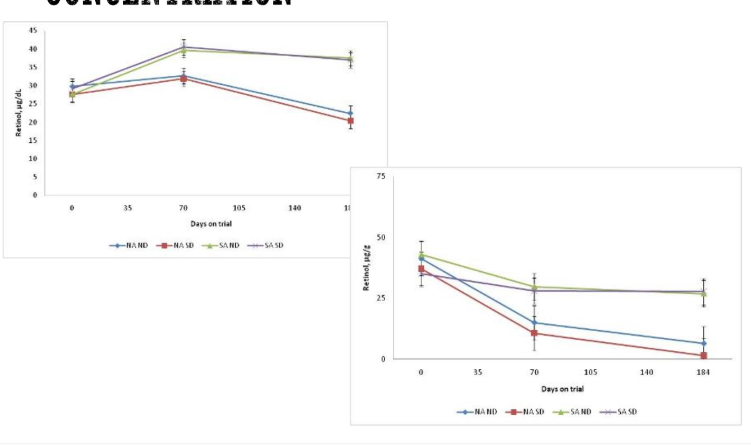
vitamin A
sources: carotenoids in feedstuffs
toxicity: 50-500x’s over requirement
the more yellow the more vA that can be produced
function:
night vision
epithelial cells
adipose tissues
feeding more than NRC recommendation in feedlot cattle can inhibit fat cell development particularly in intramuscular cells (marbling)
needed for skin function and epithelial function
may need supplementation of feed has been stored for a while, bleached, low quality
dairy cattle recommendation
110 IU/Kg BW (3,160 IU/Kg DM)
beef cattle recommendation
2,200 IU/Kg /DM
beef heifers and pregnant cows
2,800 IU/kg/DM
beef bulls and lactating cows
3,900 IU/kg DM
sheep
17 IU/kg BW (570 IU/kg DM)
vitamin D
sources
sunshine
cholecalciferol and ergocalciferol (plant vitamin D)
toxicity
ca deposits in soft tissue
brittle bones
only happens with extreme supplementation
function
Ca and O and Mg absorption
rickets or osteomalasia
animals with 1-2 hours of sun end up being fine
like the estimated daily value
beef cattle requirement
275 IU/kg DM
dairy cattle requirement
460 IU/kg DM (30 IU/kg BW)
sheep requirement
5.5-6.6 IU/kg BW
vitamin E
sources
plants
alpha-tocopherol
not stable and will break down
some synthetic versions are more stable
will breakdown if the fat goes bad
functions:
cell membrane integrity
antioxidant
interaction with Se
white muscle disease or ademia
beef cattle
50-100 IU/day
dairy cattle
1417 IU/day
higher because vD travels into the milk
sheep
15 IU/kg DM (35 IU/day)
25-30 mg/kg in feed
b-vitamins for ruminants
not typically supplemented due to synthesis by rumen microbes
only supplemented the animals was really sick
in high producing dairy cattle, some may be added to provided additional benefit
niacin: shown to increase microbial protein synthesis and increase peak milk production
biotin: when added to high concentration diets helps improve hoof health and milk production
choline: when feed in a rumen protected format can help reduce fatty livers
vitamin K
rumen bacteria synthesize adequate concentrations
exceptions:
surgery or traumatic injury causing bleeding
consumption of moldy forage (moldy sweet clover)
contain dicumarol (a blood thinner)
vK helps with blood clotting
Topic 20: Minerals
minerals
sources of minerals for ruminants
forages and other feedstuffs
mineral supplements
others: water, soil
used for growth, reproduction, bone immunity
why are supplements needed
prevention of mineral deficiencies
primary
lack of a mineral in the diet
low bioavailability of mineral in the diet
form that the animal can’t absorb
secondary
antagonist interactions of minerals in the diet
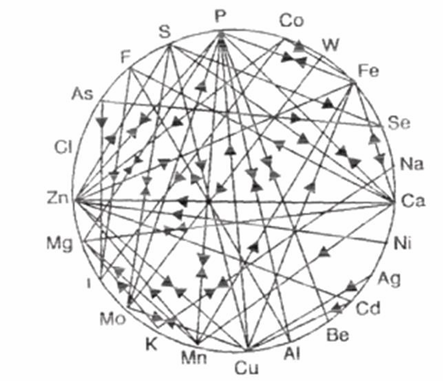
mineral deficiency
types of deficiencies
severe
clinical signs directly attributable to mineral
broken bones, lesions, hair falling out, hair color change, lameness, contusions, discoloration
marginal (no clinical signs)
low reproductive rates
reduction in weight gain
slight reductions in milk production
increased incidence of disease
goals of mineral supplementation
to provided adequate but not toxic amounts of each mineral
types of mineral supplements
1. white salt
provides sodium and chloride
almost always supplement when the animals are not consuming TMR
2. trace mineral salt
most to don’t have selenium or macro minerals
3. complete mineral supplement
trace minerals, salt, P, Ca, Mg
4. protein-molasses blocks
5-250 lbs.
feed during winter and energy
expensive
5. liquid supplements
molasses, corn steep, distillers
minerals are added so there is a benefit (protein, energy and minerals)
meeting mineral requirements
mineral supplementation vary dependent on management system
TMR
dairy cattle
feedlot cattle
added to the feed
Multipart ration
grazing cattle
sheep, goats…
free choice option
How to:
1. determine the amount of mineral required per day
NRC tables
have to know how much dry matter they are consuming
how much they are eating of the supplements
2. determine the amount of a mineral provided from a diet
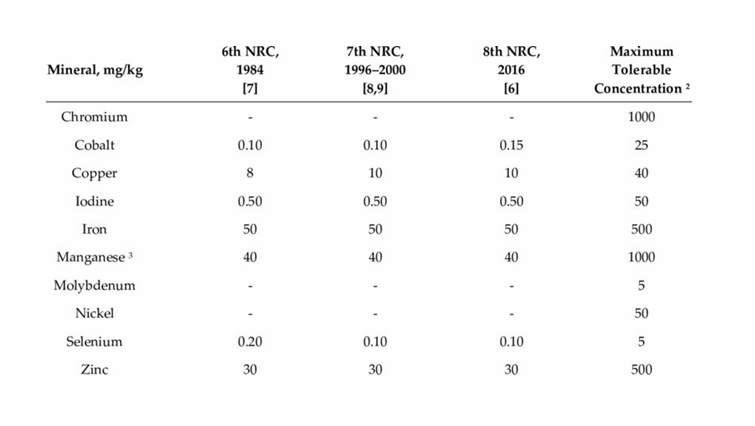
converting units
parts per million = ppm = g of mineral/1,000,000 g of feed
1 ppm = 1mg/kg
percent = parts per hundred = g of miner/100g of feed
% x 10,000 = mg/kg or ppm
example:
if feed is 0.3% Ca how many ppm of Ca does it have
.3% x 10,000 = 3,000 ppm
differences among mineral supplements
amount of minerals provided
sources of minerals used
inorganic (elemental or natural form), chelated (typically more bioavailable but also more expensive)
level of intake
factors affecting intake of a free-choice mineral
level of salt
low salt the animals are going to eat more to meet the salt requirement
high salt levels the animals are going to eat less of the free choice minerals
level of non-mineral ingredients
molasses, grain byproducts, flavoring agents
used to encourage animal to eat more
Ca and P
ratio of Ca:P is critical!
regulated by hormones
recommended by ratio for all:
Ca:P → 2:1
can handle up to a 6:1 ratio
always try and avoid a 1:1 ratio
less of a concern for ruminants
Low Ca or excess P can cause urinary calculi
water belly
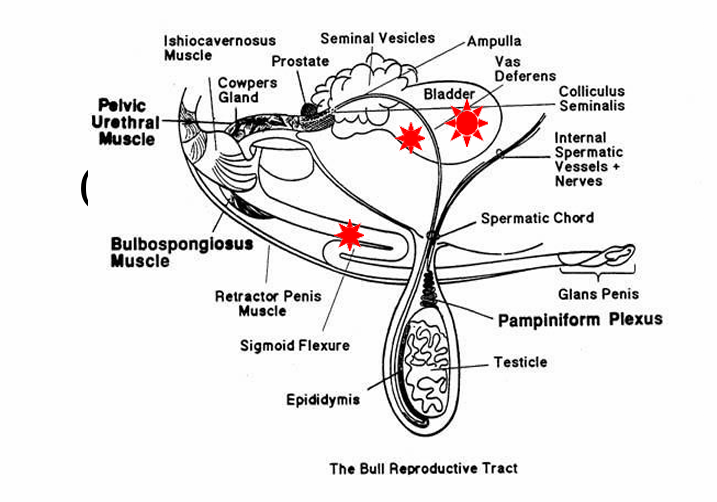
minerals most likely to be deficient in grazing situations in NC
copper
magnesium
selenium
zinc
zinc
deficiency signs of zinc
reduced growth rate and feed intake
impaired reproduction
excessive salivation
scaly lesions on legs, neck, head, and around nostrils
loss of hair
selenium
deficiency symptoms of selenium
.1-.3 ppm requirement
young animals
muscular dystrophy
unthriftiness and diarrhea
mature animals
increased incidence of retained placentas
increased rate or duration of mastitis
copper
deficiency signs of copper
anemia
copper deficiency results in iron deficiency and the inability to use iron for hemoglobin synthesis
cardiovascular disorders
can cause heart attack due to collagen and elastin not cross linking in the heart
fragile bones that fracture easily
neonatal ataxia - lamb and goats
brain disorder - not treatable and fatal
the dams must be supplemented to prevent this
lack of pigmentation in hair
black hair turns red
red hair turns lighter or grey
white hair turns reddish brown
impaired reproduction
diarrhea
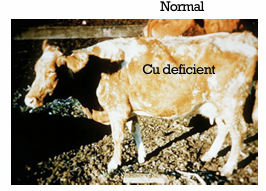
factors affecting bioavailability of cooper
sulfur
molybdenum
iron
high iron causes antagonist reactions with copper
zinc
fescue toxicity
source of copper supplementation
avoid cooper oxide
limited bioavailability
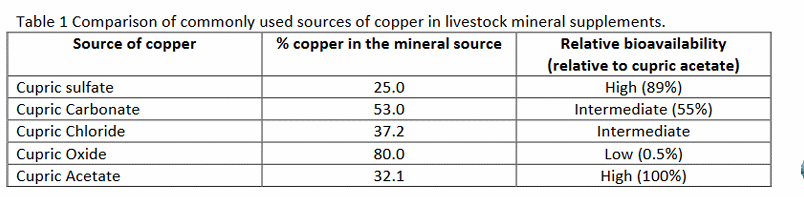
1. copper-sulfur
possible formation of CuS in rumen
insoluble and cannot be absorbed
copper-sulfur-molybdenum
formation of thiomolybdates that bind copper
concern if Mo> 1 ppm
S- + MoO4
MoO2S2
MoOS3
MoS4
can be absorbed and then steal copper from enzymes and other molecules and cells
sheep
exception, have very low copper requirements
store copper in liver
toxicity risk is much higher than other species
5 ppm required in total diet
toxicity at 25 ppm
cattle and goats
25-100 ppm in total diet
magnesium
deficiency signs of magnesium
anorexia
increased excitability
convulsions
aka grass tetany
they cannot stand up
treatment
IV or subcutaneous injection of magnesium into the blood stream
older cows are more at risk because of higher milk production and low mobilization of Mg
prevention
supplementation in the spring when it is more likely to occur
rumen in primary site of absorption
factors affecting absorption
potassium
spring forages tend to be high in potassium lowering the ability to absorb Mg
rumen ammonia
from CP
sodium
sodium is required to absorption
commercial supplements
consider major mineral needs?
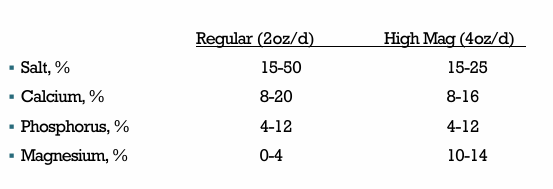
trace minerals, ppm
are there copper antagonists
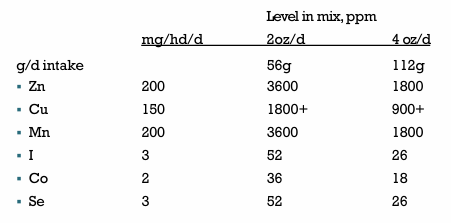
red salt
cattle will eat 1 oz salt/day
Se
Ca
P
Mg
Zn
Cu
Mn
Fe
cost considerations
prices of mineral supplements have increased over past several years
mineral pricing: 20-50$ per 50lb. bag
most commercial minerals are 2-4 oz intake/day
how long will it take 100 cows to consume one bag ……… 50 lbs. x 16 oz = 800
100 cows per 2 oz = 200 oz so 4 days
4 oz per cow = 2 days
what is the cost per head / day
4oz for $20 = .10 4oz for 50 = .25
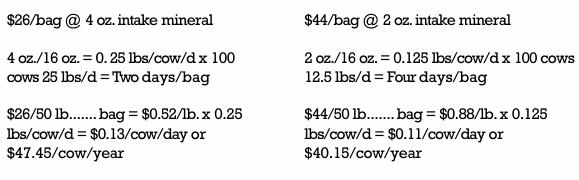
reducing mineral supplementation costs
reduce or eliminate phosphorus in supplement
forages generally contain adequate P
see what is available in your area
stay up to date on news and science
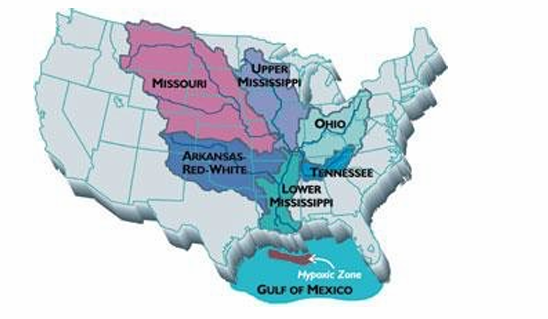
in general, some mineral program is better than none
Week 7: Sept 29- Oct 5
Topic 21: Feed and Forage Quality
what is feed and forage quality
animal performance when feedstuff evaluated is fed alone and free choice
or in combination with other dietary ingredients
determined by nutritive value and voluntary intake
forage: definition
bulk, high fiber (>35% NDF, <70% TDN) feeds typically representing the vegetative portion of plants consumed by animals
importance of forages in the US
single most important feed base for all ruminants
528 million acres (>1/4 of land area) used for grazing land in US
2021: US total crop value: $201 billion
hay value was $19.2 billion
~50/50 alfalfa vs. all other hays
grain crop values:
corn $86.2 billion
soybean $57.5 billion
sorghum $11.9 billion
wheat $8.6 billion
nutritive value
aspects of forage composition affecting nutrition independent of intake
determined by nutritional composition and digestibility
nutritional composition
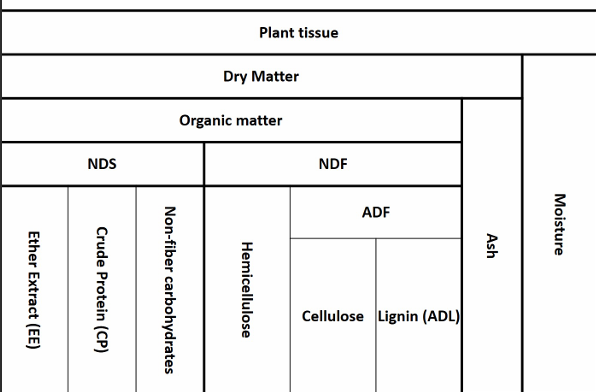
aspects of fiber
cellulose and hemicellulose % are = in grasses but in legumes hemicellulose is < cellulose
easier to digest
cellulose and hemicellulose availability will depend on their rumen digestion rate
lignin is completely unavailable and on top also sequesters some fiber too
lignin % is higher in legumes compared to grasses
pectin and beta-glycans are cell wall components but not considered part of NDF
digested at rate about 40% per hour
warning— request sequential NDF-ADF when analyzing ADF of legumes and fruit pulps
2.4% x the amount of lignin will tell you the non-digestible fiber
forage non-fiber carbohydrates (NFC)
sugars:
sucrose most abundant but some monosaccharides also present
digested/fermented at almost a 100% digestion rate per hour
starches and fructans:
reserve polysaccharides
rumen digestibility 10-40% per hour
fructans are only found in cold season grasses
crude protein (CP)
crude protein
non-protein nitrogen (type A)
soluble true protein (type B1)
rubisco (found in leaves)
insoluble true protein (type B2)
not associated with the NDF
unavailable CP
neutral detergent insoluble nitrogen (type B3)
in the cell wall protein called extensin
acid detergent insoluble nitrogen (type C)
bound to tannins and lignin
could be the result of the maillard reaction (gives aldol condensation)
aka hedwig reaction
ether extract (EE)
forage EE
fatty acids
1-3% of forage DM
~50% of EE
polyunsaturated
linoleic and linolenic acid
will be saturated biohydrogenation
waxes and terpenes
~50% of EE
grains and oilseed EE
highly variable depending on plant and processing
DDG
digestibility
in vitro analysis for 24 or 48 hours
in most cases, digestibility will decrease as plant matures
ranking of species
legumes
67-81% NDF
cool-season grasses
49-81% NDF
warm-season grasses
45-66% NDF
impact of fiber concentration on intake
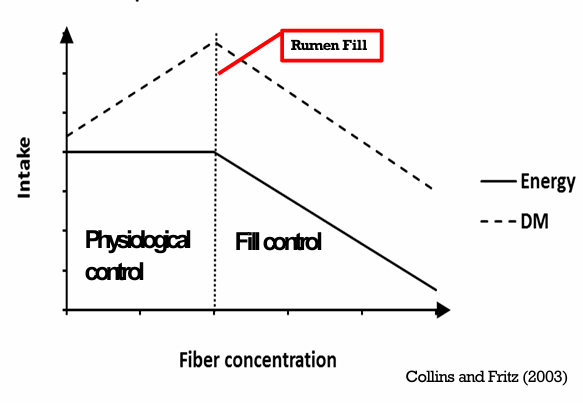
voluntary intake
unfortunately, routinely measuring intake is challenging
however, forage in vitro NDFD is a good predictor of intake and milk production
“Kind words help the dairy cow produce good milk. they go in one ear and out the udder”
Topic 22: Feed and Forage Analysis Reports
feeds and forages for ruminants
not all ruminants are created equal
beef cattle, dairy cattle, sheep, goats
physiological differences of goats from cattle/sheep
faster passage rates
lower ability to digest cell-wall fiber
eat more on a % BW basis
physiological differences form cattle/goats
store copper in their liver
why invest in feed and forage analysis
feed is major expense in livestock production
determine if the feedstuff will meet the animal requirements
diagnose problems
forage and by-products are highly variable
all feed and forage analysis reports are estimates
there is some margin of error due to sampling, sample preparation, and analysis methodology
how big of an investment are we talking???
forage testing
start with collecting a goof sample
need approximately 1 gallon of representative forage
pasture
cut at least 20 samples 6’’ x 6’’ (2’’ residual) from random points in field
avoid biased areas of field
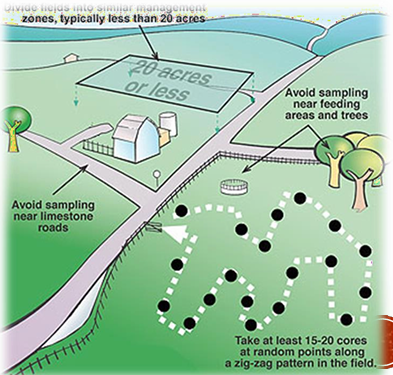
silage 12 core or face samples if sample at feed out
keep 1-2 gallon of each load, mix, subsample if collect at ensiling
hay
determine “lot” of hay
sample 20% of bales or at least 6 bales (3 cores each)
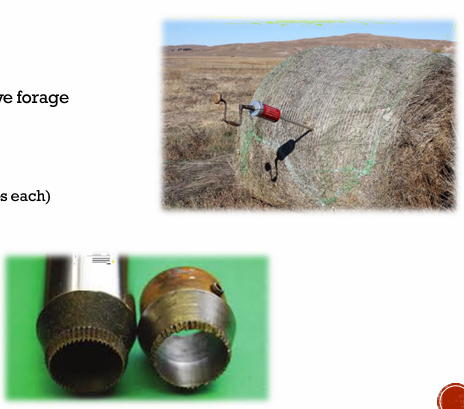
concentrates
10-15 core samples from bulk storage
10% of bagged feed (5-6 bags)

NC farm feed testing service form
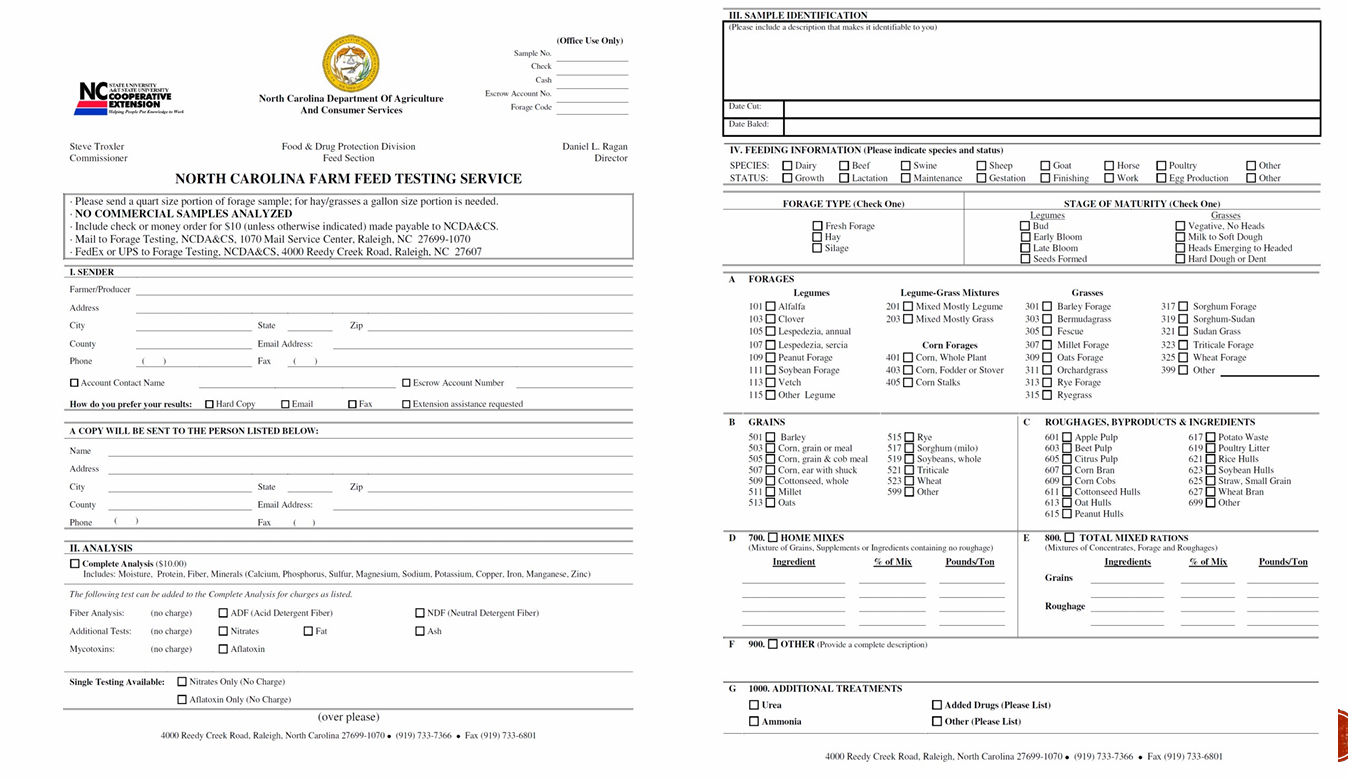
Test report samples (2x)
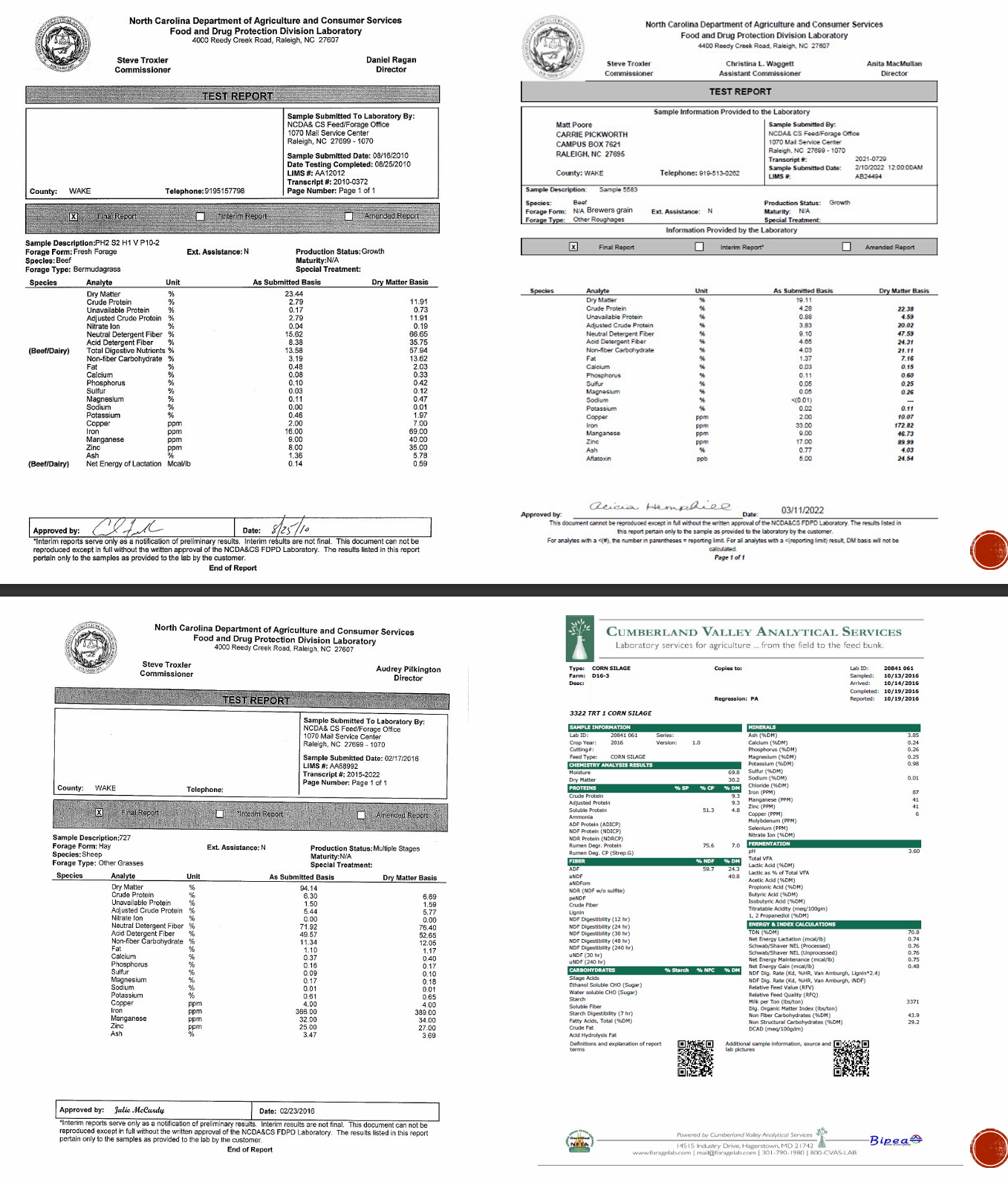
interpreting the results - dry matter
% dry matter (DM) (% moisture)
influences the stability of feedstuff
reports list test values on both AF and DM basis
animals use nutrients on a DM basis
ration formulation is conducted on DM basis
DM ranges of common feedstuffs
pasture: 15-25%
hay: 85-92%
haylage: 35-65%
silage: 30-40%
dry concentrates: 85-95%
wet concentrates (DG, BG): 20-30%
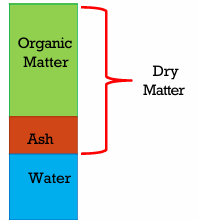
interpreting the results -protein
% crude protein
6.25% of the N of the feedstuff
mixture of all N sources
true AA, nitrate, NPN (urea/ammonia)
unavailable CP
some protein is bound thus making it unavailable for digestion
>10% of total protein indicates heat damage
% adjusted CP (insoluble CP)
use this value if >10% CP is unavailable
CP of some feeds
hays and grass: 5-20%
fibrous co-products: 12-29%
interpreting the results - fiber
% neutral detergent fiber (NDF)
total fiber component
hemicellulose, cellulose, lignin
can be used to estimate voluntary feed intake
>NDF<DMI
% acid detergent fiber (ADF)
primary fiber components not digested
cellulose, lignin, ask, fiber-bound protein
used to calculate energy potential of forage
>ADF<energy
NDF of forages
50-80%
ADF of forages ~40%
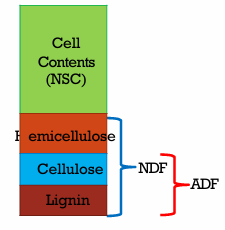
interpreting the results - minerals
% ash
total mineral
normal range 3-12%
>15% possible contamination
% calcium (Ca) and % phosphorous (P)
ratio is critical
1.5:1 to 4:1
watch P levels to determine if Ca needs to be supplemented
dry cow requirements
.25% Ca and .15% P
lactating cow requirements
.31% Ca and .21% P
% sulfur (S)
forages are rarely deficient
excess S in forage and water can limit copper availability
poultry litter, municipal biosolids, distiller’s grain
% magnesium (Mg), sodium (Na), and potassium (K)
Mg typically adequate
Na requires supplementation
K typically adequate, seasonally high
use hug quality free-choice mineral
sulfur requirements
.15%
UL .40%
lactation requirements
.12% Mg, .08% Na, .6% K
PPM copper (Cu), iron (Fe), manganese (Mn), zinc (Zn)
Cu is almost always deficient for cattle and goats
Fe is typically adequate
>1000 ppm is a concern
Mn is typically adequate
Zn is often marginal or deficient
selenium (Se)
not analyzed due to cost of analysis
deficient in NC- need supplementation
cattle micro-mineral requirements
Cu 10-15 ppm
more if S, Fe, Mo are high
Fe 50 ppm
Mg 40 ppm
Zn 30 ppm
% nitrate ion
high accumulation possible in some forages, especially during plant stress
sudan x sorghum hybrids
adapt animals slowly to nitrate forages
abortion and/or death can result
nitrate considerations
<.25% is considered safe
>.5% concern for un-adapted animals
>1% considered very dangerous
interpreting the results - energy
% total digestible nutrients (TDN)
calculated estimate of energy content
ADF, NDF, CP, ash used in calculation
used in beef cattle ration balancing
net energy
more precise system
gain and lactation requirements
more common in dairy and beef feedlots
TDN requirements:
dry beef cow: 52%
lactating beef cow: 60%
dry ewes: 55%
growing lambs: 65%
TDN of forages
low quality hays: 40-50%
high quality hays: 50-60%
legume hays: 60-70%
interpreting the results - other options
pH
measured in ensiled forages
indicator of fermentation success
mycotoxins
aflatoxin
can be valuable in silage
pH ranges after ensiling
corn silage: 3.5-4.5
haylage: 3.8-5.3
aflatoxin levels
<20 ppb for cattle
quick look at the results
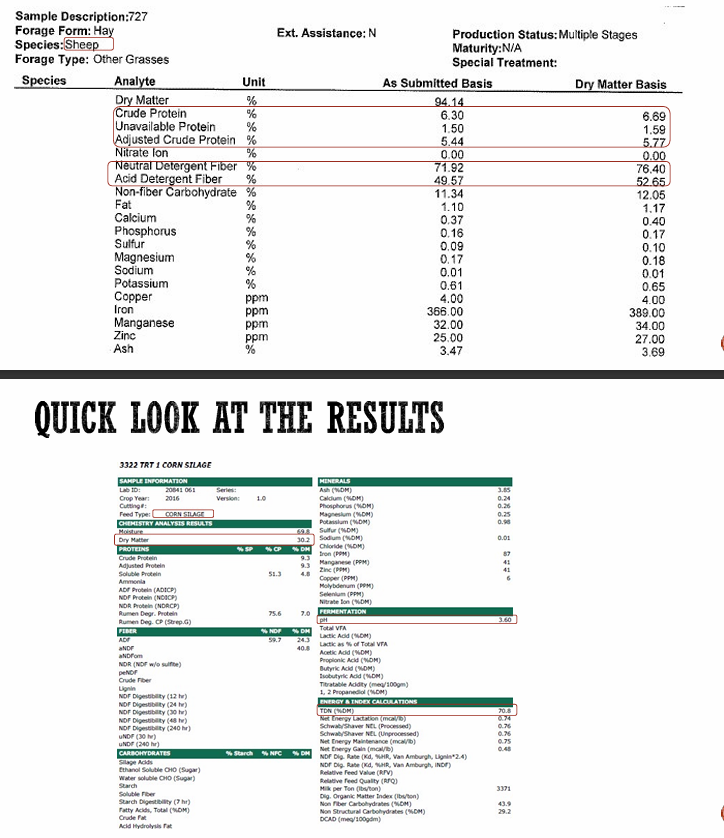
Topic 23: Interpreting Results
Sample picture
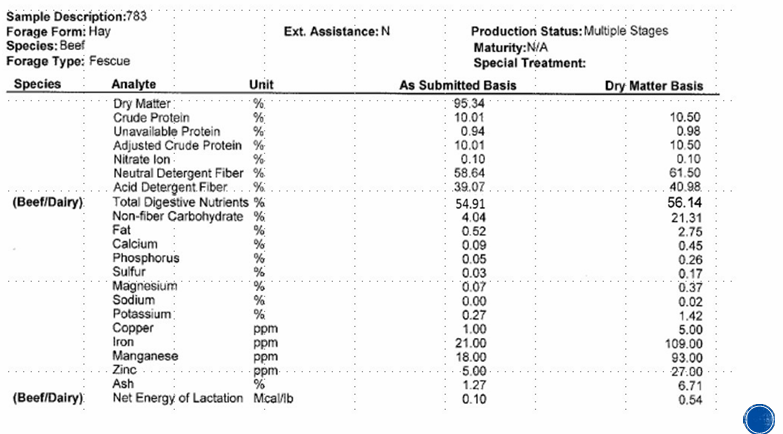
how do I calculate if my forage will meet my cow’s needs?
step 1: determine predicted DMI of free-choice hay
use the hay analysis provided to you:
medium quality
medium TDN (56.14%) medium CP (10.5%)
the average BW of lactating cow her is 1150 lbs.
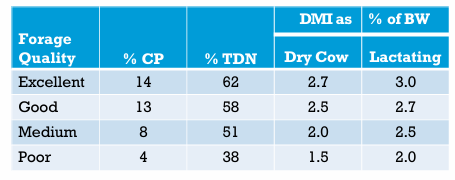
calculate DMI
DMI = 1150 lbs. x 0.025 = 28.8 lbs
step 2: determine if forage will meet the CP requirement of the cow herd
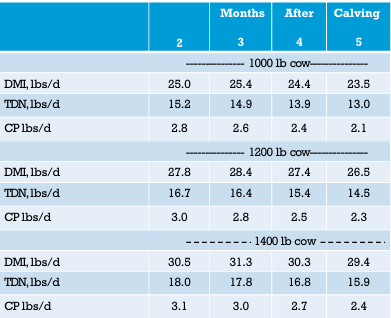
calculate CP intake
28.8 DMI x 0.105 = 2.9
27.8 * 0.105 = 2.9
28.4 * 0.105 = 3.0
27.4 * 0.105 = 2.9
26.5 * 0.105 = 2.8
CP would be adequate
step 3: determine if forage will meet the TDN requirements of the cow herd
determine TDN intake:
28.8 lbs DMI * 0.5614 = 16.2 lbs/d TDN
27.8 * 0.5614 = 15.6
28.4 * 0.5614 = 15.9
27.4 * 0.5614 = 15.4
26.5 * 0.5614 = 14.9
TDN is limiting for cows 2-3 months after calving even at maximum DMI
comparing the results
were CP and TDN requirements met at maximum DMI?
yes, CP and TDN exceed requirements
feed resource is an option for the animals under the given conditions
yes CP and/or TDN greatly exceed requirements
if fed as libitum animals may gain weight (increase BCS)
limit feed the forage to prevent weight gain
consider a lower quality forage for the animals
no CP and/or TDN were below requirements
animals could lose BCS
fetal programming effect/conception rates
need supplemental protein/energy
co-products
provide higher quality forage when current forage is inadequate
mix higher and lower quality forage to optimize diet
how much forage will I need
estimate hay requirements
step 1: convert DMI to as-fed intake
28.8 lbs. DMI/0.9534 = 30.2 lbs./ as fed
step 2: estimate total hay fed
20 cow herd for 90 days
20 cows *90 days * 30.2 lbs./d / 2000 lbs./ton = 27.2 tons
step 3: estimate has losses from storage and feeding
assume 20% loss (5-50% can be lost depending on methods)
27.2 tons/0.80 = 34 tons
step 4: calculate cost
estimate cost at $165/ton
34 × 165 = $5,610
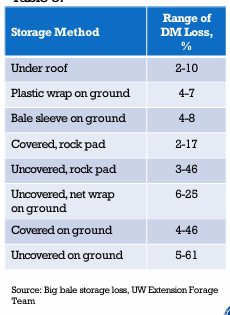
Another sample picture
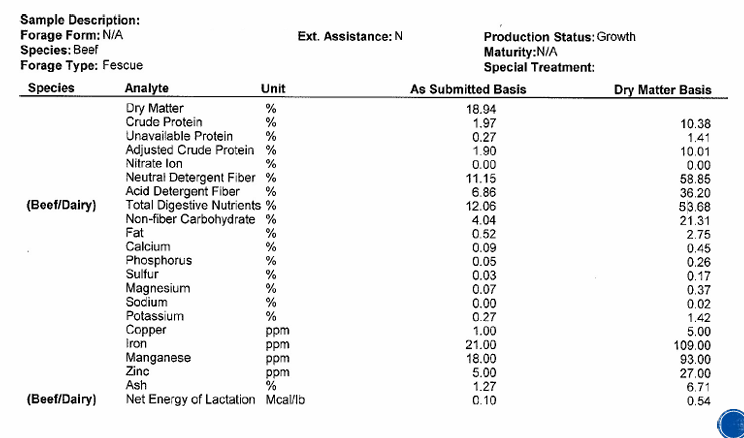
How much forage will I need?
estimate pasture requirements
step 1: convert DMI to as-fed intake
28.8 lbs DMI /0.1894 = 152 lbs/d As Fed
step 2: estimate total pasture DM consumed
20 cow herd for 90 days
20 × 90 × 28.8 = 51,840 lbs.
step 3: estimate grazing efficiency
assume 70% efficiency (40-80% can be consumed depending on grazing strategies)
51,840/0.70 = 74,057 lbs.
step 4: calculate acreage available
if 3,000 lbs. DM/acre available
74,057/3000 = 24.7 acres
step 5: calculate cost
estimate cost at $85/acre
24.7 acres * $85/acre = $2,100
summary
you know what you have … you know what you need
Topic 24: Comparing Feed Resources
farm scenario
there are 4 forage resources available to feed the cow herd
capacity for hay and/or pasture feeding
there are 2 groups of cattle to focus on feeding
can be grouped or fed separately
the cattle need feed for 30 days
forage analysis results
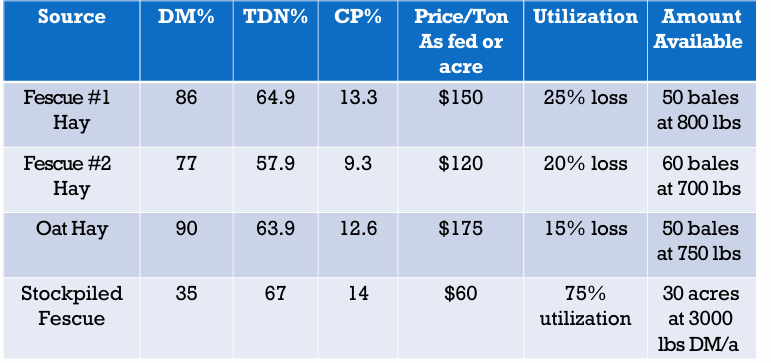
cattle requirements
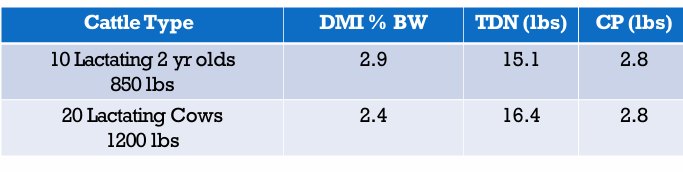
where do we go from here
multiple approaches to consider
start with determining feed resources available
actual DM available
cost per lb. DM, Cp, TDN
start with determining needs of herd
each group of animals
total herd
fescue hay 1

50 bales * 800 lbs. AF / 2000 lbs./ton = 20-ton AF
20 ton * $150 = $3000 for whole lot
20 ton * 75 % uses = 15-ton AF available to feed
15 ton * 86% DM = 12.9-ton available DM
12.9 ton *64.9% TDN = 8.4-ton TDN
12.9 ton * 13.3% CP = 1.7-ton CP
$3000 / (12.9 ton * 2000 lbs./ton) = $0.12 /lb. DM
$3000 / (8.4-ton TDN* 2000 lbs./ton) = $0.18 /lb. TDN
$3000 / (1.7-ton CP* 2000 lbs./ton) = $0.88 /lb. CP
fescue hay 2

60 bales * 700 lbs. AF / 2000 lbs./ton = 21-ton AF
21 ton * $120 = $2520 for whole lot
21 ton * 80 % uses = 16.8-ton AF available to feed
16.8 ton * 77% DM = 12.9-ton available DM
12.9 ton *57.9% TDN = 7.4-ton TDN
12.9 ton * 9.3% CP = 1.2-ton CP
$2520 / (12.9 ton * 2000 lbs./ton) = $0.10 /lb. DM
$2520 / (7.4-ton TDN* 2000 lbs./ton) = $0.17 /lb. TDN
$2520 / (1.2-ton CP* 2000 lbs./ton) = $1.05 /lb. CP
oat hay

50 bales * 750 lbs. AF / 2000 lbs./ton = 18.75-ton AF
18.75 ton * $175 = $3281 for whole lot
18.75 ton * 85 % use = 16-ton AF available to feed
16 ton * 90% DM = 14.4-ton available DM
14.4 ton *63.9% TDN = 9.2-ton TDN
14.4 ton * 12.6% CP = 1.8-ton CP
$3281 / (14.4 ton * 2000 lbs./ton) = $0.11 /lb. DM
$3281 / (9.2-ton TDN* 2000 lbs./ton) = $0.18 /lb. TDN
$3281 / (1.8-ton CP* 2000 lbs./ton) = $0.91 /lb. CP
stockpiled fescue
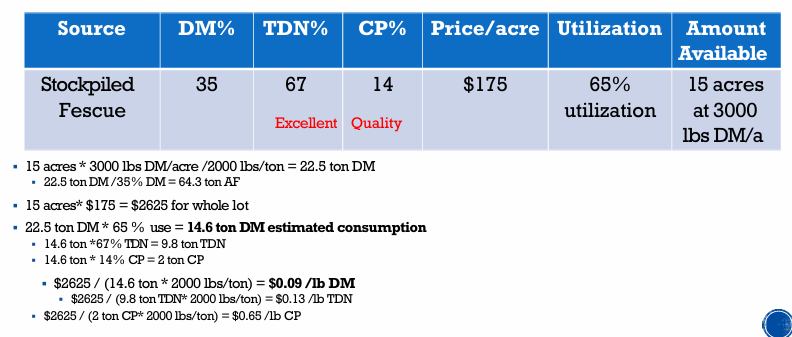
where do we go from here?
multiple approached to consider
start with determining feed resources available
actual DM available
cost per lb. DM, CP, TDN
starting with determining needs of herd
each group of animals
total herd
2 year old cows
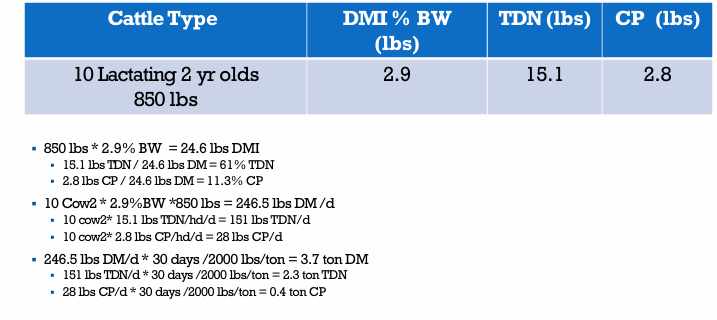
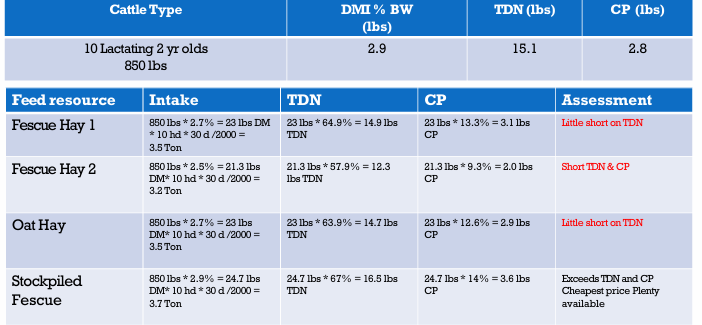
mature cows
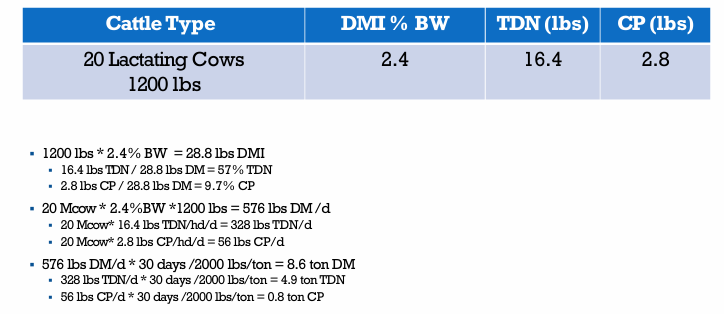
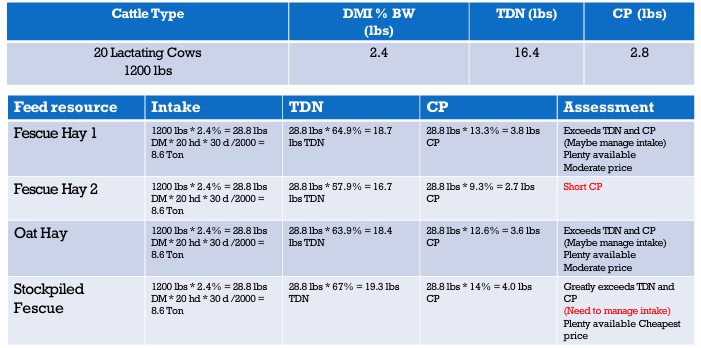
where do we go from here
begin comparing what is available vs. what the herd needs
in quick look how does supply meet demand
combined herds need 12.3 ton of DM
all forage resources have ample DM for one or both groups
how will forage quality impact intake
need to make adjustments
all 3 hays will reduce intake of heifers from NRC expectation of 2.9%
2.7% FH1, 2.5% FH2, 2.7% OH
how do forages compare to each other
any major concerns
high moisture content of FH2 may limit storage (molding potential)
cost comparisons
FH1 most expensive on DM basis
FH2 most expensive on CP basis
FH1 & OH equal, expensive on TDN basis
SF cheapest on DM, CP, and TDN basis
management decision
management decides that trying to avoid excess nutrient intake is important
want to optimize both groups
decision:
strip graze 2-year-old heifers on the stockpiled fescue
drylot the mature cows and limit feed oat hay
1 bale per day for the herd would be ~2.3% BW DMI and still slightly exceed requirements
2.2% BW DMI would be ideal but harder to manage than feeding 1 bale/day
other factors to consider
know what you have ... know what you need
underutilized resources
feed allocation based on requirements
supplement strategies
improve feedstuff quality
farm productivity
fencing and water capacity
breeding or management groups
equipment and labor
feed storage resources
Week 8: Oct 6-12
Topic 25: Small ruminant nutrition - overview
Topic 26: Small ruminant nutrition - nutrients
Topic 27: Small ruminant nutrition - health
Topic 28: Small ruminant nutrition - feeding calculations
dry matter vs. as-fed
lamb weights 75 lbs.
how much of its body weight should it consume?
average 4-6% (average 5%)
what is the dry matter percent of haylage
50-70% ?????????
how much protein is an animal eating?
example: a 80-pound lamb is eating 5 pounds of 88% dry matter diet (dry corn and supplement) that is formulated to contain 12.5% crude protein (CP)
1. convert intake to dry matter basis (DMB) to get rid of water intake (water doesn’t contain CP)
Lbs. of feed x %DM = Lbs. of DM
5 pounds x .88 = 4.4 pounds of dry matter intake
how much protein is an anima eating
example: a 80-pound lamb is eating is eating 5 pounds of an 88% dry matter diet (dry corn and supplement that is formulated to contain 12.5% crud protein)
2. check to make sure this is reasonable. remember that lambs eat to up 6% of their body weight on a dry matter basis
lbs. of DM/lbs. BW x 100 = % BW DMI
4.4/80 × 100 = 5.5%
how much protein is animal eating
3. calculate the pounds consumed
4.4 of DMI x .125 = .55 lbs. CP
lamb of this size gain 0.8 lbs. per day requires 0.52 lbs. of CP
Pearson square
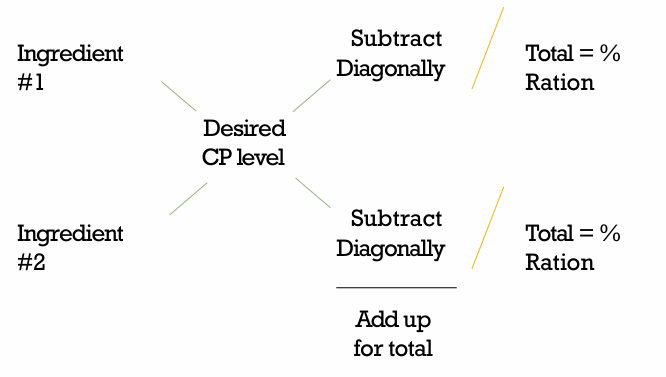
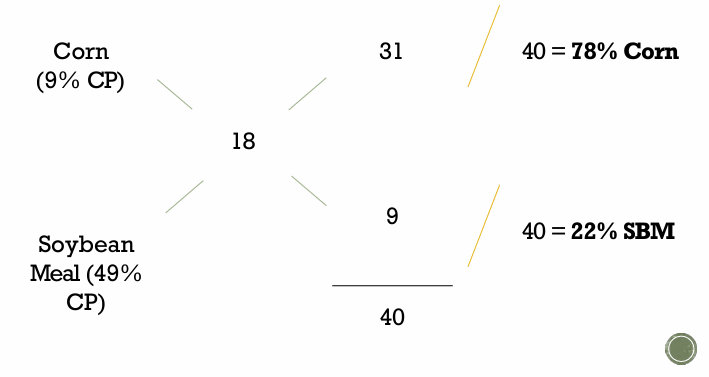
nutrient supply case study
take the previous ration (78% corn and 22% SBM). this ration approximately 18% CP. if you wanted to feed 1 lb./hd/d of this ration, how much TDN and CP are you supplying to your sheep/goats
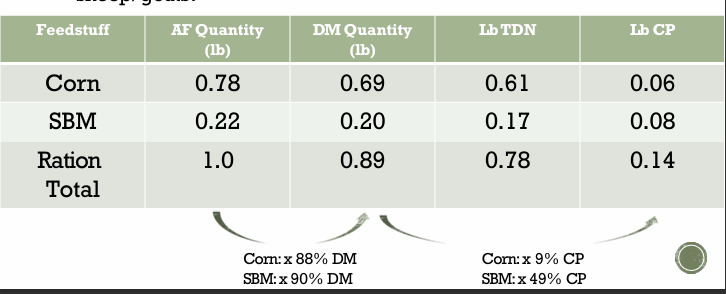
nutrient supply case study
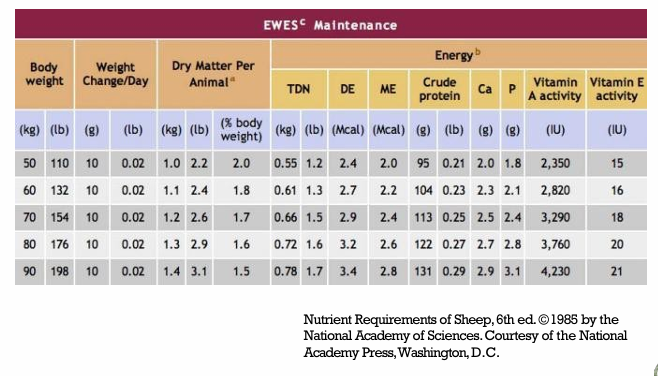
how much does this ration cost
same ration (78% corn and 22% SBM) at approximately 18% CP. current corn prices are $7.20/bu. soybean meal is currently $16.10/bu. what does the ration cost on per ton basis? What about per lb?
2000 lb/ton
2000 lb x .78 = 1560 lb. corn
2000 lb. x .22 = 440 lb SBM
]\