9/18 Psychological Barriers to Conflict Resolution III: Emotions and Moral Disengagement
Barriers III: Emotions and Moral Disengagement
Focus of this section: barriers related to emotions and the cognitive mechanisms people use to morally disengage from harmful actions.
Core idea: Understanding how emotions (power, moral image) and moral disengagement processes enable or hinder reconciliation after injustice.
Needs-Based Model of Reconciliation (Shnabel & Nadler, 2008)
Needs-Based Model: Roles and Resources
Roles:
Victim
Perpetrator
Impaired Emotional Resources (blocked or diminished):
Sense of power (power)
Public moral image (love)
Resource Sought from Partner:
Victim seeks empowerment from the partner (e.g., the victim wants the partner to take responsibility for causing the injustice)
Perpetrator seeks acceptance from the partner (e.g., the perpetrator wants the partner to express empathy)
Mechanism (how balance is restored):
By providing these resources, the affected party’s impaired needs are restored:
Restored sense of power (for the victim)
Restored public moral image (for the perpetrator)
Outcome:
Restored balance leads to increased willingness to reconcile
Figure 1: The needs-based model of reconciliation (illustrative description)
Illustration links victim and perpetrator through the two impaired resources and the two sought resources, showing how empowerment and acceptance restore balance and promote reconciliation.
Practical Reflection: Thinking of these needs (Page 5 prompts)
Paper frames conflict as a dynamic where the other party helps restore impaired needs.
Questions to consider:
What are some things that transgressors do to restore their need to protect their moral image?
Apologize, Grand gesture, Manipulate the victim or general public, etc.
What are some things victims do to increase their sense of power?
Get even (Cyclic), Social Power, Forgive (only victim increases their power)
Broader implications:
Beyond the dyadic relationship, what are potential consequences of having a depleted sense of power or a diminished moral image (e.g., within communities, institutions, or future conflicts)?
Mechanisms of Moral Disengagement in the Exercise of Moral Agency (Bandura et al., 1996)
Core idea: People can morally disengage to justify harmful actions, enabling immoral behavior without self-ccognition of wrongdoing.
Eight mechanisms:
Moral Justification
Example: "It is alright to beat someone who bad mouths your family."
Euphemistic Language
Example: "To hit obnoxious classmates is just giving them a ‘lesson’."
Advantageous Comparison
Example: "It is okay to insult a classmate because beating him/her is worse."
Displacement of Responsibility
Example: "Kids cannot be blamed for using bad words when all their friends do it."
Diffusion of Responsibility
Example: "A kid in a gang should not be blamed for the trouble the gang causes."
Distorting Consequences
Example: "It is okay to tell small lies because they don’t really do any harm."
Attribution of Blame
Example: "If kids fight and misbehave in school it’s their teacher’s fault."
Dehumanization
Example: "Some people deserve to be treated like animals."
Results Image
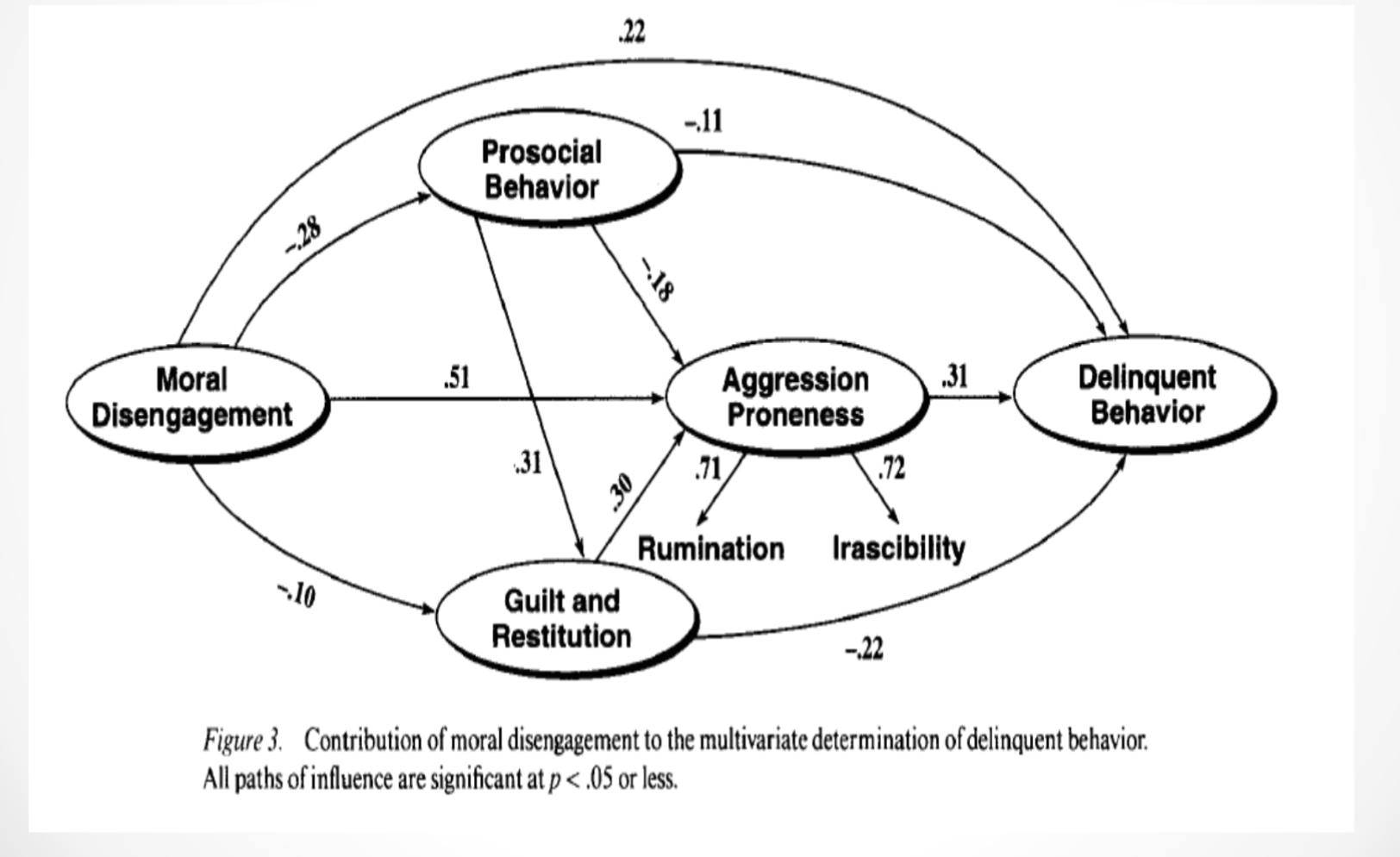
Empirical Link: Figure 3 — Moral Disengagement and Delinquent Behavior (Bandura et al.)
Study focus: Contribution of moral disengagement to the multivariate determination of delinquent behavior.
Key takeaway: All paths of influence in the model are significant at p < 0.05 (i.e., the relationships observed are statistically reliable within the study).
Reported (legible) path coefficients (as shown in the figure):
Prosocial Behavior:
Aggression:
Proneness:
Rumination:
Irascibility: not explicitly given in the legible caption
Guilt and Restitution:
Delinquent Behavior: coefficient not legible in the provided transcription, but the figure relates moral disengagement to delinquent outcomes through the multivariate network.
Caption note:
"Figure 3. Contribution of moral disengagement to the multivariate determination of delinquent behavior. All paths of influence are significant at p < 0.05 or less."
Discussion and Implications
Quotation to frame moral disengagement:
"It is easy to hurt others when such conduct is viewed as doing worthy things to unworthy people."
Key questions raised:
When we use these moral disengagement strategies, are we aware that we are using them at some level, or is it all operating without our awareness? What implications does this have for our ability to intervene?
The study found that elementary-aged children are already sophisticated moral disengagers. Where does this tendency/ability to disengage come from?
The study found a strong gender difference, with boys exhibiting more moral disengagement than girls. Where might this gender difference come from? How might it help us interpret other gender differences in behavior?
Barriers and group discussion (Page 10)
Barriers to reconciliation include:
Attributions (Motive Attribution Asymmetry; Ladder of Assumptions)
Perceptions (Discrepant victim/transgressor accounts)
Reactive Devaluation
Dehumanization
Emotional Needs (Power and Moral Image)
Moral Disengagement (8 methods; see above)
Class activity prompt:
Get in groups of 3–4 and discuss ways to overcome any of these barriers, in your own life or at the world-stage level.