Current, Potential Difference & Resistance
Wires are made of metal because metal is a good conductor. Current is actually the flow of negatively charged electrons. Charge, current and time are found using the equation Q = It. Charge (Q) is measured in Coulombs (C) and current (I) is measured in Amperes (A).
Terminals of a cell make one end positive and the other negative, setting up potential differences across the circuit**. Potential difference** is also known as voltage and is the amount of energy transferred per unit of charge passing through the terminals. One volt is equivalent to one joule per coulomb. This is found through the equation 1 V = 1 J / C. Voltage can be found using the equation V = E / Q. Voltage (V) is measured in volts (v) and energy transferred (E) is measured in joules (J).
Resistance (R) is the opposition to the current, meaning that a higher resistance has a lower current. Good conductors will have low resistance, and insulators have high resistance. Resistance is measured in Ohms (Ω), which are one volt per ampere (1V/A). Resistance can be increased by adding resisters, however, all of the components of a circuit do have resistance. Wires and batteries are negligible.
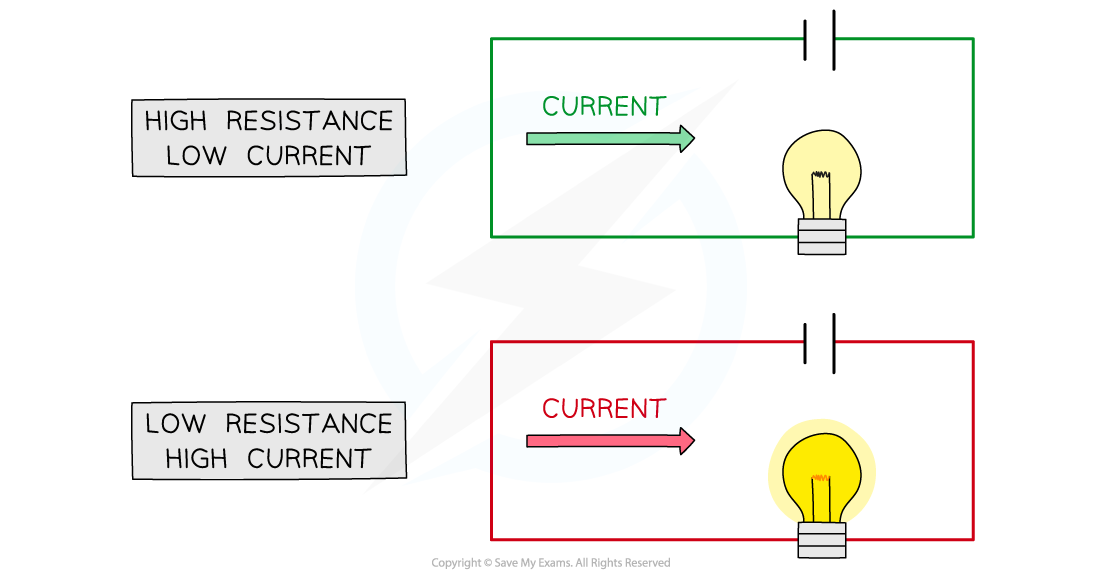
Current through components depends on the resistance and potential difference. More resistance means that there is a lower current, and more resistance means that there is a higher current. This is found through the formula V = IR.
Power is the rate of energy transfer or the amount of energy transferred per second. Power depends on voltage and current. The equation for this is P=IV. Power is measured in Watts (W).
A fuse is a safety device designed to cut off the flow of electricity to an appliance if the current becomes too large. Fuses are made of glass cylinders with thin metal wires, and when the current is too large then the wire heats up, melting, thus causing the wire to break which breaks the circuit and stops the current. This prevents fires and damage to equipment. To choose the right fuse, the current must be known, as there are a variety of sizes of fuses (3A, 5A, 13A etc). Fuses must have a higher rating than the current. Always choose the next size up than the current which the appliance runs at.
Work is done when charge flows through a circuit (work done = energy transferred). Energy transfer depends on three factors:
- current
- potential difference
- time appliance is used for
Energy transfer is calculated using the equation P = E / t. Since P = IV, you can also say that E = IVt.
When electricity passes through components, electrical energy is turned into heat, increasing temperature. This is because energy is transferred due to collisions between electrons flowing in the conductor and the lattice of atoms in the metal conductor. In metals, electricity is the flow of electrons, which ic current, and metals are made of lattices of ions, where, then electrons pass through the lattice, they collide with ions, which resists the flow of electrons.
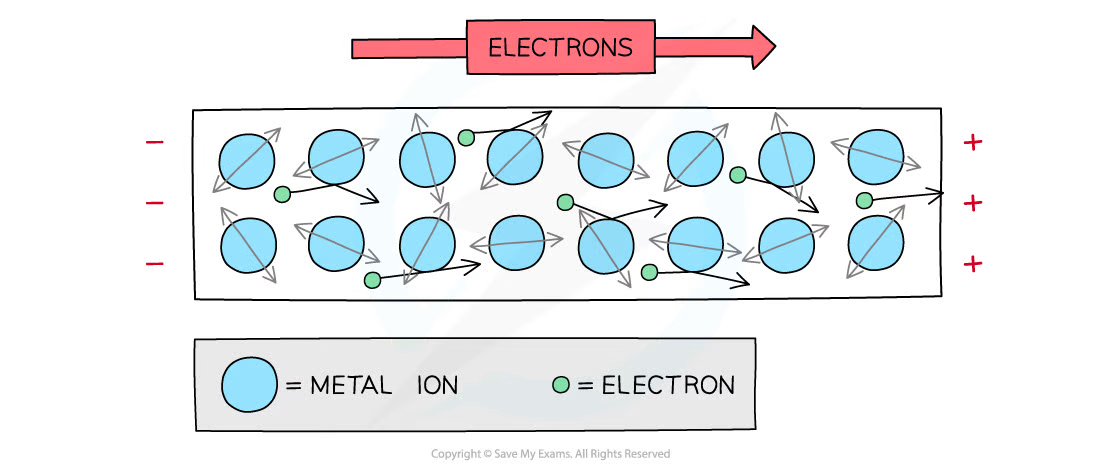 When electrons collide, they lose some energy as they give it to the ions, making them vibrate more, thus heating up the metals (such as in a kettle, induction hob, and toaster).
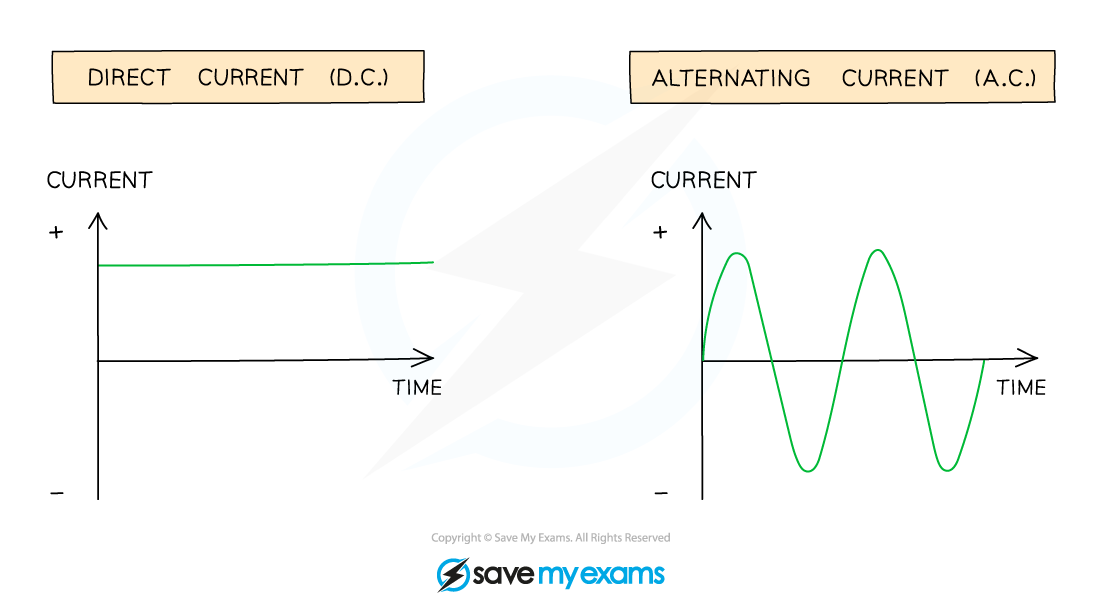
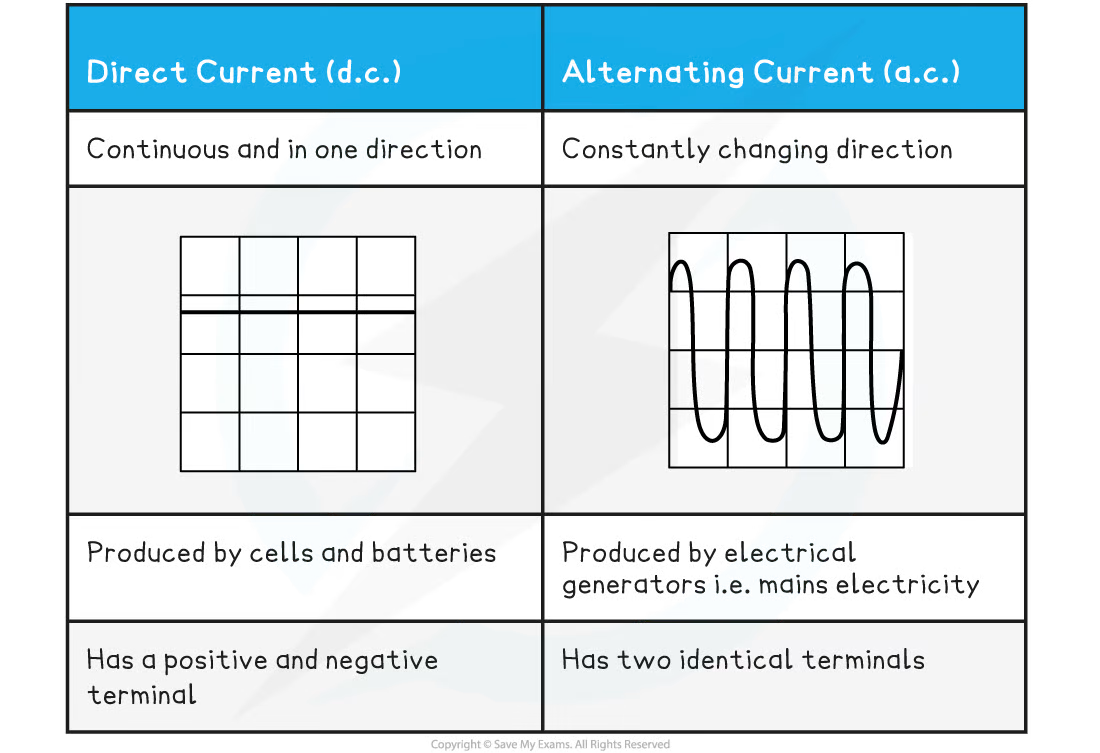
Direct Current (dc) is a current that is steady, constantly flowing in the same direction in a circuit, from positive to negative. The potential difference in a dc circuit is in only one direction, with only positive or only negative current. There are fixed positive and negative terminals in the electric cells or batteries.
Alternating Current (ac) is a current that is continuously changing its direction, going back and forth around a circuit. It has two identical terminals switching between positive and negative. Frequency of ac is the number of times it changes back and forth each second, and it can be measured on an oscilloscope.