Social cognition and antisocial behaviour
Social Cognition Definition:
Understanding perceptions, thoughts, emotions, motives, and behaviors of self and others.
Key Concepts of Social Cognition
Theory of Mind (ToM): Ability to comprehend others' beliefs and desires; understand they are different from own
develops between ages 4-6.
Sally Anne Test: If children pick ‘basket’ they understand sally’s perception is different from own / reality (TOM)
Perspective Taking: Begins around age 12, allowing children to understand multiple viewpoints. Related to parental modeling and peer relationships.
Social Cognition in Adulthood
Older adults can view both sides of arguments; social activities enhance cognitive skills
Social cognitive skills retained
'Post Formal Reasoning' may emerge, involving complex reasoning styles.
ToM link to morality
can be used prosocially
can be used antisocially (immoral behaviour) - bullying and lying
Morality
Definition of Morality: Ability to discern right from wrong and act accordingly.
Components:
Cognitive: Understanding right and wrong; perspective taking.
Affective: Emotions like guilt and pride related to moral actions.
Behavioral: Implementation of moral beliefs through actions.
Theories of Moral Development
Cognitive Developmental Theory: Stages of moral reasoning based on the work of Piaget and Kohlberg.
Piaget: Children's moral reasoning evolves in stages as they interact with their environment
6-10: wrongness judged using consequences
11: wrongness judged using intentions, rules more flexible
Kohlberg
Moral understanding
drives moral action
develops through direct and repeated socio-moral experiences with moral conflicts/dilemmas
Stages of moral reasoning:
Preconventional:
Punishment & obedience
Instrumental hedonism (only wrong if caught)
Conventional:
Good boy/good girl (approval)
Authority and social order (illegalness)
Post Conventional:
Individual rights, majority focused
Individual principles of conscience
Critiques include cultural bias and an assumption of reasoning correlating with moral behavior.
Psychoanalytic Theory:
Motivation for moral behaviour: avoid negative emotions, experience positive ones
Must be cognitively developed
Empathy
Super-ego (morality principle) - development through identification with parents.
Social Learning Theory:
Behaviour conforms to moral standards to avoid censure (negative judgement)
Developed through reinforcement from interactions with parents and peers
Moral Identity
0-6yrs - idea of ‘moral self’
8-12 yrs - moral identity emerges
CHildren - motivation for moral identity: protecting social reputation
Adulthood - moral identity = 'abstract, internalised self-ideal'
CUltural influences: AUtonomy, community and divinity
Antisocial Behavior: Overview
Definition: Behavior that harms or violates the rights of others.
Age Factors: Youths are more likely to reoffend; peaks in teenage years due to peer pressure and brain maturity.
Moffitt's Taxonomy of Antisocial Behavior
Early Onset/Life-course Persistent: Antisocial behaviour begins in childhood, continues through adolescence / adulthood
Late Onset/Adolescent Limited: Often associated with peer pressure, antisocial behavior often ceases as prosocial rewards become more attractive.
Maintenance of Antisocial Behaviour
Influenced by peer associations and a lack of alternative choices.
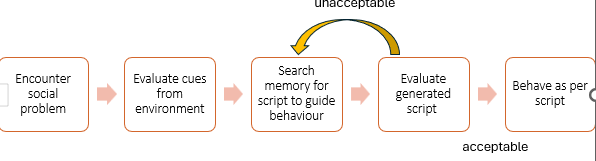
Social Information Processing Model (Dodge (1993):
Desistence of Antisocial Behaviour
Maturity
Assessment of future implications - cost/rewards
Development of prosocial behaviours (with age?)