Biology Chapter 1 Notes Flashcards
Biology - the study of living things.
Organism - any living thing
Living things/organisms can be found with many different levels of complexity.
Complexity can range from the smallest/lowest level of organization and progressing to more complex levels.

Characteristics of All Living Organisms
Cellular organization
Ordered complexity
Sensitivity to environment
Growth, development, and reproduction
Energy utilization
Homeostasis
Evolutionary adaptation
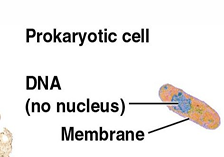
Prokaryotic Cells
Simpler
Usually smaller
Does not contain a nucleus or other membrane-eclosed organelles
Organism is typically a single cell
Eukaryotic Cells
Has membrane-enclosed organelles - largest of which is nucleus
Organism can be made of a single cell or multiple cells

Hierarchical Organization of Living Systems
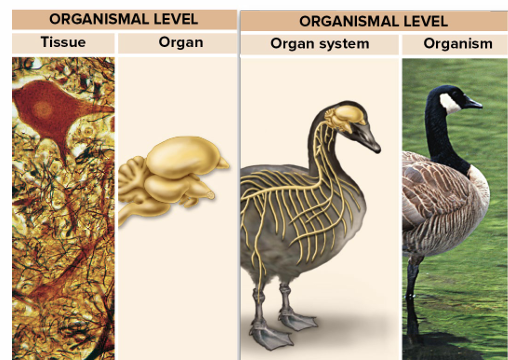
Living systems show hierarchical organization.
Organismal Level
tissues, organs, organ systems.
Population Level
population, community
Ecosystem Level
Biosphere
Earth is an ecosystem we call the biosphere
Each level has emergent properties - due to the arrangement and interactions of parts as the complexity increases.
Biology as a Scientific Discipline
Science
the observation, identification, experimental investigation, and theoretical explanation of natural phenomena.
benefits from diverse viewpoints.
Many scientists focus research on the same model organisms - species easily grown in the lab that lend themselves to being investigated/studied.
The Scientific Method - is used to test theories
The Scientific Method
Scientists use a systematic approach to gain understanding of the natural world.
Steps to Method
Observation
Hypothesis
Prediction
Experimentation
Conclusion
Hypothesis - a possible explanation for an observation
must be tested to determine its validity
is often tested in many ways
allows for predictions to be made
Controlled Experiment
an experimental group is compared with a control group.
Experimental variables - features or quantities that vary in an experiment
independent variable - the one that is manipulated by the researchers
dependent variable - the one predicted to be affected in response
Types of Reasoning
Deductive
works from general observations to specific conclusions
the act of validating a generalized statement with specific scenarios.
Ex: you must have 120 credits to graduate. Because I only have 38 credits, I will not be graduating this semester.
Inductive
works the other way - moving from specific observations to broader generalizations and theories.
the act of using specific scenarios to make generalized conclusions
Ex: I completed 120 credits. My advisor said that my degree program is 120 credits. I am ready to graduate.
Basic Research
intended to extend the boundaries of what we know
research at universities that is supported by grants from various agencies and foundations.
Applied Research
foundation provided by basic research
scientists are often employed in some kind of industry
may involve the manufacture of goods such as food additives or drugs.
Core Concepts in Biology
Life is subject to chemical and physical laws.
Biological systems follow known chemical properties, like molecular bonding.
Properties of physics, such as thermodynamics, are also key determining factors of biological systems.
Structure Determines Function
at each level of organization, there is a correlation between structure and function.
analyzing a biological structure gives us clues about what it does and how it works.
Conversely, knowing the function of something gives us clues about its structure and organization.
Energy and Matter
Living organisms transfer and transform energy and matter.
They acquire energy from their environment (sun) and use that energy to maintain their internal order (Producers vs. Consumers)
Energy is channeled, stored, and used in every aspect of life.
It is converted from one form of energy to other forms of energy as needed.
Ex: cellular respiration, metabolism, photosynthesis.
Information Transactions
Life’s processes involve the expression + transmission of genetic information.
The genetic information of cells is in the form of DNA (deoxyribonucleic acid)
DNA is organized into genes which are in turn organized into chromosomes.
DNA
made of two individual strands that are chains of “bases"“(G, A,T,C) connected by special chemical bonds.

Genes
the units of inheritance that contain the information needed to build the molecules that the cell needs to synthesize whatever it needs.
the expression/usage of genes at specific times and at specific levels is what determines a cell’s identity (structure) and therefore its function.
The entire “library” of genetic information an organism (or cell) has is called its genome.
Transcription
biological process of synthesizing RNA from a DNA template, playing a crucial role in gene expression and the central dogma of molecular biology.
Translation
the biological process by which cells synthesize proteins by decoding the information in messenger RNA (mRNA).

Information in DNA used to direct synthesis of cellular components.
Control of gene expression leads to different cells/ tissue types.
Gene Expression
the process of converting the “code” of DNA into a protein
requires an RNA intermediate.
DNA → RNA→ Protein
DNA→RNA = transcription
RNA→ Protein = translation
Evolution
accounts for the unity (shared features) and the diversity (differences) of life.
it is the process of biological change in which species accumulate differences from their ancestors as they adapt to different environments overtime.
populations of organisms evolve from one generation to the next.
two different species can develop from a single common ancestor.
Domains of Life
Taxonomy
the grouping of species based on common ancestry
Three Domains of Life
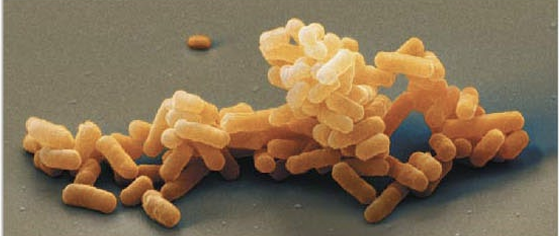
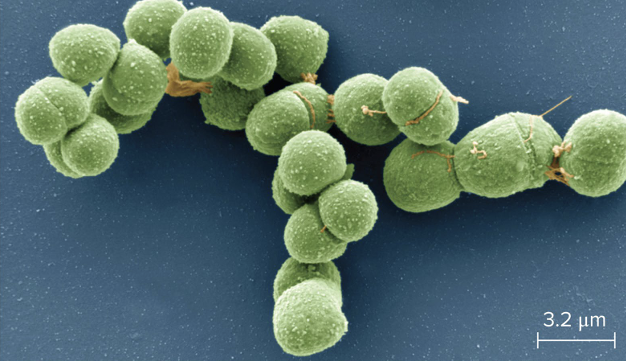
Bacteria - unicellular prokaryote
Archaea - unicellular prokaryote
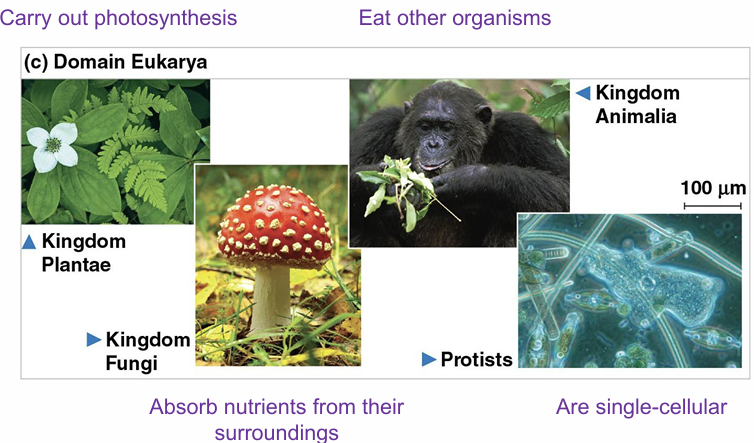
Eukarya - unicellular and multicellular eukaryotes
Members of Domain Bacteria
Mostly unicellular prokaryotes that inhabit many diverse environments on Earth.
Can be classified into multiples kingdoms.
Members of Domain Archaea
Unicellular prokaryotes that often live in extreme environments, such as hot springs and salty lakes.
Members of Domain Eukarya
Unicellular and multicellular organisms having cells with internal compartments that serve various functions