Chemistry - 8 Rates and Equilibrium - Required Practical 5: Rate of Reaction
Aims:
investigate how changes in concentration affect the rates of reaction by measuring gas volume and change in colour or turbidity
Risk Assessment:
acid is an irritant and could damage the eyes
Safety:
wear safety goggles
Equipment:
conical flask
rubber bung (opt.)
delivery tube (opt.)
gas syringe (opt.)
stopwatch
40 g/cm³ sodium thiosulfate solution
1.0 M and 1.5 M hydrochloric acid solution
3cm lengths of magnesium ribbon
printed black cross
measuring cylinders
Control variables:
Method 1: Volume of Gas
temperature of surroundings
size of magnesium ribbon piece
volume of hydrochloric acid
Method 2: Disappearing Cross
temperature of surroundings
total volume of liquid
size and colour of cross
concentration of original sodium thiosulfate solution
volume of hydrochloric acid
concentration of hydrochloric acid
Independent variable:
Method 1: Volume of Gas
concentration of hydrochloric acid
Method 2: Disappearing Cross
concentration of sodium thiosulfate solution
Dependent variable:
Method 1: Volume of Gas
rate of production of hydrogen
Method 2: Disappearing Cross
time taken for cross to no longer be visible
Method:
Method 1: Volume of Gas
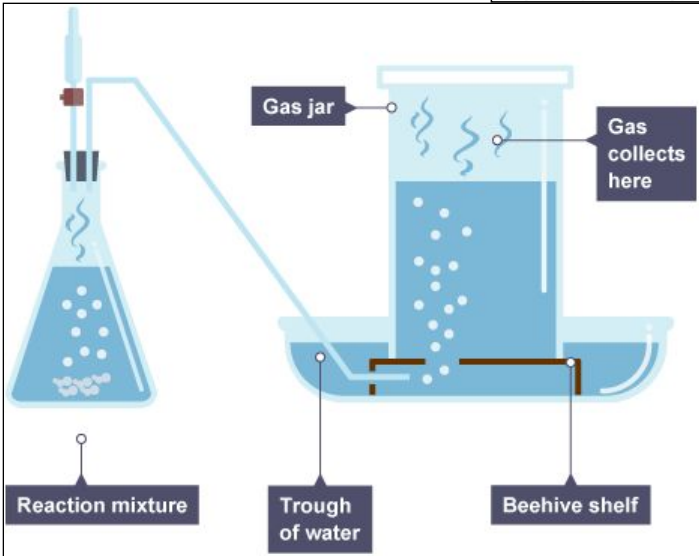
Using the measuring cylinder, measure 50 cm³ of 1.0 M hydrochloric acid into a conical flask
Add a 3 cm strip of magnesium ribbon to the acid and quickly fit the flask with a rubber bung attached to a delivery tube or gas syringe. Start the stopwatch
Every 10 seconds, record the volume of gas produced until no more gas is produced
Repeat steps 1-3 using the 1.5 M hydrochloric acid solution
Method 2: Disappearing Cross
Using a measuring cylinder, measure 10 cm³ sodium thiosulfate solution into a conical flask. Dilute with enough water to bring the total liquid to 50 cm³ (here, 40 cm³)
Place the conical flask on top of the printed black cross
Using a measuring cylinder, measure out 10 cm³ dilute hydrochloric acid. Add the acid to the conical flask, swirl gently and immediately start the stopwatch
Look down into the conical flask, at the black cross. When it can no longer be seen, stop the stopwatch
Repeat steps 1-4, using different volumes of sodium thiosulfate in step 1 (20 cm³, 30 cm³, 40 cm³)
Repeat steps 1-5 again and calculate a mean time for each concentration
Calculations/graphing:
Method 1: Volume of Gas
plot a graph of time against gas volume, plotting two curves - one of 1.0 M hydrochloric acid and one for 1.5 M
Method 2: Disappearing Cross
plot a graph of sodium thiosulfate concentration against time taken