Lecture 11: Comprehensive Study Guide to Parental Imprinting, Epigenetic Mechanisms, and Maternal Effects
Foundations and Epigenetic Basis of Parental Imprinting
Definition of Parental Imprinting: Parental imprinting, also called the parent-of-origin effect, is an epigenetic phenomenon wherein the expression of a specific gene depends strictly on the sex of the transmitting parent (whether inherited from the maternal or paternal germline).
Non-Equivalence of Parental Alleles: Under classical Mendelian inheritance, maternal and paternal alleles are assumed to function with complete equivalence. In contrast, parental imprinting dictates that even when both parents transmit intact copies of a gene, only the allele derived from one parent is transcriptionally active, while the homologous copy derived from the other parent is silenced or "turned off."
Epigenetic Nature of Imprinting: Imprinting represents an epigenetic modification rather than a change in genomic content. The underlying nucleotide sequence of the DNA remains entirely unaltered. Instead, sex-specific epigenetic chemical tags (predominantly covalent DNA methylation marks) are established during gametogenesis to designate which parental allele must be transcriptionally repressed.

Functional and Phenotypic Consequences:
Two homologous alleles possessing identical nucleotide sequences can exhibit diametrically opposed transcriptional behavior within the same cell purely as a result of their parent of origin.
The differential activity does not stem from intrinsic sequence divergence within the gene itself, but from parental epigenetic imprints that dictate to the somatic cellular machinery which copy is permissible to transcribe.
Crucial organismal characteristics, such as embryonic and postnatal growth rates, placental efficiency, resource partitioning, and susceptibility to distinct congenital diseases—depend fundamentally on which parent contributed the expressed allele.
EXAMPLES INCLUDE: Prader-Willi syndrome and Angelman syndrome happen when the active (non- silent) gene copy is missing or not working, and the other (imprinted) copy is silent. This causes serious health issues.
Molecular Mechanisms Regulating Genomic Imprinting
Clustered Distribution of Imprinted Loci: Genomic imprinting does not affect all genes across the genome. Only a specialized subset of genes is subjected to imprinting. These genes are predominantly organized into coordinately regulated, evolutionarily conserved physical clusters within the genome.

Primary Epigenetic Mechanisms of Imprinting:
DNA Methylation:
Involves the enzymatic addition of methyl groups () to targeted cytosine residues (predominantly within CpG islands and Differentially Methylated Regions, or DMRs).
Serves as the primary and best-characterized epigenetic silencing mark, functioning to repress gene transcription directly or prevent transcription factor binding.
Mechanistic analogy: DNA methylation functions like placing a sticky note over a switch labeled "Do not use."
Long Non-coding RNAs (lncRNAs):
Long RNA transcripts (exceeding nucleotides in length) that DO NOT code for proteins.
They help organize and regulate clusters of
imprinted genes, essentially, acting as guides or
scaffolds to bring in other silencing machinery.
Mechanistic analogy: lncRNAs operate like managers coordinating teams of genes.
Insulator Architectural Proteins (e.g., CTCF):
Specialized DNA-binding proteins, such as CCCTC-binding factor (CTCF), that recognize and bind specific non-methylated DNA boundary elements.
Function as physical "roadblocks" or chromatin insulators that block spatial interactions between distal transcriptional enhancers and gene promoters, ensuring that enhancer-driven activation is strictly restricted to the right parental chromosome.
Small Non-coding RNAs (siRNAs and microRNAs / miRNAs):
Short, single-stranded non-coding RNA molecules that can target messenger RNAs, preventing them from making proteins or marking them for destruction.
These silent genes after transcription, adding another layer of control.
Recognize and bind complementary sequences within target messenger RNAs (mRNAs), marking them for endonucleolytic destruction or directly preventing their translation into functional proteins by the ribosome, thereby adding a downstream regulatory checkpoint to imprinting clusters.
Evolutionary Significance and the Parental Conflict Theory
Why did evolution develop so many layers of control for imprinting?
Imprinted genes often control very important processes, like growth and development before birth. Mistakes in imprinting can cause serious health problems or even be deadly.
Multiple layers of control act as a safety net: If one mechanism fails, others can still help keep gene expression properly regulated.
Helps respond to different situations: Some genes might need to be tightly turned off in certain tissues or at certain times, so having different types of control allows for precise regulation.
Parental Conflict (Kinship) Theory:
The evolutionary origin of genomic imprinting is widely conceptualized as an intragenomic tug-of-war between maternal and paternal genetic interests regarding maternal resource investment in offspring.
The intricate, multi-tiered molecular controls governing imprinting evolved to maintain a stable evolutionary equilibrium between these conflicting parental interests.
Disambiguating Non-Mendelian Phenomena: Maternal Effects vs. Maternal Inheritance vs. Genomic Imprinting
Fundamental Conceptual Distinctions:
Maternal Effect: An inheritance pattern in which the offspring's phenotype is determined directly by the nuclear genotype of the mother, independent of the offspring's own inherited genotype. This is mediated via maternal provisioning of the unfertilized egg cytoplasm (mRNAs, proteins), maternal uterine environment, or placental nutrient transfer, rather than the transmission or expression of specific offspring alleles.
Maternal Inheritance: The physical transmission of extranuclear genetic material (such as mitochondrial DNA, mtDNA) from the maternal lineage to all progeny through the cytoplasm of the egg, with zero contribution from the paternal germline.
Parental (Genomic) Imprinting: Imprinting is a gene expression pattern dependent on the parent of origin—not an effect of the mother’s environment/genotype.
Crucial Rule of Maternal Effects: In a maternal effect, it is strictly the mother's nuclear genotype (and not her outward phenotype) that governs the phenotypic outcome of the offspring.
Case Study: Recessive Maternal Effect in Soft Coated Wheaten Terriers (SCWT):
Condition: Microphthalmia (congenital development of abnormally small or absent eyes) observed in Soft Coated Wheaten Terrier (SCWT) puppies.
Underlying Mutation: Caused by a specific deletion mutation designated in the gene (Retinol Binding Protein 4).
Pathophysiological Mechanism:
RBP4 is essential for transporting retinol (Vitamin A) from the maternal circulation across the placenta to the developing fetus.
Adequate retinol availability during critical embryonic windows is an absolute requirement for normal ocular morphogenesis.
Microphthalmia results directly from an insufficient supply of retinol crossing the placenta, which is governed exclusively by the dam's ability to produce functional RBP4.
If the dam carries at least one wild-type functional allele ( or ), she synthesizes sufficient RBP4 to transfer normal quantities of retinol across the placenta. Consequently, all her puppies develop normal eyes, even if the puppies themselves are homozygous mutants ().
If the dam is homozygous for the mutation (), she cannot provide sufficient retinol to the embryonic ocular tissue across the placenta. Consequently, all puppies delivered by a dam develop microphthalmia, regardless of whether the puppies are genetically or heterozygous carriers ().


Maternal Effect Genotype-to-Phenotype Matrix in SCWT Dogs:
Mother Genotype: | Father Genotype: Any | Offspring Genotype: Any | Offspring Phenotype: Normal | Interpretation: The dam supplies normal RBP4 across the placenta; ocular development proceeds normally.
Mother Genotype: | Father Genotype: Any | Offspring Genotype: Any | Offspring Phenotype: Normal | Interpretation: A single functional allele in the heterozygous dam provides sufficient retinol transport; the microphthalmia phenotype is not expressed.
Mother Genotype: | Father Genotype: | Offspring Genotype: | Offspring Phenotype: Small eyes (Microphthalmia) | Interpretation: Despite the offspring possessing a normal wild-type allele from the sire, small eyes develop due to the absolute lack of maternal RBP4-mediated retinol transport in gestation.
Mother Genotype: | Father Genotype: | Offspring Genotype: | Offspring Phenotype: Small eyes (Microphthalmia) | Interpretation: All puppies born to dams are affected; phenotypic expression is entirely independent of puppy genotype.
Comparative Genomic Imprinting: Mammals vs. Plants
Conservation across Kingdoms: Genomic imprinting is not restricted to the mammalian clade; it occurs prominently in angiosperms (flowering plants) as well.
Classic Botanical Model in Maize:
In maize, paternal imprinting at loci such as the (colorless) and (colored) gene cluster controls kernel endosperm pigmentation.
Maize (corn) provides a classic example of paternal imprinting, where the gene's effect differs depending on whether it was inherited from the father.
Mechanisms may vary; plants often use RNA-directed DNA methylation or other plant-specific factors and target more endosperm/tissue-specific genes than mammals.

Evolutionary Drivers across Kingdoms:
In Plants: Imprinting balances maternal and paternal genetic resource allocation strictly during seed development. Imprinting functions to prevent the paternal genome from sequestering excessive maternal resources toward its own seeds, thereby protecting the maternal plant from metabolic exhaustion and optimizing total viable seed production across the plant's lifetime.
In Animals: Imprinting controls development and how resources are shared. The focus is on regulation growth and survival of offspring
The Paradigm of Mammalian Imprinting: The IGF2/H19 Cluster and Disease Pathologies **************
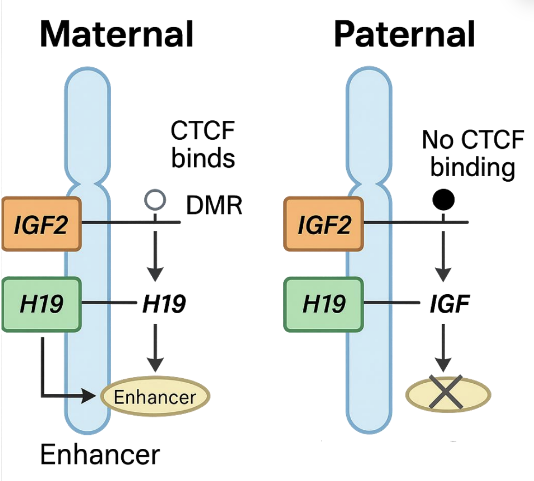
The IGF2 (Insulin-like Growth Factor 2) and H19 genes form a classic example of a mammalian imprinted cluster.
DMR (Differentially Methylated Region): Expression of IGF2 or H19 depends on whether the DMR is methylated (silenced) or unmethylated (active).
CTCF Protein: CTCF is an insulator protein that binds only unmethylated DMRs, blocking access to the enhancer for one of the genes.
Outcome:
From mother: DMR is unmethylated → CTCF binds → only H19 is expressed (IGF2 silenced).
From father: DMR is methylated → CTCF does not bind → only IGF2 is expressed (H19 silenced).
Pathological Consequences of Imprinting Errors:
Aberrant Methylation (imprinting errors) and Loss of Imprinting (LOI): Disruptions in methylation maintenance or imprinting establishment alter physiological gene dosage, leading to severe somatic growth disorders and oncogenesis.
Overexpression = loss of gene expression, disrupts normal balance
Consequence = Growth disorders, developmental diseases, increased cancer risk
Pathways Induced by Imprinting Deregulation:
Overexpression of (due to loss of imprinting) drives uncontrolled cellular proliferation and severe overgrowth syndromes, markedly increasing the risk of pediatric malignancies such as Wilms' tumor of the kidney.
Overexpression or loss of disrupts the cell cycle, leading to broad developmental dysmorphology, tissue overgrowth, and tumorigenesis.

Genetic and Epigenetic Determinants of Muscling Traits in Livestock
Skeletal Muscle Proliferation Mechanisms:
Muscular Hypertrophy: An increase in total skeletal muscle mass resulting from the post-developmental enlargement of individual muscle fiber cells (increased cross-sectional area and volume per myocyte).
Muscular Hyperplasia: An increase in total skeletal muscle mass resulting from an elevated total number of discrete muscle fibers formed during embryogenesis and myogenesis.
Comparative Livestock Muscling Models:
Callipyge Sheep: Muscular hypertrophy caused by an imprinted parent-of-origin regulatory mutation.
Double-Muscled Belgian Blue Cattle: Muscular hyperplasia resulting from a loss-of-function knockout mutation in the myostatin () gene, a negative regulator of embryonic muscle development.
Pietrain Swine: Heavy muscling and extreme lean yield driven by the regulatory upregulation of expression (via a non-imprinting regulatory mutation).
Texel Sheep: Muscular hypertrophy driven by the "Patrocles mutation," a single-nucleotide mutation within the untranslated region () of the gene that creates a de novo binding site for microRNAs (miR-1 and miR-206), leading to translational repression and down-regulation of myostatin protein.

Case Study: The Callipyge Locus and Polar Overdominance in Sheep
Discovery and Phenotypic Characterization:
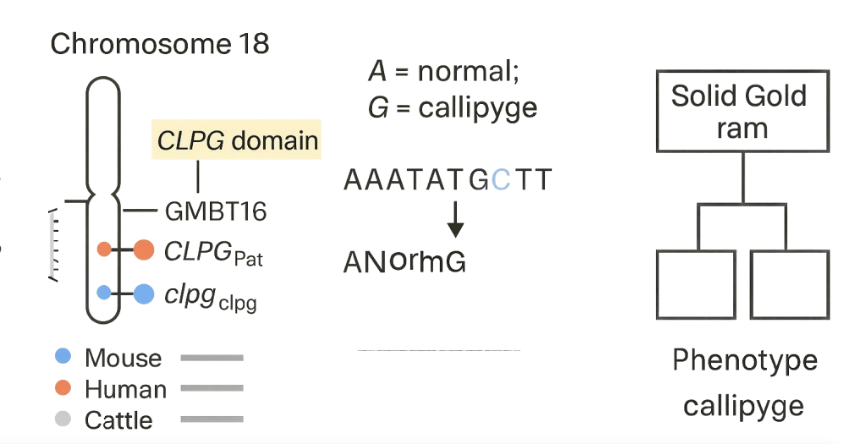
Origin: A Dorset ram named "Solid Gold," born in Oklahoma in , exhibited remarkable muscular hypertrophy concentrated in the hindquarters and rump.
Heritability: Solid Gold transmitted the extreme muscling trait to approximately of his total progeny across both male and female offspring.
Autosomal Non-Sex-Linked Transmission:This strong muscle trait was determined to be heritable rather than the result of feeding, exercise, or sex (i.e., not sex-linked).

The Four Classic Experimental Matings:
Mating A:
Cross Design: Rams Ewes
Expected Phenotype (under Mendelian dominance): callipyge, normal
Observed Phenotype: normal ( callipyge)
Key Deduction: The callipyge phenotype is not expressed when the mutant allele is transmitted from the dam (mother).
Mating B:
Cross Design: Rams Ewes
Expected Phenotype (under Mendelian dominance): callipyge, normal
Observed Phenotype: callipyge, normal
Key Deduction: Only offspring inheriting the CLPG allele paternally, and from a non-CLPG dam, show the phenotype.
Mating C:
Cross Design: Rams Ewes
Expected Phenotype: callipyge, normal
Observed Phenotype: callipyge, normal (closely matching a Mendelian segregation ratio)
Key Deduction: Only CLPG Pat / clpg Mat genotype (CLPG from father, clpg from mother) produces callipyge phenotype; all other genotypes are normal.
Mating D:
Cross Design: Rams Ewes
Expected Phenotype: callipyge
Observed Phenotype: callipyge, normal
Key Deduction: Nearly all progeny display callipyge because all receive a paternally transmitted allele paired with a wild-type maternal allele ().
Experimental Tracking: Researchers utilized the closely linked molecular marker to rigorously trace the parental gametic origin of each allele.
The Non-Mendelian Concept of Polar Overdominance:
Polar overdominance is a distinct mode of inheritance where the mutant phenotype is manifested exclusively in heterozygous individuals that inherit the mutation specifically from their father.
Homozygous mutants () paradoxically present with a completely normal muscle phenotype, because maternal transmission of the locus silences or counteracts the paternal locus.
Mutant allele must be inherited from the father for expression!

Genetic and Physical Basis of the Callipyge Mutation:
Genetic mutation causing callipyge: A single base change (A → G) in a region once considered “junk” DNA (non-coding).
Mapped by identity-by-descent (IBD): Researchers followed the mutation down from “Solid Gold” ram’s lineage.
High synteny: This chromosomal region (homologous gene cluster) is highly conserved (syntenic) among sheep, mice, and humans.
Co-segregation: The mutation exhibits perfect, absolute co-segregation with the callipyge phenotype.
Questions & In-Class Discussions
Discussion Prompt 1: Situations where Having One Silent Gene Copy Produces Significant Biological Consequences:
Primary Question: In what clinical, physiological, or genetic contexts does carrying a silenced, imprinted gene copy result in observable phenotypic consequences or severe human disease?
Explanation: When an individual inherits a deleterious mutation, microdeletion, or structural chromosomal defect on their single active (non-silenced) parental allele, they become functionally hemizygous. Because the homologous allele inherited from the other parent is epigenetically locked in a transcriptionally silent state, the cell has no backup functional copy to compensate, resulting in clinical disease.
Discussion Prompt 2: Evolutionary Drivers for Multiple Layers of Imprinting Control:
Primary Question: Why would natural selection favor the evolution and maintenance of multiple, overlapping layers of control (such as DNA methylation, lncRNAs, insulator proteins, and small RNAs) to govern imprinted gene expression?
Explanation:
High Developmental Stakes: Imprinted genes primarily regulate embryonic viability, placental nutrient exchange, and fetal growth. Subtle quantitative variations in gene dosage can precipitate embryonic death, severe congenital anomalies, or maternal gestational failure.
Redundant Safety Nets: Relying on a single regulatory mechanism creates an evolutionary vulnerability to stochastic epigenetic drift. Multi-layered architectures establish functional redundancy; if DNA methylation undergoes partial demethylation or slippage, downstream insulator proteins or post-transcriptional small RNAs still prevent inappropriate gene transcription or translation.
Spatiotemporal Specificity: Different tissues and developmental stages demand distinct levels of repression. Combining chromatin architecture (CTCF) with transcriptional scaffolds (lncRNAs) and post-transcriptional destroyers (miRNAs) enables cell-lineage-specific and temporally dynamic gene silencing.
Resolution of Parental Conflict: Imprinting represents an active, ongoing evolutionary conflict between maternal and paternal reproductive strategies. Multi-tiered epigenetic machinery evolved as biochemical weapons and counters within this parent-offspring resource allocation conflict.