Unit Three: Elbow & Forearm Complex
Definitions
Elbow
Joint separating arm from forearm
Distal Humerus
Proximal Ulna
Forearm
Bones between elbow and wrist joints
Radius
Ulna
Bones of the Elbow and Forearm
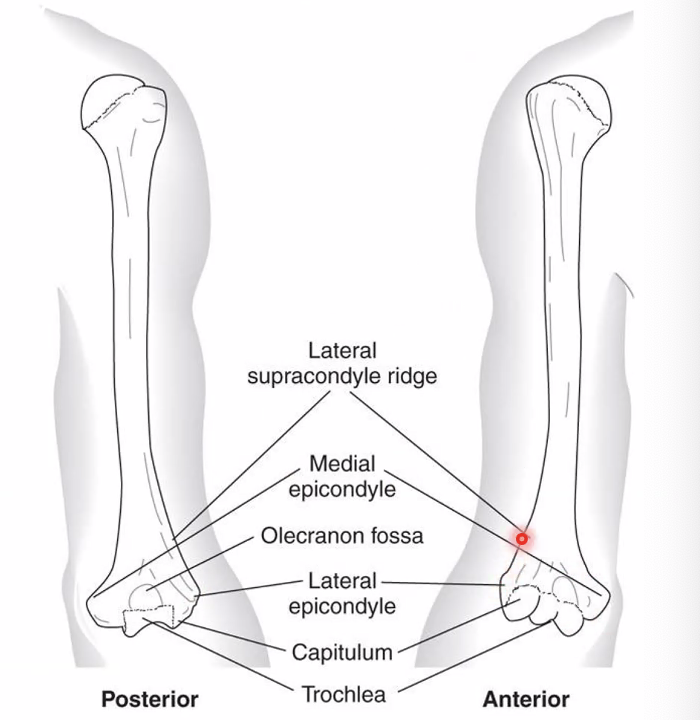
Humerus
Arm
Major bone of the upper arm
Landmarks:
Lateral & Medial Epicondyle
Lateral & Medial Supracondylar Ridge
Capitulum
Trochlea (true elbow)
Coronoid Fossa
Olecranon Fossa
Spiral Groove
Radius
Function
Lateral bone of forearm
Landmarks:
Head
Neck
Tuberosity
Styloid Process

Ulna
Function
Medial bone of forearm
Landmarks:
Olecranon
Coronoid Process
Trochlear Notch
Ulnar Tuberosity
Styloid Process
Head

Joints of the Elbow and Forearm
Articulations
Humero-ulnar Joint
Known as the "elbow"
Type: Synovial hinge
Motions: Flexion/extension
Characteristics:
Stable joint
Bone congruity
Ligament capsule
Humero-radial Joint
Type: Synovial hinge joint
Articulation: Capitulum of humerus articulates with head of the radius
Motions: Flexion/extension
Arthrokinematics: Spin of radial head as forearm pronates & supinates
Radial-ulnar Joint
Type: Synovial, pivot
Distal & Proximal Joints
Motions: Pronation & supination
Radial-ulnar Joint (Fibrous)
Type: Fibrous joint created by interosseous membrane along shaft
Motions: Supportive
Motions of the Elbow and Forearm
Elbow Motions:
Flexion
Extension
Forearm Motions:
Pronation
Supination
Concept Check
Planes & Axes?
Supination/Pronation
Mechanics: Radius moves around ulna
Action: Radial head spins on capitulum (in annular ligament)
Static Motion: Ulna does not move for this motion – try it!

Anterior View of Supination/Pronation
Key components include:
Olecranon
Trochlear Notch
Coronoid Process
Radial Tuberosity
Interosseous Membrane
Ulnar Tuberosity
Ligaments of the Elbow and Forearm
Ulnar Collateral Ligament
Also known as medial collateral
Attachments:
From medial epicondyle to coronoid process
Features:
Most stable/strong joint of elbow
Resists valgus stress
Radial Collateral Ligament
Also known as lateral collateral
Attachments:
From lateral epicondyle to radial head
Features:
Smaller, less stable
Helps resist varus stress
Annular Ligament
Function:
Wraps around head of radius from ulna
Helps radius maintain position during pronation/supination
Keeps radial head “spinning” on capitulum of humerus
Interosseous Membrane
Description:
Broad, flat, fibrous membrane located between radius and ulna
Function:
Keeps bones from separating
Provides surface area for attachment
Olecranon Bursa
Location:
Over olecranon process
Condition:
Olecranon bursitis, known as “student’s elbow”
Often occurs from excessive leaning, driving, or sitting
Landmarks of the Elbow and Forearm
Cubital Fossa
Description:
Shallow, triangular depression on anterior elbow
Borders:
Lateral: Brachioradialis
Medial: Pronator teres
Superior: Imaginary line between medial & lateral epicondyles
Floor:
Brachialis and supinator
Contents:
Biceps tendon
Brachial artery
Median nerve
Other Landmarks
Olecranon Process
Head of Radius
Radial Styloid
Ulnar Styloid
Compartments of the Elbow and Forearm
Volar Compartment (Flexors)
Innervation:
Median and ulnar nerve innervates superficial flexors
Median nerve innervates deep flexors
Dorsal Compartment (Extensors)
Innervation:
Radial nerve innervates extensors
Mobile wad of 3: (flexors often)
Radial nerve
Posture
Carrying Angle
Angle of elbow in anatomical position
Abnormal Postures:
Cubital Valgum - carrying angle above 5-15 degrees
Cubital Varum - Known as “gunstock deformity”
Muscles of the Elbow and Forearm
Muscles of Elbow Flexion
Brachialis
Origin: Distal half of anterior humerus
Insertion: Coronoid process & ulnar tuberosity
Strong flexor, known as “workhorse of the elbow”
Not involved in supination/pronation because it doesn’t attach to the radius
Biceps Brachii
Two heads: Long head from supraglenoid and short head from coracoid to radial tuberosity
Innervation: Musculocutaneous nerve
Brachioradialis
Origin: Lateral supracondylar ridge of humerus
Insertion: Styloid process of radius
Does not assist in pronation/supination due to anatomical position
Innervation: Radial nerve
Pronator Teres
Assists flexion (small, diagonal muscle)
Muscles of Elbow Extension
Triceps Brachii
Heads: Long head from infraglenoid tubercle, lateral and medial heads from posterior humerus
Insertion on olecranon process

Anconeus
Origin: Lateral epicondyle of humerus
Insertion: Lateral & inferior of olecranon process
Small muscle that rolls with annular ligament
Innervation: Radial nerve
Muscles of Forearm Supination
Supinator
Origin: Posterior lateral epicondyle
Insertion: Anterior proximal radius (deep)
Innervation: Radial nerve
Biceps Brachii
Also contributes to supination
Innervation: Musculocutaneous nerve
Muscles of Forearm Pronation
Pronator Teres
Origin: Medial epicondyle of humerus
Insertion: Lateral radius
Pronator Quadratus
Origin: Distal quarter of ulna
Insertion: Distal quarter of radius
Assists in pronation (small muscle)
Innervation: Median nerve
Pathologies of the Elbow and Forearm
Common Pathologies
Lateral Epicondylitis
Known as “tennis elbow”
Medial Epicondylitis
Known as “golfer’s elbow”
Little League Elbow
Epicondylitis
Bone Chips
UCL Stretching
Growth Plate Injuries
Early Onset Arthritis
Innervation of the Elbow and Forearm
Overview of Brachial Plexus
Nerve Formation:
Nerves from cervical spinal cord merge, blend, and then split into major nerves that innervate upper extremity (UE)
Spinal Nerves Involved:
C5, C6, C7, C8, T1
Innervation of Anterior Arm
Musculocutaneous Nerve
Innervates: Brachialis, Biceps Brachii, Coracobrachialis
Innervation of Posterior Arm & Forearm
Radial Nerve
Innervates: Triceps Brachii, Anconeus, Brachioradialis, Supinator
Innervation of Anterior Forearm
Median Nerve
Innervates: Pronator Teres, Flexor Carpi Radialis, Palmaris Longus, Flexor Digitorum Superficialis, Flexor Digitorum Profundus, Flexor Pollicis Longus, Pronator Quadratus, Abductor Pollicis Brevis, Opponens Pollicis, Flexor Pollicis Brevis (superficial head), and 1st and 2nd lumbricals
Lab Components
Focus:
Identification and palpation of bones & landmarks
Review of muscles (Origin, Insertion, Action)
Questions?
SALTO
Additional References
Copyright © 2011 F. A. Davis Company www.fadavis.com