MEIOSIS
Each chromosome is made up of 2 chromatids and a centromere.
The 2 chromatids are held together by the centromere.
Each chromosome contains small portions of DNA called the genes.

Chromosomes
Chromosomes consist of two chromatids joined by a centromere.
Somatic (body) cells → diploid (2n = 46) chromosomes.
Gametes (sperm/ova) → haploid (n = 23) chromosomes.
Chromosomes are arranged in pairs: 22 autosomes + 1 pair of sex chromosomes (XX in females, XY in males).
🌱 Meiosis Overview
Type of cell division producing 4 genetically different haploid cells.
Occurs in sex organs:
Spermatogenesis → sperm (males).
Oogenesis → ova (females).
Ensures chromosome number remains constant across generations.
🌀 Phases of Meiosis
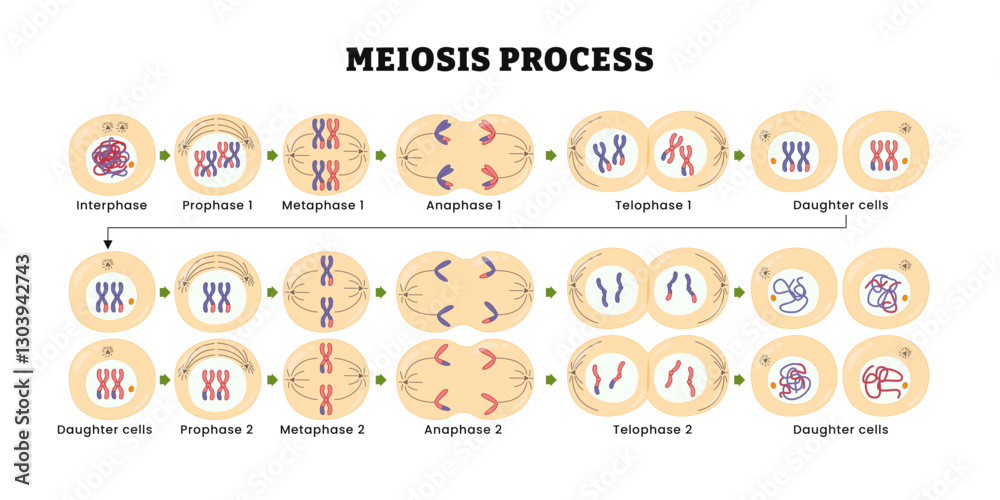
Meiosis I
Interphase: DNA replication → double-stranded chromosomes.
Prophase I: Nuclear membrane disappears, crossing over occurs (exchange of genetic material).
Metaphase I: Homologous pairs align at equator.
Anaphase I: Whole chromosomes pulled to opposite poles.
Telophase I: Two haploid cells form.
Meiosis II
Similar to mitosis, but no interphase.
Prophase II: Chromosomes visible, nuclear membrane disappears.
Metaphase II: Single chromosomes align at equator.
Anaphase II: Chromatids separate.
Telophase II: Four haploid cells form, all genetically different.
🌍 Importance of Meiosis
Maintains chromosome number (halving and doubling effect).
Produces variation through:
Crossing over (Prophase I).
Random arrangement of chromosomes (Metaphase I & II).
Random fertilisation.
📊 Differences Between Meiosis I & II
Crossing over occurs only in Meiosis I.
Meiosis I halves chromosome number; Meiosis II keeps it constant.
Meiosis I separates homologous chromosomes; Meiosis II separates chromatids.
🔄 Meiosis vs Mitosis
Meiosis: 2 divisions, 4 haploid gametes, genetic variation.
Mitosis: 1 division, 2 diploid somatic cells, genetically identical.
⚠ Abnormal Meiosis
Non-disjunction → chromosomes fail to separate.
Aneuploidy: extra/missing chromosomes (e.g., Down Syndrome – Trisomy 21).
Polyploidy: extra sets of chromosomes (common in plants, rare in animals).
🌾 Advantages of Polyploidy in Agriculture
Produces seedless fruits (bananas, watermelons).
Larger flowers, fruits, and storage organs.
Infertile plants become fertile (e.g., wheat).
Greater disease resistance.