Pancreas
Identify the physiology of the exocrine pancreas.
Describe the pathophysiology including the clinical presentation, epidemiology and risk factors, pathogenesis, pathology and clinical manifestations of the following disorders of the exocrine pancreas:
Acute pancreatitis
Chronic pancreatitis
Pancreatic insufficiency
Carcinoma of the pancreas
Objective 1: Identify the physiology of the exocrine pancreas.
Secretory Functions and Ductal System:
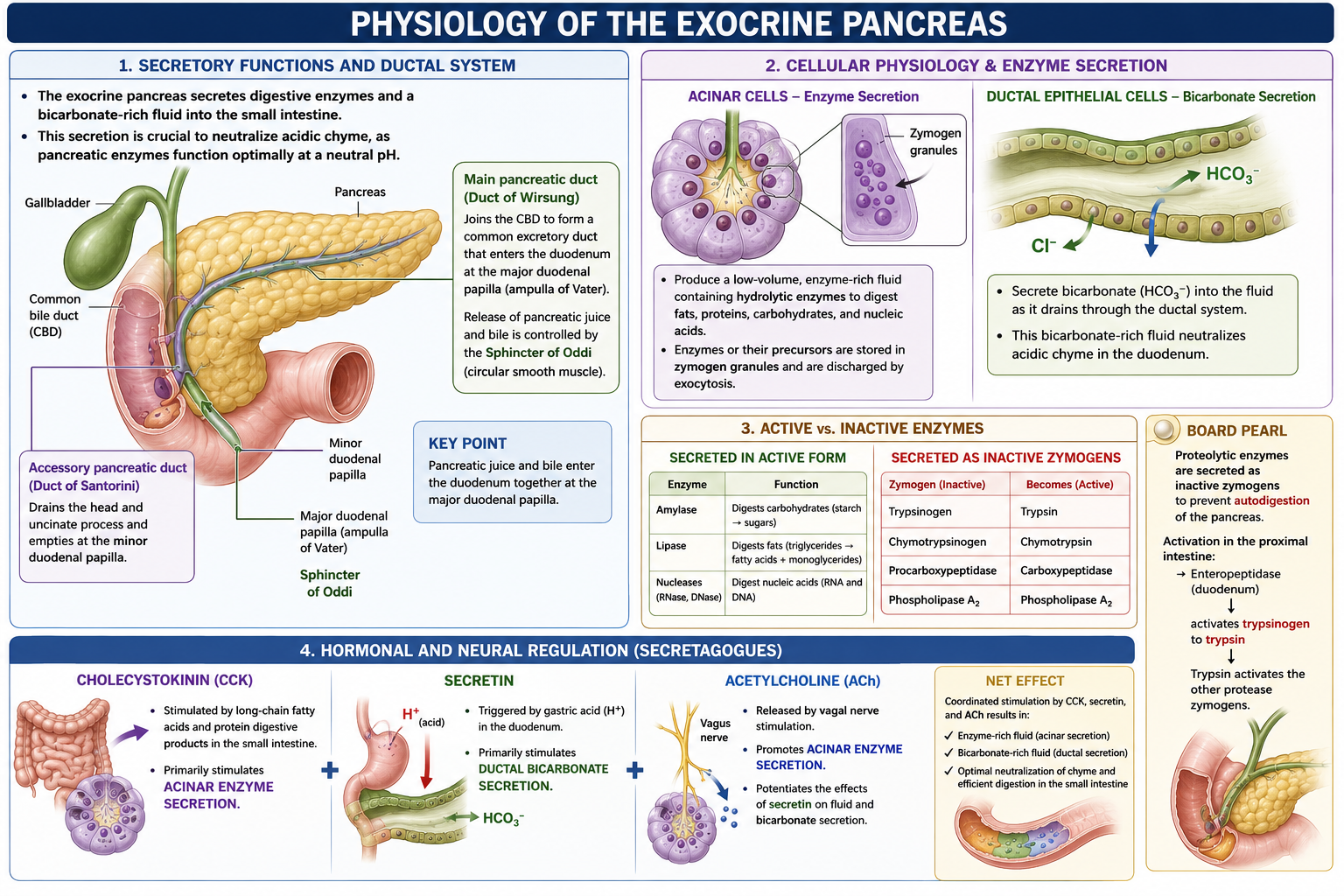
The exocrine pancreas secretes digestive enzymes and a bicarbonate-rich fluid into the small intestine.
This secretion is crucial to neutralize acidic chyme, as pancreatic enzymes function optimally at a neutral pH.
The main pancreatic duct (Duct of Wirsung) joins the common bile duct (CBD) to form a common excretory duct that enters the duodenum at the major duodenal papilla (ampulla of Vater). The release of pancreatic juice and bile is controlled by the Sphincter of Oddi, a circular smooth muscle.
An accessory pancreatic duct (Duct of Santorini) drains the head and uncinate process and empties at the minor duodenal papilla.
Cellular Physiology & Enzyme Secretion:
Acinar cells: Produce a low-volume, enzyme-rich fluid containing hydrolytic enzymes designed to digest fats, proteins, carbohydrates, and nucleic acids. These enzymes or their precursors are stored in zymogen granules within the acinar cells and are discharged by exocytosis.
Ductal epithelial cells: Secrete bicarbonate (HCO₃⁻) into the fluid as it drains through the ductal system.
Active vs. Inactive Enzymes:
Secreted in active form: Amylase (digests carbohydrates), Lipase (digests fat), and Nucleases (ribonuclease and deoxyribonuclease for nucleic acids).
Secreted as inactive Zymogens: Proteases (protein-digesting enzymes) like Trypsinogen, Chymotrypsinogen, and Procarboxypeptidase, as well as Phospholipase A2.
Board Pearl: Proteolytic enzymes are secreted as inactive zymogens to prevent autodigestion of the pancreas. They are activated only once they reach the lumen of the proximal intestine, where enteropeptidase activates trypsinogen into trypsin, and trypsin subsequently activates the other protease zymogens.
Hormonal and Neural Regulation (Secretagogues):
Cholecystokinin (CCK): A hormone stimulated by long-chain fatty acids and protein digestive products in the small intestine, which primarily stimulates acinar enzyme secretion.
Secretin: A hormone triggered by gastric acid in the duodenum that primarily stimulates ductal bicarbonate secretion.
Acetylcholine (ACh): A neurotransmitter from vagal nerve stimulation that promotes enzyme secretion; along with CCK, it also potentiates the effects of secretin on fluid and bicarbonate secretion.

Objective 2: Pathophysiology and clinical manifestations of exocrine pancreas disorders
a. Acute Pancreatitis
Pathology/Pathogenesis: It is an acute inflammatory process characterized by the uncontrolled, premature activation of pancreatic enzymes (specifically trypsinogen) within the pancreatic acini. Once trypsin is prematurely activated, it activates other proenzymes (like elastase, phospholipase A2, and kallikrein-kinin), leading to a cascade of edema, inflammation, vascular damage, hemorrhage, coagulation necrosis, and fat necrosis. It can manifest morphologically as interstitial edematous pancreatitis or necrotizing pancreatitis.
Epidemiology & Risk Factors: The main causes are biliary tract disease (specifically gallstones) that obstruct the CBD and pancreatic duct, and alcohol (binge or heavy drinking) which causes direct toxic effects on acinar cells and intracellular trypsin activation.
Clinical Manifestations: Patients present with acute epigastric abdominal pain that radiates to the back, anorexia, nausea, and vomiting. They may also have dyspnea due to diaphragmatic inflammation, and labs will show an elevation of amylase and lipase. Complications can include pulmonary issues and pancreatic abscesses.
b. Chronic Pancreatitis
Pathophysiology & Pathology: Chronic inflammation resulting from recurrent attacks of acute pancreatitis, chronic alcohol abuse, or long-term obstruction of the pancreatic duct. This long-standing inflammation causes irreversible scarring, shrinkage of the pancreas, acinus fibrosis and atrophy, and ductal stenosis/dilation. The destruction of exocrine tissue leads to an inadequate delivery of digestive enzymes to the duodenum.
Clinical Manifestations: Can be asymptomatic, but often presents with epigastric abdominal pain with radiation to the back that worsens with recumbency or after eating (postprandial). Other signs include nausea, vomiting, anorexia, elevated amylase, and profound steatorrhea due to pancreatic insufficiency. It may also progress to diabetes.
c. Pancreatic Insufficiency
Pathophysiology & Epidemiology: A complication of pancreatic disease leading to maldigestion secondary to ineffective pancreatic enzyme activity. The most common cause is chronic pancreatitis, but it can also be caused by cystic fibrosis, pancreatic resection, Shwachman-Diamond syndrome, and Gastrinoma.
Clinical Manifestations:
Mild/Asymptomatic: Mild abdominal discomfort, bloating, but normal bowel movements.
Moderate/Severe: Leads to severe maldigestion of fat and protein, causing weight loss, steatorrhea, and deficiencies in fat-soluble vitamins (A, D, E, K) as well as vitamin B12.
d. Carcinoma of the pancreas (Pancreatic Adenocarcinoma)
Pathology: The majority (70%) of these carcinomas develop in the head of the pancreas. Tumors in the head are often small at presentation but rapidly cause obstruction of the common bile duct. Conversely, tumors in the body (20%) or tail (10%) typically present late and are large at presentation. The cancer can spread via direct invasion to adjacent organs and vessels (like the portal vein), or metastasize via lymph nodes or hematogenous spread to the liver and lungs.
Epidemiology & Risk Factors: There is a strong etiology associated with cigarette smoking and a high dietary saturated fat intake.
Clinical Manifestations: A hallmark presentation for tumors in the head of the pancreas is painless, progressive jaundice along with a palpable gallbladder (Courvoisier sign) caused by distal obstruction. Other symptoms include abdominal pain, vomiting, anorexia, weight loss, and impaired glucose tolerance
