T2W3 - L3 - Language Development
Slide 2
Learning Objectives
By the end of this week’s lectures and reading, you should be able to understand and describe:
• What does language acquisition involve – what are the features of language development?
• What challenges and problems are involved in acquiring language?
• The main stages of language development – what does the child acquire, when, and how?
• The main theories for language development – how well do they explain development?
Something to think about:
What is the role of nature and nurture in language development?
Slide 3
Structure of the lecture
Part 1: What does language acquisition involve?
Symbolisms: conventional vs arbitrary
Rules vs creativity
Comprehension vs production
Components of language
Part 2: Theories of language development
Nature vs nurture
Chomsky and the LAD
Experience-based language development
Part 3: Sounds
Speech perception: How do children break into the speech stream?
Identifying sounds
Speech production
Slide 4
Structure: part 1
What does language acquisition involve?
Symbolisms: conventional vs arbitrary
Rules vs creativity
Comprehension vs production
Components of language
Take-away:
Language acquisition is the process by which children acquire the capacity to comprehend and produce language (in other words, gain the ability to understand and use language), as well as to produce and use words and sentences to communicate successfully.
Languages are symbolic systems
Sounds/word-forms are symbolic – they represent meaning
Slide 6
Symbolism: conventional and arbitrary
Languages are symbolic systems
Sounds/word-forms are symbolic – they represent meaning
Language boils down to a system of codes that represent a meaning
Banana
Bananas
Symbols are conventional – they are used by all speakers of the same language in the same way.
When we communicate using language, it has to be understood by all. We trust that the listener understands the codes within the language; if not it will be meaningless.
Symbols are arbitrary – there is no inherent relation between the word form and its meaning
For example, the word ‘banana’ does not have any inherent relation to the object.
Different languages use different word forms:
‘book’, ‘livre’, ‘buch’, ‘Bestil’, ‘kirja’, ‘kitab’, ‘boek’, ‘ksiażka’, ‘llyfr’, ‘knjigo’, ‘libër’, ‘pustaka’, ‘bok’, ‘leabhar’
Slide 7
Symbolism: An exception to the general rule
Not all symbols are conventional
Sound symbolism – a non-arbitrary link between the sound and meaning of a word
These are words where there is an object that has a non-arbitrary relation to the word assigned to it.
Different languages use similar word forms (these words are usually based on onomatopoeia, where the word IS the sound used to represent the meaning):
In English, a cat makes a meow noise,
in German, it is miau,
in French miaou,
in Dutch miauw,
in Spanish miau,
in Chinese miāo.
Examples of such words help children to understand that the words are related to a specific meaning/entity
Slide 9
Rules vs Creativity
Children have to learn the rules of their language to communicate successfully.
Tom chased Jerry. It is not “Jerry chased Tom”, or “chased Jerry Tom”.
To express new ideas, children must learn how to combine sounds, words and phrases in new ways:
Tom chased Perry
Tom was kicked by Jerry
Slide 10
Comprehension vs production
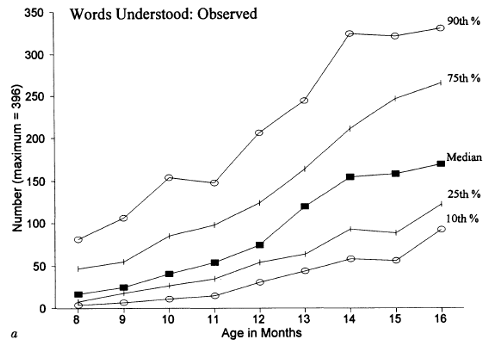
Children tend to understand more than they can say themselves
Production tends to lag behind comprehension
Possibly because of the difficulty of articulation
A lot of control of the musculature of the face and mouth needs to be coordinated to produce long speech, which children do not yet have much control over.
Possibly because of memory difficulties
Why is this important?
Links to competence vs performance
Slide 11
Components of language
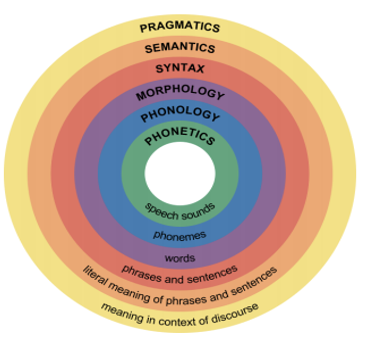
Sounds – phonology
This refers to very young children babbling and producing general sounds, not limited to just words
Vocabulary – lexicon
This refers to the number of words that children know/understand the correct meaning of.
Word meanings – semantics
Word transformations – morphology
Sentences – syntax
This refers to understanding the rules of the language and what is accepted as proper grammar and what isn’t.
Communicative acts – pragmatics
This refers to how communication actually takes place. How the words are used, and what for. Studying how children go about learning, understanding, and then using this themselves.
Slide 12
Structure: part 2
Theories of language development
Nature vs nurture
Chomsky and the LAD
Experience-based language development
Slide 15
How do we learn language?
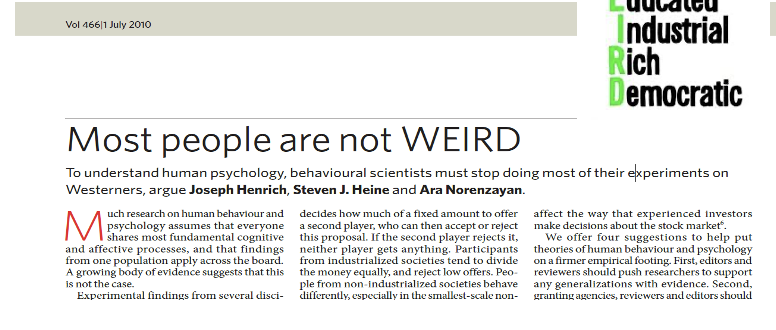
“Consideration of more diverse human populations is necessary to build generalizable theories of language acquisition”
Cristia, Dupoux, Gurven & Stieglitz (2019)
Classical debate: Nature vs nurture
How much language ability are we born with, and how much is learned during the early stages of development
Nativist theories of language development
Linguistic knowledge is innate (encoded in the genome)
Experience-based theories of language development
Innate ability to learn, but linguistic knowledge is acquired
Input has a role in both theoretical approaches
Slide 18
Nativist Theories of Language Acquisition
Chomsky’s Language Acquisition Device (LAD) – a specialised mechanism
Chomsky claimed that the experience that children are exposed to and the stimuli that are input into children are not enough for children to fully develop language as we know it. This means there could be a mechanism within the child that provides additional support for language development.
Learning/experience cannot account for all aspects of language acquisition
Children must have innate knowledge of language: AKA Universal Grammar
Slide 19
Language Acquisition Device
Argument 1: Poverty of the stimulus
Input language is not always grammatical
Parents do not correct errors or explain language
Argument 2: Speed and uniformity of development
Input differs between individuals, but:
Children acquire language quickly, especially considering the immense complexity of language
Early comprehension – suggests early, innate knowledge
Children’s early language follows rules
Universal stages of development
Slide 20
Experience-based theories of Language Acquisition
Language is a behaviour learned from the environment
Input from social interactions
Tracking the nature of the input, finding patterns in the language
No innate knowledge
Constructivist / Emergentist / Socio-Pragmatic / Usage-Based accounts
Something to think about: Could language rules be learnt through interaction alone?
Slide 22
Child-directed speech (CDS)
Also known as ‘motherese’ or ‘parentese’
Phonology: Exaggerated intonation; lengthened vowels, slower production
Syntax: Shorter, simpler utterances
Vocabulary: Here and now topics, abbreviations and diminutives
Facilitates language learning
May be universal (although magnitude differs)
However, American CDS is much more extreme compared to British CDS when measuring things such as speech
There is also research that a version of CDS may be used on pets, PDS.
Slide 23
Contemporary views on Nature/Nurture
Chomsky reframed language acquisition as a cognitive problem
Influential: Sets the reference point for most acquisition theories
Less dominant today: Strong Universal Grammar is widely questioned
More recent emphasis on: Rich input, Statistical learning, Social interaction, Development
Growing consideration of overheard speech (Sperry et al., 2018; Dailey & Bergelson, 2022)
Language emerges from dynamic interaction between biology, cognition, and environment (e.g., Samuelson, 2006)
Slide 24
Bronfenbrenner’s (1979) Bioecological model
Language develops through interaction between biology and the environment over time
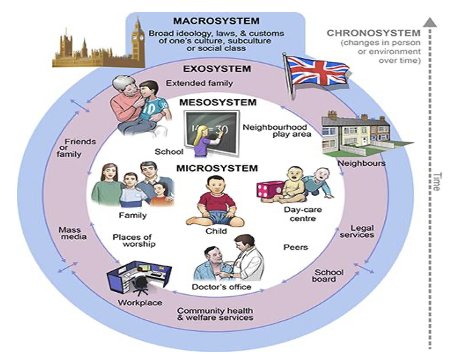
The child is at the centre of nested influences.
The child will experience layers of input that are proximal to the child, which act as input in how the child develops language.
Each layer of input affects the child, and they all interact with each other.
Theoretically flows, but this is hard to apply.
Nature (Child): Biological capacity for language, Individual differences
Microsystem: e.g., home & school
Proximal processes: Language input through regular interaction (e.g., turn-taking, talking, reading)
Broader systems: e.g., family–school links, parental work, cultural exposure
Time (chronosystem): Early brain development makes early input critical
Slide 26
Structure: part 3
Sounds
Speech Perception:
How do children break into the speech stream?
Identifying sounds
Speech production
Take-away:
Infants must learn to segment and categorise the individual sounds and words in the continuous stream of speech. Once they master this skill, they will start to comprehend and produce language themselves.
Slide 28
How do children break into the speech stream?
Slide 29
Segmenting speech
Infants make use of many cues to find words:
Word stress
Isolated words - it is possible that children are hearing isolated words, and then apply the context in which they are used to understand what they mean. E.g., hello, thank you.
A lot of the words that children first learn are ‘labelling words’. E.g., ball, key, cup.
Native language sound patterns
str- vs sdr- her / straw vs his / drink
Transitional probabilities – statistical learning
Slide 30
Identifying sounds – categorisation
Compare these words:
bat, cat, fat, hat, mat, (g)nat, pat, rat, sat, vat
‘bat’ and ‘pat’ are the most similar words phonetically – they only differ in voicing of the first sound /b/ vs /p/.
N.b.: Phonemes – sounds which are meaningfully distinct
The sounds ‘p’ and ‘b’ are categorised by their voicing feature
Voicing – the time between the release of a consonant and the onset of the sound it makes.
‘p’ is unvoiced and ‘b’ is voiced
Slide 32
Part 3: Sounds
Identifying sounds – categorisation
Bot
Spot
Pot
The ‘p’ in spot doesn’t sound the same as ‘p’ in pot but sounds a bit like the ‘b’ in bot.
Slide 33
Identifying sounds – categorisation
In reality, production is messy, and there is a continuum of possible sounds between /p/ and /b/ depending on voice onset time (VOT).
But we hear sounds categorically as either /p/ or /b/.
What do children do?
Eimas et al. (1971) tested categorical perception at 1- and 4-months old
Habituation paradigm
Infants habituated to ‘ba’ (VOT = 20) or ‘pa’ (VOT = 60)
Tested discrimination of sounds with different VOTs
Across or within a phoneme boundary
Results:
Sucking rates increased when sounds crossed the phoneme boundary (a→b)
(dishabituation)
Sucking rates did not increase when sounds were within the phoneme boundary (c→d)
This has been interpreted as evidence of young infants perceiving sounds categorically
Infants perceive native and non-native sounds categorically at 1–4 months old
Is categorical perception of speech an innate mechanism?
Occurs very early, before extensive exposure
Infants categorise sounds from other languages
But…
Humans also perceive musical tones categorically
Non-humans perceive sounds categorically (with training)
This may therefore mean that categorical sound perception may be innate
Slide 38
Identifying sounds – tuning in
Cross-language speech perception in infants (Werker & Tees, 1984)
Tested 6–8, 8–10, and 10–12-month-old infants’ discrimination of native (English) and non-native sounds (Hindi and Salish)
Conditioned head-turn procedure (habituation and discrimination)
Video of the procedure:
Slide 39
Identifying sounds – tuning in
Cross-language speech perception in infants (Werker & Tees, 1984)
Results:
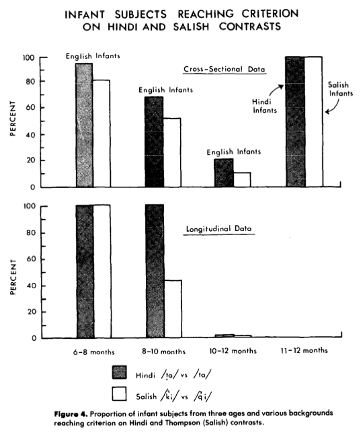
Sensitivity to non-native sounds declines with age, already in the first year of life
Older infants have ‘tuned in’ to the sounds of their own language system
So, Language experience focuses the ability to distinguish native sounds while losing sensitivity to non-native sounds
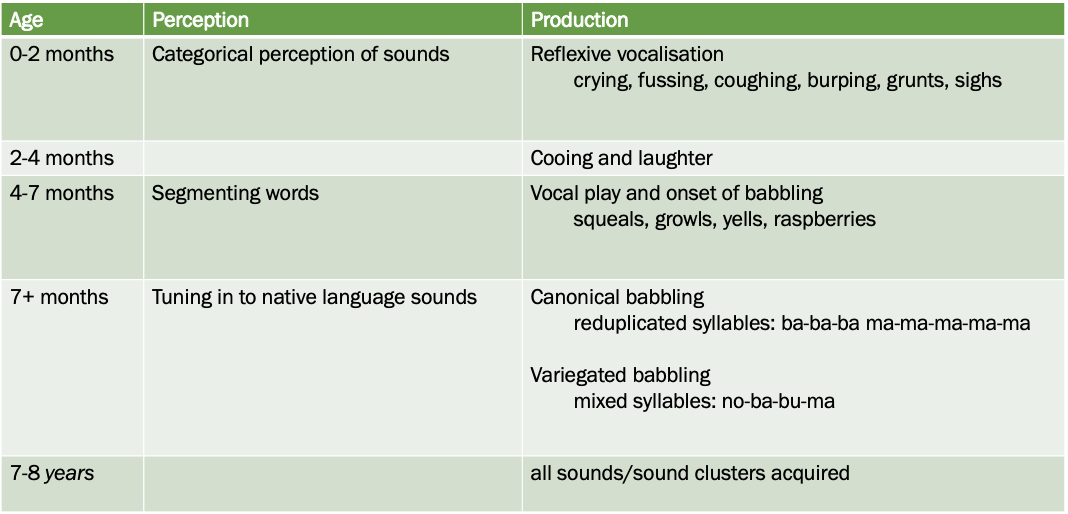
Sound perception vs Production:
Slide 40
Developing speech production
Errors in production of target word form common for many years
e.g., ‘giger’, ‘wabit’, ‘efelant’, ‘hiccupotamus’
Slide 41
Structure of the lecture
Part 4: Words, vocabulary, and later language
How do children discover words?
Acquiring words
Early language and later language
Part 5: Sentences, syntax, and morphology
How do children learn to combine words in sentences?
Combining words in comprehension
Combining words in production
Part 6: Communicating and pragmatics
How do children learn to use language
Developing pragmatics
Taking perspectives
Slide 42
How do children discover words?
“Gavagai!”
Slide 43
Acquiring words
Reference problem: words refer to things, have meaning
Children start solving this very early: 6–9-month-olds recognise familiar words
Typically solved before the second birthday – children experience the naming insight
Slide 44
Producing First Words
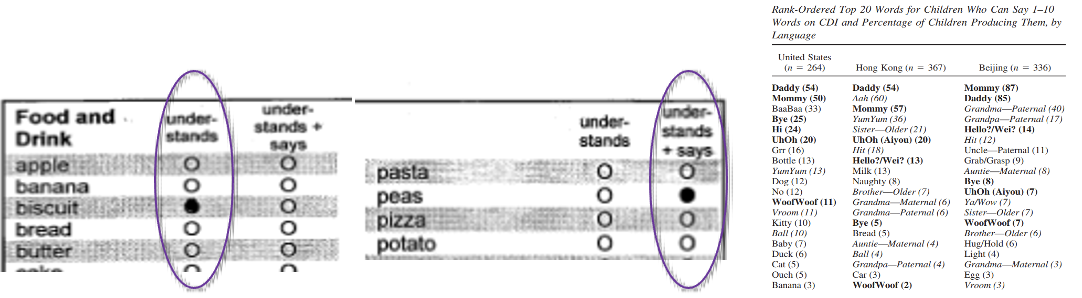
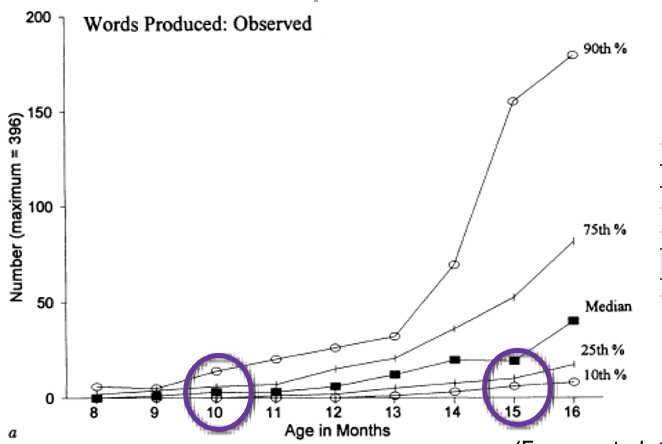
Most children start producing their first words within a few months of their first birthday
Measured by parental reports with the MacArthur-Bates Communicative Development Inventory (CDI)
Slide 45
Individual differences in Word learning
Slide 46
The Vocabulary Spurt?
Reference problem: words refer to things, have meaning
Once children solve this problem, vocabulary rapidly grows
Argued to occur around 18 months
BUT based largely on smaller sample observational data show
Larger scale data analysed statistically tells a different story only ~14% show a clear spurt
Slide 47
Beyond First Words
By age 6: ~10–14,000 words
Learning accelerates until 8–10 years (~12 new words/day)
20,000–40,000 in adulthood
Large individual differences
Slide 48
Early language → Later language
Early individual differences predict:
• Later vocabulary
• Grammar
• Narrative development
Which predict academic success, employment opportunities, and social wellbeing
Slide 49
Structure: part 5
Sentences, syntax, and morphology
Slide 50
Take-away
Children must learn grammar (word order, syntax, morphology) and thematic role rules to comprehend and produce sentences
Slide 51
Combining words in production
12–24 months: One-word stage (holophrases)
24 months+: Two-word stage (telegraphic speech)
30 months+: Three–four word stage
3–4 years+: Increasingly complex sentences
Slide 52
The wug test (Berko, 1958)
Slide 53
Overgeneralisation errors
foots, mans, mouses
goed, drinked, swimmed
Slide 54
Structure: part 6
Communicating: pragmatics
Slide 55
Pragmatics
How context influences meaning
Understanding non-literal language:
• Irony
• Sarcasm
• Metaphor
• Jokes
• Idioms
Slide 56
Pragmatics in Language Development
Gestures, eye contact, joint attention
Theory of mind linked to pragmatics
Advanced pragmatics develop into late childhood
Slide 57
Language Development Summary
Language is symbolic
Comprehension precedes production
Nature and nurture interact
Children acquire phonology, semantics, syntax, morphology, pragmatics
Simpler explanation of the lecture:
Here's the full lecture broken down and explained in a way that's much easier to follow:
So this lecture is all about language development — specifically how children go from making random noises as babies to being able to hold full conversations. It's a fascinating topic because when you really think about it, language is incredibly complex, and yet most children pick it up seemingly without much effort at all. The big question running through the whole lecture is how much of this ability we're born with, and how much we learn from the world around us — the classic nature vs nurture debate.
To start, let's think about what language actually is and what acquiring it involves. At its most basic level, language is a symbolic system. Words and sounds are symbols — they represent meaning. The word "banana" doesn't look like a banana, it doesn't sound like a banana, and there's no logical reason it had to be called that — it just is, because everyone who speaks English agreed on it. That's what it means when we say symbols are "conventional" — they work because the whole community of speakers uses them in the same way, and everyone trusts that everyone else understands them. And they're also "arbitrary," meaning there's no natural or obvious connection between the word and the thing it refers to. You can see this clearly when you look across languages — the word for "book" in French is "livre," in German it's "buch," in Welsh "llyfr," and so on. All completely different, but all pointing to the same thing. Now, there is one interesting exception to this: sound symbolism, or onomatopoeia. These are words where the sound of the word actually mimics what it refers to — like the word "meow" for the sound a cat makes. Across different languages, these kinds of words tend to be pretty similar (French "miaou," German "miau," Chinese "miāo"), which makes sense because they're based on real sounds in the world. These words are actually really useful for young children because they have an obvious, non-arbitrary connection to their meaning.
Another key part of language is the balance between rules and creativity. Children have to learn that language has a structure — "Tom chased Jerry" means something completely different from "Jerry chased Tom," even though it uses the same words. Word order matters. But at the same time, children have to learn to be creative within those rules — combining words in new ways to express new ideas. It's not just about memorising fixed phrases; it's about understanding the underlying grammar well enough to construct sentences you've never heard before.
There's also an important distinction between comprehension (understanding language) and production (actually speaking it). Children almost always understand more than they can say. A toddler might understand "go and get your shoes" perfectly well but not yet be able to say much themselves. This lag between understanding and speaking is thought to be partly because speaking requires incredible muscular coordination — your lips, tongue, teeth, and breath all have to work together in precise ways — and partly because of memory demands. This is actually really relevant to something mentioned in the previous lecture: the difference between what a child knows (competence) and what they can demonstrate (performance).
Language itself can be broken down into several components. Phonology refers to sounds — the babbling and sound-making that young children do before they're using real words. Lexicon is vocabulary — the bank of words a child knows. Semantics is about word meanings — not just knowing the word, but knowing what it means. Morphology is about word transformations — for instance, knowing that you add "-s" to make something plural or "-ed" to make it past tense. Syntax is grammar — understanding the rules of how sentences are put together. And finally, pragmatics is about how language is actually used in context — things like knowing when to take turns, how to be polite, how to understand humour or sarcasm. All of these components have to come together for a child to be a fully competent language user.
Now onto the big theoretical debate: how do children actually learn language? On one side, you've got nativist theories, which argue that we're born with some kind of built-in language machinery. The most famous version of this is Noam Chomsky's Language Acquisition Device (LAD). Chomsky argued that the language children hear around them — the "input" — is simply not enough to explain how well and how quickly they learn. Parents don't give grammar lessons, they don't correct every mistake, and the speech children hear isn't even always grammatically perfect. And yet children all over the world, regardless of how much or how little their parents talk to them, tend to hit the same milestones at roughly the same ages. This "poverty of the stimulus" argument — that the input isn't rich enough to explain the output — led Chomsky to propose that children must be born with some innate knowledge of language, which he called Universal Grammar. The speed and consistency of language development across cultures and children is a compelling point — it does suggest something internal is doing a lot of the heavy lifting.
On the other side, you've got experience-based theories, which argue that language is learned from the environment through interaction and exposure. There's no need to assume any special built-in grammar knowledge — just a general ability to learn, combined with the right kind of input. These approaches include things like constructivist, emergentist, and usage-based accounts, and they emphasise that children learn by tracking patterns in the language around them. One important concept here is child-directed speech, also called "motherese" or "parentese" — this is the way adults naturally adjust how they speak when talking to young children. They slow down, use a higher pitch, exaggerate their intonation, use shorter and simpler sentences, and stick to topics in the here and now. This kind of simplified, engaging speech is thought to help children tune into language more easily, and it appears to be fairly universal across cultures, though the degree to which it's exaggerated varies — American parents, for example, tend to use it more extremely than British ones. Interestingly, research has also noted that people use a similar kind of speech with pets.
The current thinking in the field is that neither extreme — pure nature or pure nurture — is quite right on its own. Chomsky's work was hugely influential in getting people to think about language as a cognitive problem worth studying seriously, but the idea of a rigid Universal Grammar has become less dominant over time. More recent work emphasises things like statistical learning (children are remarkably good at picking up on patterns and probabilities in language), social interaction, and the importance of rich, varied input. There's also growing interest in "overheard speech" — language that children hear around them even when it's not directed at them — as a significant source of input. A useful framework here is Bronfenbrenner's bioecological model, which pictures the child at the centre of a series of nested layers of influence — their immediate home environment, their school, broader cultural and social contexts — all of which interact with each other and with the child's own biological capacities over time. Crucially, it highlights that early brain development makes the quality of early input especially important, because there are sensitive periods in development where certain kinds of learning happen more easily.
Moving on to sounds — how do babies actually start to make sense of the stream of speech they hear? When you think about it, speech doesn't come in neatly packaged words with gaps between them. It flows continuously. So one of the first challenges for infants is figuring out where one word ends and another begins. Babies use several clever strategies for this. They pick up on word stress patterns (English words typically have a stressed first syllable, for instance). They notice isolated words — words they hear clearly on their own, like "hello" or "thank you," and can then recognise them when they pop up in longer speech. A lot of early words are also labelling words — simple nouns like "ball," "cup," or "key" — which probably helps children make the connection between words and the things they refer to. Children also pick up on the patterns of their native language — which combinations of sounds are allowed and which aren't — and they use statistical learning, essentially tracking how often sounds appear together, to figure out where word boundaries are likely to be.
One of the most fascinating aspects of sound development is categorical perception — the fact that we hear sounds in categories, not as a continuous spectrum. Take the sounds "p" and "b." In reality, the difference between them is a matter of tiny timing — specifically, the time between releasing the consonant and when your voice starts (called voice onset time, or VOT). But we don't hear them as being on a sliding scale; we hear them as distinctly either "p" or "b." Eimas et al. (1971) tested whether very young infants — as young as one month old — perceive sounds this way too, using a habituation paradigm where babies were given a dummy to suck and changes in sucking rate indicated when they noticed a difference in sounds. The results showed that even 1 to 4-month-old babies distinguished between sounds that crossed a phoneme boundary (like going from "ba" to "pa") but didn't react to sounds that were different within the same category. This is remarkable because these babies had barely had any exposure to language yet. Interestingly though, categorical perception isn't unique to humans — it's also found in other species with some training, and humans perceive musical tones categorically too. So it may be a general feature of how the brain processes sound, not something unique to language.
What does change with experience is which sounds you're sensitive to. Werker and Tees (1984) tested babies at different ages on their ability to distinguish sounds from other languages — specifically English-speaking babies being tested on sounds from Hindi and a Canadian Indigenous language called Salish. At 6 to 8 months, babies could discriminate sounds from all three languages equally well. But by 10 to 12 months, their sensitivity to the non-native sounds had dropped significantly. Basically, babies start life as "universal language learners," capable of detecting sound distinctions from any language, and then gradually tune in specifically to the sounds of the language they're growing up with. It's a kind of perceptual narrowing — you get better at the sounds you need, at the cost of sounds you don't. This is a great example of how biology and environment work together: the brain is wired to tune into language, but which language it tunes into depends entirely on what the child hears.
On the production side — actually making sounds and words — development takes quite a bit longer. Children often mispronounce words for several years, producing things like "giger" for "tiger," "wabit" for "rabbit," "efelant" for "elephant," or "hiccupotamus" for "hippopotamus." It's charming, but it also shows that even when children know a word and understand it, producing it accurately takes a lot more time and physical coordination to develop.
So when do children actually start using words? Most children start producing their first words around or just after their first birthday. Vocabulary grows fairly slowly at first, and there's long been an idea that sometime around 18 months children experience a "vocabulary spurt" — a sudden burst where new words start being learned at a much faster rate, often linked to what's called the "naming insight" (the moment children really click that everything has a name). However, larger-scale data suggests this spurt is actually only clearly visible in about 14% of children — for most, vocabulary growth is more gradual. By age 6, most children have around 10,000 to 14,000 words, and vocabulary continues to grow rapidly until around ages 8 to 10, at a rate of roughly 12 new words a day. Adults typically have between 20,000 and 40,000 words. There are large individual differences in vocabulary size, and importantly, early differences in vocabulary tend to predict later differences not just in language, but in grammar development, storytelling ability, academic achievement, employment, and social wellbeing. So the foundations built in those early years genuinely matter.
Once children have a few words, they start putting them together. From around 12 to 24 months, children use single words (called holophrases) to communicate whole ideas — "milk" might mean "I want milk" or "I've spilled the milk" depending on context. From around 24 months, they start producing two-word combinations ("more juice," "daddy go"), and from 30 months onwards, sentences get progressively longer and more complex. A famous study called the Wug test (Berko, 1958) demonstrated beautifully that children aren't just memorising words — they're picking up grammatical rules. Children were shown a made-up creature called a "wug" and told "there are two of them" — and they correctly said "wugs," applying the plural rule to a word they'd never heard before. This shows genuine understanding of morphological rules. However, children at this stage also make "overgeneralisation errors" — applying rules too broadly in cases where the language actually has an irregular form. So you get things like "foots" instead of "feet," "mouses" instead of "mice," "goed" instead of "went," "swimmed" instead of "swam." Interestingly, this kind of error actually shows progress — it means the child has learned the rule and is applying it consistently, even if they don't yet know the exceptions.
The final piece of the puzzle is pragmatics — understanding how language actually works in social situations. This includes things like taking turns in conversation, making eye contact, using gestures, understanding that what someone says isn't always what they literally mean (irony, sarcasm, metaphor, idioms, jokes), and adjusting your language to suit your audience. Pragmatics is closely tied to theory of mind — the ability to understand that other people have different knowledge, beliefs, and perspectives from your own. Advanced pragmatic skills, like understanding sarcasm or complex idioms, continue developing well into late childhood. Gestures and joint attention (where two people focus on the same thing together) are some of the earliest building blocks of pragmatic communication, emerging before proper language even begins.
To pull it all together — language is a symbolic, rule-governed system that children acquire remarkably early and remarkably consistently. Comprehension always comes before production, and children understand far more than they can say. Whether language ability is primarily innate or primarily learned is still debated, but the current consensus is that both matter — biology gives children a powerful capacity for learning language, and the environment shapes exactly which language they learn and how well they learn it. Children have to master sounds (phonology), words (semantics and lexicon), grammar (syntax and morphology), and social use of language (pragmatics), and doing all of this takes years of active engagement with the language around them.