Chromatographic Separations of Proteins
Introduction to Chromatographic Separations
Conceptual Overview: Modern protein separation methods rely heavily on chromatography. This technique involves dissolving a mixture of substances in a liquid or gaseous fluid, known as the mobile phase, and percolating it through a column consisting of a porous solid matrix, known as the stationary phase.
Separation Mechanism: The physicochemical properties of individual substances in the mixture determine their specific interactions with the matrix. Different retarding forces cause the substances to migrate at different rates, resulting in the separation of the mixture into distinct bands of pure substances.
Classification Criteria:
Phase State: Chromatography is classified according to the state of the mobile and stationary phases. Techniques discussed here are primarily solid-liquid chromatography.
Dominant Interaction: Further classification is based on the nature of the dominant interaction between the substances (solutes) and the stationary phase (e.g., charge, size, or binding specificity).
General Methodology and Column Chromatography
Process Flow:
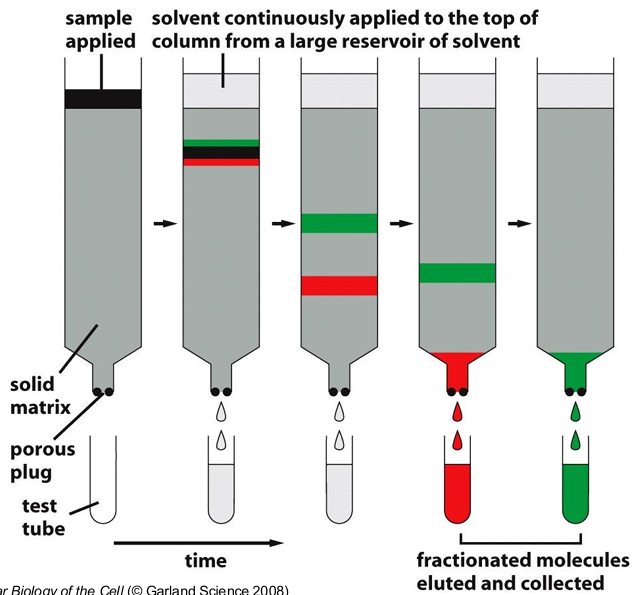
A sample mixture is applied to the top of a column containing a solid matrix. from a large reservoir of solvent
Solvent (the mobile phase) is continuously applied from a large reservoir.
As the solvent flows through the porous plug, molecules are fractionated based on their interactions with the matrix.
Molecules are eluted and collected sequentially in test tubes via a fraction collector.
Laboratory Setup: Modern protein purification setups often utilize specialized fridges to maintain protein stability. These setups include columns and automated fraction collectors for precision.
Classification of Protein Purification Procedures
Proteins are separated based on five primary characteristic properties:
Solubility:
Procedure: Salting in.
Procedure: Salting out.
Ionic Charge:
Procedure: Ion exchange chromatography.
Procedure: Electrophoresis.
Procedure: Isoelectric focusing.
Polarity:
Procedure: Adsorption chromatography.
Procedure: Paper chromatography.
Procedure: Reverse-phase chromatography.
Procedure: Hydrophobic interaction chromatography (HIC).
Molecular Size:
Procedure: Dialysis and ultrafiltration.
Procedure: Gel electrophoresis.
Procedure: Gel filtration chromatography.
Procedure: Ultracentrifugation.
Binding Specificity:
Procedure: Affinity chromatography.
Ion Exchange Chromatography (IEX)
Fundamental Principle: Ions that are electrostatically bound to an insoluble, chemically inert matrix are reversibly replaced by ions in the solution.
Types of Exchangers:
Anion Exchanger: Represented as , where is the bound ion (annion exchanger) and is the ion in solution. The reaction is: .
Cation Exchanger: Represented as , where is the bound ion (cation exchanger) and is the ion in solution. The reaction is: .
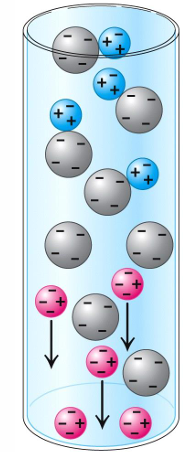
Retention Example: In a cation exchange setup, a positively charged protein binds to a negatively charged bead, while negatively charged proteins flow through the column.
Factors Influencing Affinity:
different proteins have different affinity for the ion exchanger, depending on their net changes, this will be exploited for chromatographic separation
Ion Concentration: identity and concentrations of other ions in solution because of the competitions amongst various ions
pH Level: the net charges of acid-base groups vary with pH.
Isoelectric Point (pI):
At a pH below the pI, a protein carries a net positive charge.
At a pH above the pI, a protein carries a net negative charge.
Reference Data: Isoelectric Points (pI) of Common Proteins
Protein | Isoelectric pH (pI) |
|---|---|
Pepsin | <1.0 |
Ovalbumin (hen) | |
Serum albumin (human) | |
Tropomyosin | |
Insulin (bovine) | |
Fibrinogen (human) | |
-Globulin (human) | |
Collagen | |
Myoglobin (horse) | |
Hemoglobin (human) | |
Ribonuclease A (bovine) | |
Cytochrome c (horse) | |
Histone (bovine) | |
Lysozyme (hen) | |
Salmine (salmon) |
Ion Exchange Elution Techniques and Matrices
Elution Methods:
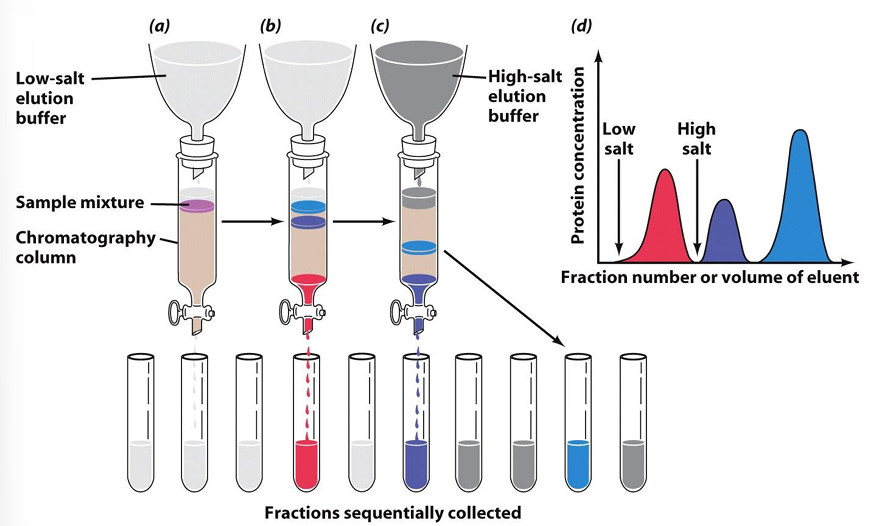
Stepwise Elution: The column is sequentially washed with buffers of increasing salt concentration. Low-salt buffers elute weakly bound proteins first, followed by high-salt buffers to elute strongly bound proteins.
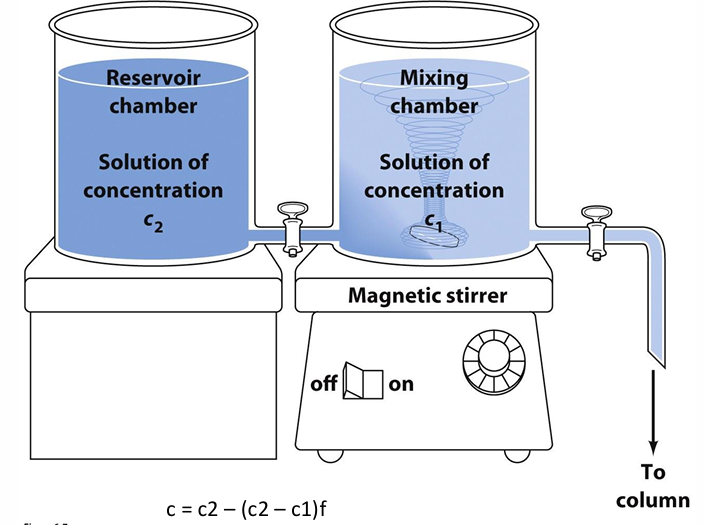
Gradient Elution: A mixing chamber is used to continuously vary the concentration of the eluent from a reservoir. The concentration of the solution applied to the column follows the relationship: . A peristaltic pump is typically used to manage flow.
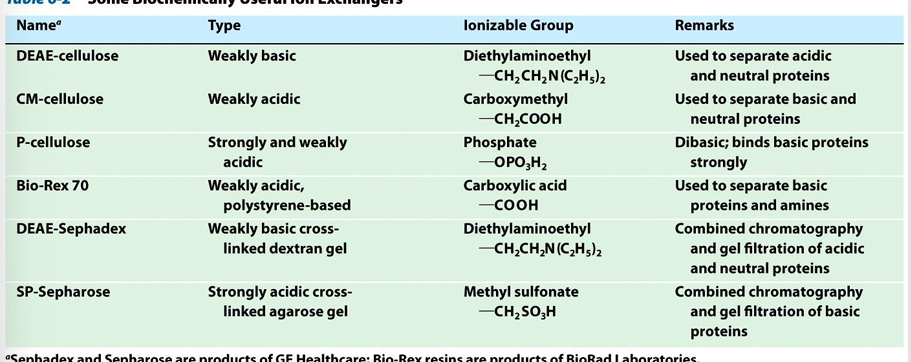
Biochemically Useful Ion Exchangers:
Gel Filtration (Size Exclusion) Chromatography
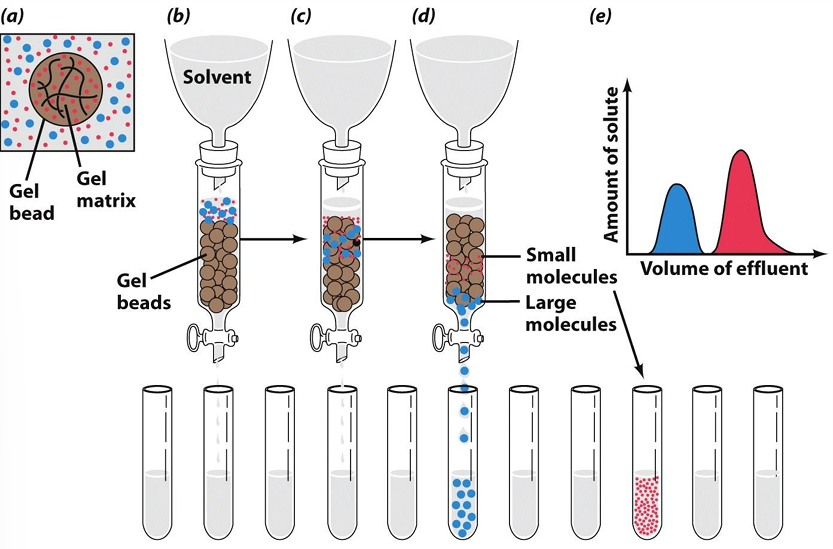
Principle of Operation: Molecules are separated based on their size and shape. The matrix consists of gel beads with specific pore sizes.
Mechanism:
Large molecules that are too big to enter the pores of the gel beads are excluded and eluted in a smaller volume of eluent.
Small molecules enter the aqueous spaces within the beads and take a longer, more circuitous path, eluting later.
Key Definitions:
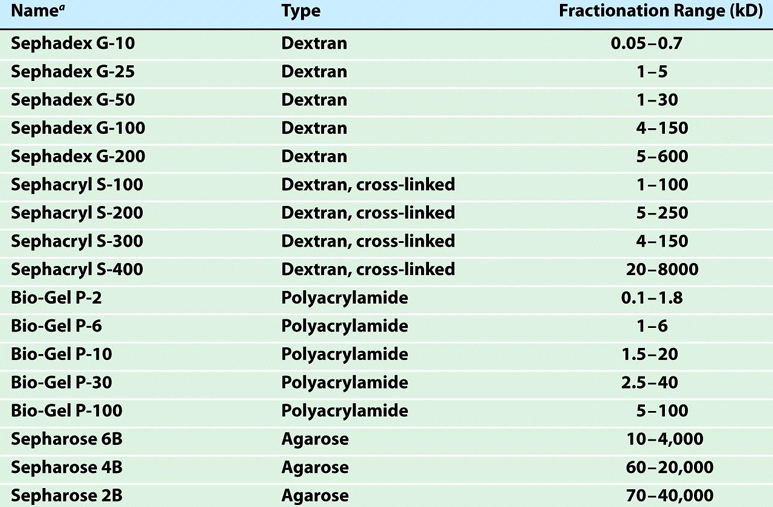
Exclusion Limit: The mass of the smallest molecule unable to penetrate the pores of a given gel.
Elution Volume (): The solvent volume required to elute a specific solute from the column.
Void Volume (): The volume of the solvent space surrounding the beads outside the pores. easily measured
Relative Elution Volume (): This value characterizes each solute and is used to estimate molecular masses.
Molecular Mass Estimation and Gel Materials
Estimation: A plot of against the logarithm of molecular mass (in kD) yields a linear relationship for substances within the gel's fractionation range.
Common Gel Filtration Materials:
Affinity Chromatography
Principle: many proteins can bind specifically to other molecules, at a very high affinity but not covalently, this property is exploited in affinity chromatography
Methodology:
A ligand that binds specifically to a protein of interest is attached covalently to a resin.
Impure protein solution is passed through the column; the target protein binds while others wash away.
The desired protein is released changing elution conditions (e.g., adding a competitor ligand).
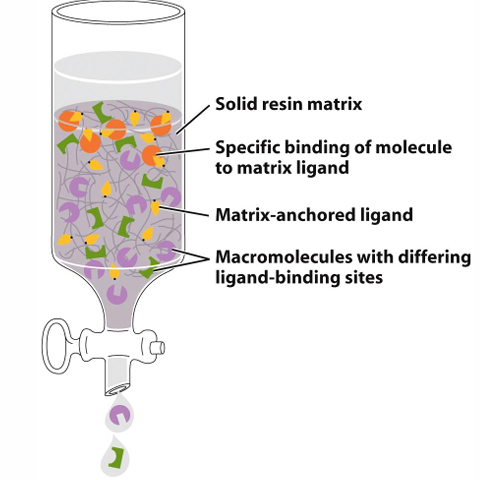
Example: Glucose-Binding Proteins: Glucose residues () are attached to beads. The protein attaches to these residues. Addition of free glucose results in the release of the protein as it prefers to bind the free glucose.
Different Types:
Immunoaffinity chromatography: Uses antibodies as ligands.
GST-tag: Glutathione-S-transferase binds to glutathione.
Receptor-Ligand: e.g., Insulin binding to the insulin receptor.
Glucose - glucose binding protein
glucose binding protein attaches to glucose residues on beads → addition of glucose → glucose binding proteins released on addition of glucose
Metal Chelation: Utilizes a His-tag (poly-histidine) and divalent metal ions such as , , or .
Reverse Phase Chromatography (RPC)
Nature: A type of liquid-liquid chromatography.
Phase Configuration: The stationary phase is a liquid immobilized on silica beads substituted with and alkyl chains. The mobile phase is a more polar liquid.
Application: Used to separate a mixture of non-polar substances. For proteins, denaturation results in exposure of hydrophobic side chain
Elution: phase is less polar to dislodge the hydrophobic substances from the stationary phase (increasing concentrations of acetonitrile in an aqueous solution)
Retention Time Rules (time at which a compound emerges from the column): Retention depends on:
Hydrophobicity: Increased hydrophobicity leads to longer retention.
Carbon Count: Longer carbon chains increase retention.
Branching: Unbranched chains take longer to elute than branched ones.
Saturation: Saturated chains take longer than unsaturated chains (unsaturated chains are more polar due to electron dipoles).
Functional Groups: neutral Polar and charged species elute earlier followed by acid then basic compounds
Ways to Increase Retention Time:
Add salts to the mobile phase.
Add more water to the mobile phase.
Mobile phase pH (typically using sodium phosphate buffers).
Hydrophobic Interaction Chromatography (HIC)
Principle: Separates native (non-denatured) proteins based on surface hydrophobicity.
Phase Configuration: Stationary phase is a hydrophilic substance lightly substituted with hydrophobic groups like octyl or phenyl residues.
Mechanism: Hydrophobic amino acid side chains on the protein surface interact weakly with the column, maintaining the native fold.
Elution: Achieved by weakening interactions, typically by decreasing salt concentrations (e.g., starting with high ammonium sulphate).
Comparison to RPC: In RPC, ligands are much more hydrophobic, requiring harsher elution conditions. HIC uses moderate conditions that preserve protein structure.
High Performance Liquid Chromatography (HPLC)
Definition: Also known as High Pressure Liquid Chromatography. It utilizes pumps to apply the sample under high pressure.
Native proteins separated on the basis of surface hydrophobicity
Stationary phase: is a hydrophilic substance lightly substituted with hydrophobic groups (octyl or phenyl residues)
amino acids, hydrophobic amino acid side chains on the surface of the proteins will interact with the column
Weak interactions maintain the native fold of the protein
Elution is achieved by weakening progressively the hydrophobic interactions (e.g. aqueous solutions with decreasing salt concentrations)
ligands in reverse phase chromatography are more hydrophobic than the ligands in HIC, therefore can use more moderate elution conditions in HIC that don’t disrupt the sample as much
Mechanism:
use pumps to apply sample under high pressure
can use smaller sample amoutns
no longer on gravity (use smaller columns)
columns made of smaller absorbent particles which give superior resolving power
Advantages:
High Resolution: Due to the use of smaller adsorbent particles ().
High Speed and Sensitivity.
Small Sample Volume: Can handle much smaller amounts than gravity-fed systems.
Automation: Highly compatible with automated fraction collectors and detector systems.
Mechanism: No longer relies on gravity; uses smaller columns made of fine particles to maximize surface area and resolving power.