Graphical Vector Operations: Addition, Subtraction, and Scalar Multiplication
Problem Statement and Overview
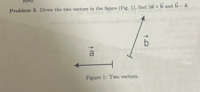
Problem Description: Given two vectors a and b shown in Figure 1, determine the graphical constructions and mathematical representations for:
Vector combination 1: 2a+b
Vector combination 2: b−a
Characterization of Given Vectors
Vector a:
Orientation: Horizontal.
Direction: Directed toward the left.
Representation: An arrow extending from a vertical tail bar on the right to an arrowhead on the left.
Vector b:
Orientation: Tilted vertically / inclined.
Direction: Directed upward and slightly to the right.
Representation: An arrow extending from a crossbar tail at the bottom-left toward an arrowhead at the top-right.
Principles of Scalar Multiplication
Definition: Scaling a vector v by a scalar factor k produces a new vector kv:
Magnitude: The magnitude of the scaled vector is ||k\vec{v}|| = |k| \times ||\vec{v}||\n - Direction for positive scalar (k > 0):Thedirectionofk\vec{v}isidenticaltothatof\vec{v}.\n - Direction for negative scalar (k < 0):Thedirectionofk\vec{v}isoppositetothatof\vec{v}(rotatedby180^\circ).\n- Scaling Vector \vec{a}byk = 2:\n - The vector 2\vec{a}maintainstheexactsameleftwardhorizontaldirectionas\vec{a}.\n - The length (magnitude) of 2\vec{a}istwicetheoriginallengthof\vec{a}.\n\n# Graphical Construction of 2\vec{a} + \vec{b}\n\n- Head-to-Tail (Tip-to-Tail) Method:\n - Step 1: Draw vector 2\vec{a}horizontallypointingleft,withamagnitudeequaltodoublethelengthof\vec{a}.\n - Step 2: Position the tail of vector \vec{b}directlyatthehead(arrowheadtip)ofvector2\vec{a}.\n - Step 3: Draw vector \vec{b}extendingupwardandslightlyrightfromthetipof2\vec{a}.\n - Step 4: Draw the resultant vector 2\vec{a} + \vec{b}startingfromthetailof2\vec{a}(theinitialorigin)directlytothehead(tip)ofvector\vec{b}.\n- Parallelogram Method Alternative:\n - Place the tail of 2\vec{a}andthetailof\vec{b} at a common origin point.\n - Construct parallel sides matching 2\vec{a}and\vec{b} to form a complete parallelogram.\n - The resultant vector 2\vec{a} + \vec{b} extends as the diagonal from the common origin point to the opposite vertex of the parallelogram.\n\n# Graphical Construction of \vec{b} - \vec{a}\n\n- Algebraic Definition of Vector Subtraction:\n - Vector subtraction is expressed as the addition of the negative (opposite) vector:\n \vec{b} - \vec{a} = \vec{b} + (-\vec{a})\n- Properties of Opposite Vector -\vec{a}:\n - Magnitude: Identical to the magnitude of \vec{a}.\n - Direction: Horizontally directed to the right (reversed relative to \vec{a}).\n- Head-to-Tail Construction Method:\n - Step 1: Draw vector \vec{b} in its original orientation (pointing upward and slightly right).\n - Step 2: Attach the tail of vector -\vec{a}(pointinghorizontallyright)totheheadofvector\vec{b}.\n - Step 3: Draw the resultant vector \vec{b} - \vec{a}startingfromthetailof\vec{b}tothearrowheadtipof-\vec{a}.\n- Tail-to-Tail Direct Difference Method:\n - Place the tail of \vec{a}andthetailof\vec{b} together at the exact same starting point.\n - The difference vector \vec{b} - \vec{a}isthevectordirectedfromthearrowheadtipof\vec{a}tothearrowheadtipof\vec{b}$$.